
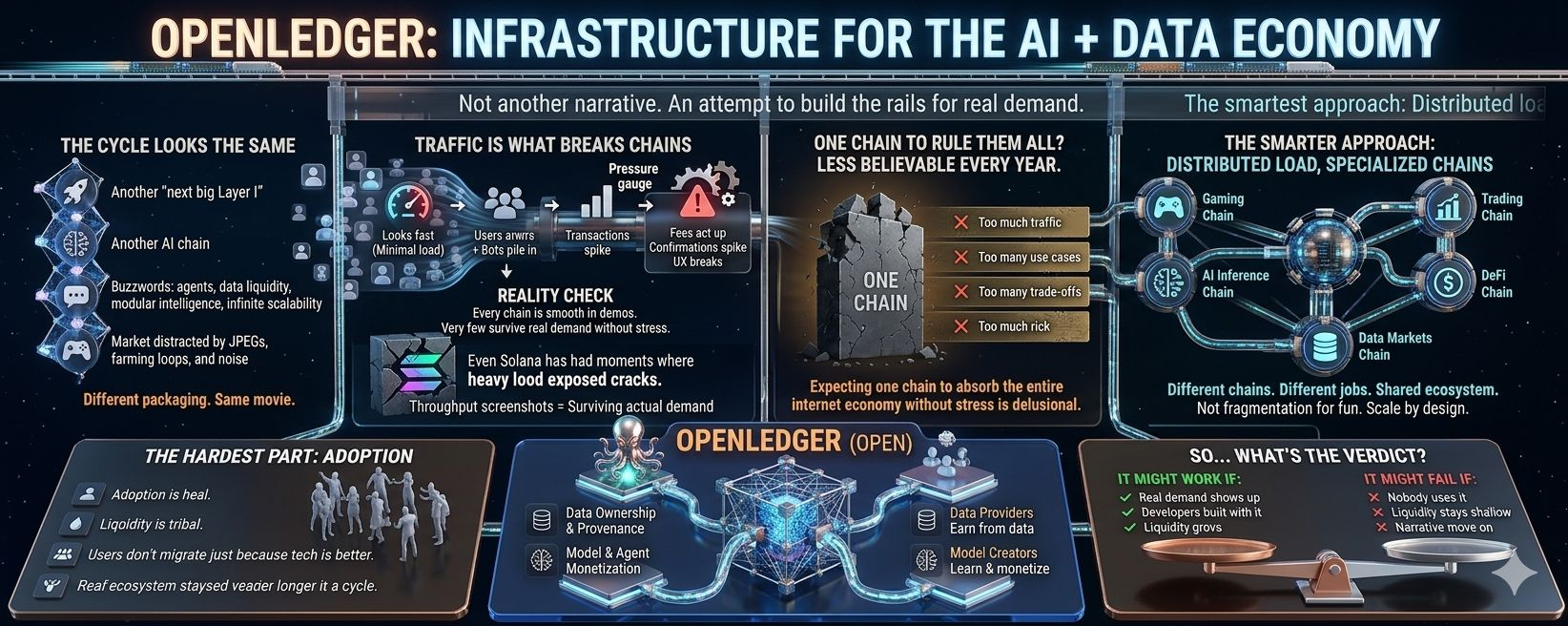
The crypto industry always follows new trends. Every cycle brings another “fast Layer 1,” “AI blockchain,” or “next-generation network.” But when real users arrive and traffic increases, many of these systems struggle with congestion, high fees, and poor performance.
OpenLedger ($OPEN ) is trying to solve a different problem. Instead of focusing only on hype, it is building infrastructure designed for the growing AI and data economy.
1. Why Most Chains Struggle
Many blockchains try to handle everything on one network. At first, it works smoothly, but heavy traffic often creates problems:
Transaction fees rise quickly
Confirmations become slower
User experience gets worse
Networks become unstable during peak activity
A chain may look powerful in testing, but real-world demand is much harder to handle.
2. OpenLedger’s Different Approach
OpenLedger believes one chain should not do every job.
Instead, different chains can focus on different tasks:
Gaming chains for fast microtransactions
Trading chains for low-latency markets
DeFi chains for financial activity
AI chains for computation and inference
Data chains for storage and verification
This structure spreads the workload more efficiently and keeps the ecosystem scalable.
3. The Real Challenge: Quality Data
AI systems need clean and trusted data. That is where OpenLedger focuses heavily.
Many users expect simple uploads with instant rewards, but real AI infrastructure requires:
Clear metadata
Provenance tracking
Verified ownership
Structured datasets
Smaller, well-organized datasets often receive rewards faster than large messy uploads. The system favors quality over quantity.
4. Building an AI Data Economy
OpenLedger connects three important parts of the ecosystem:
Data Providers
People who own valuable datasets can prove ownership and earn rewards.
AI Model Creators
Developers can monetize models, agents, and AI tools directly on-chain.
Autonomous Agents
AI agents can eventually interact, trade, and operate automatically using blockchain infrastructure.
The goal is to create transparent value sharing between everyone involved.
5. The Biggest Test: Adoption
Technology alone is not enough.
For OpenLedger to succeed, it needs:
Developers building real applications
Strong liquidity and user activity
Enterprise demand for AI data infrastructure
Long-term ecosystem growth
If adoption grows, OpenLedger could become an important layer for the AI economy. If activity stays low, even strong technology may struggle to survive.
Final Thoughts
The AI + data economy needs more than marketing narratives. It needs reliable infrastructure capable of handling real demand.
OpenLedger’s focus on structured data, attribution, and specialized chains makes it one of the more practical approaches in the space today. 🚀