
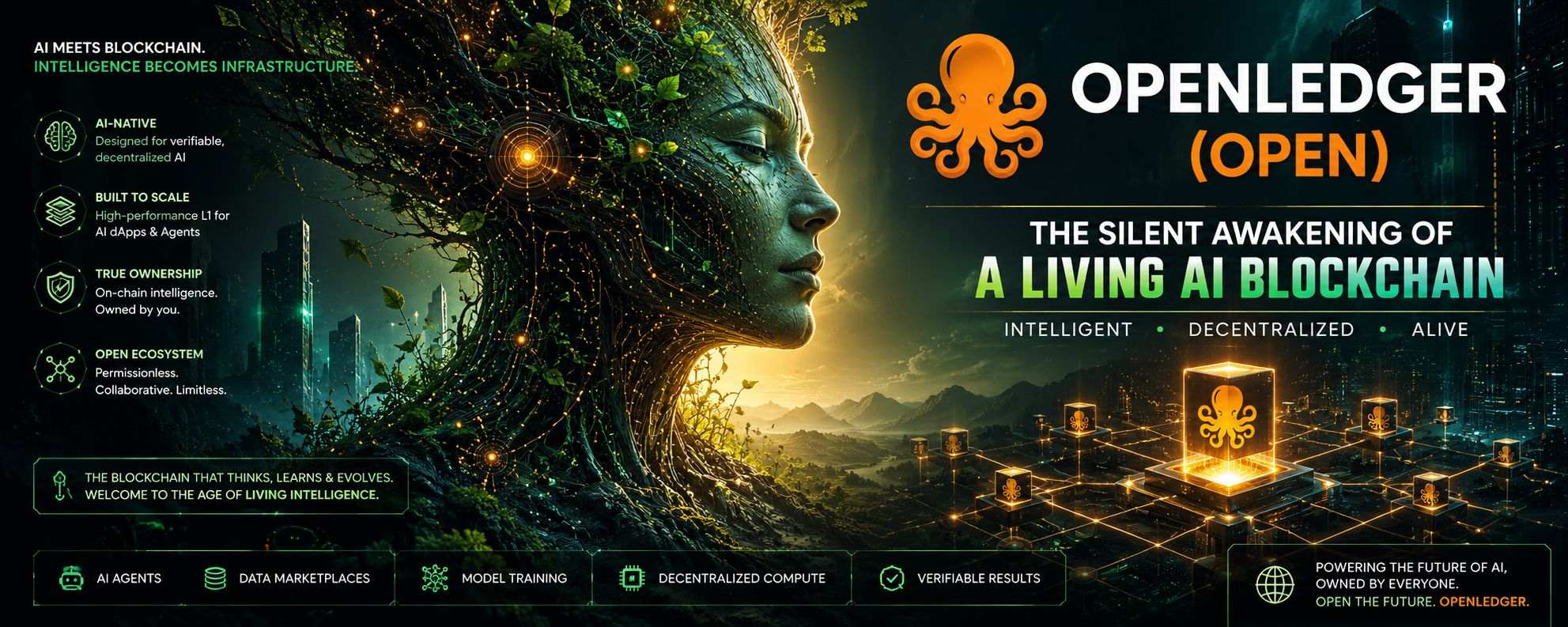
I am not sure when the system first started to feel alive. It was not a single moment. It was more like a slow shift in the air, like the digital world itself started breathing differently. I have seen many projects in this space, many promises of change, but OpenLedger did not feel like a promise. It felt like a signal already in motion, like something that was never waiting for permission to exist.
At first, it looks like just another layer in the endless architecture of blockchain systems. Data, models, agents, liquidity. These words are familiar. But when I looked closer, I started feeling something unusual. It was not just structure. It was behavior. As if the system was not built, but grown. Like it had learned how to organize itself while nobody was watching.
I remember thinking that most networks are loud in the wrong way. They shout transactions. They broadcast movement. They expose every action like it is proof of life. But this one felt different. It was quiet in a way that made me listen harder. And the more I listened, the more I felt that silence was not empty. It was full of hidden coordination, invisible agreements, and logic moving beneath the surface.
I am not just observing a blockchain anymore. I am observing a kind of digital organism. Smart contracts here do not feel like code alone. I'have started to see them as veins. Not static instructions, but pathways carrying value like blood through something that behaves like a body. Liquidity is not just capital. It feels like oxygen. Something that keeps the system conscious, responsive, alive in motion.
And then there is data. In most systems, data is stored. Locked. Indexed. Forgotten until needed. But here, I sense something different. Data does not sit still. It moves through the system like memory inside a thinking mind. It is not passive. It reacts. It influences. It becomes part of the decision layer itself, like thoughts forming before speech.
I am beginning to understand why this feels unfamiliar. It is not just technology evolving. It is the role of technology changing. The system is no longer just recording reality. It is participating in it. And in that participation, something subtle is forming. A kind of shared intelligence between humans and machines that does not belong fully to either side.
I'have noticed how builders interact with this kind of environment. They do not just deploy code. They shape behavior. Every contract feels like a decision point in a larger nervous system. Every model becomes a perspective inside a collective mind. And every agent is not just automation. It is execution with intention, even if that intention is distributed across unknown layers.
There is something emotional hidden inside this structure too. At first that sounds strange, even wrong. But I cannot ignore it. When liquidity flows efficiently, when models respond with precision, when agents coordinate without friction, there is a feeling of harmony. Not human emotion in the simple sense, but something closer to system satisfaction. Like the network is functioning the way it was meant to.
I have seen traders trying to read this environment like they read traditional markets. Candles, charts, signals. But this system does not always reveal itself in visible movement. Sometimes the real shift happens before the chart even knows how to represent it. It is like watching shadows move before the object appears. That delay between cause and visibility becomes the real space of opportunity.
And in that gap, perception becomes everything. Not speed. Not volume. But understanding structure before it becomes obvious. I am starting to feel that this is where a new kind of intelligence is forming. Not artificial in the cold sense, but distributed. Shared. A networked awareness built from models, liquidity paths, and human intention merging into one field of activity.
I walk through this idea slowly in my mind. If data can be liquidity, and liquidity can move like memory, then what is the system really storing. Maybe it is not storing anything at all. Maybe it is learning in real time. Maybe every action is both input and output at once, feeding a loop that never fully closes.
There is a moment where I stop thinking of OpenLedger as a platform. It becomes something closer to an environment. Not a place I use, but a place I enter. And once I am inside that mindset, everything changes. The line between user and system starts to fade. I am not just interacting anymore. I am participating in its evolution.
I'have begun to notice how agents behave like instincts. They do not wait for instructions in the traditional sense. They respond to conditions. They adjust. They collaborate with other agents in ways that feel less like coordination and more like reflex. It reminds me of biological systems, where no single part has full awareness, yet the whole behaves intelligently.
This is where the mystery deepens. Because if intelligence can emerge from distributed systems like this, then ownership becomes unclear. Who owns the decision when it is shaped by models, executed by agents, and funded by liquidity that moves without a single center. The answer is not simple. It may not even exist in the old sense of ownership anymore.
I am starting to see the emotional weight of that shift. It removes certainty. But it also removes limitation. Builders are no longer confined to isolated systems. They are shaping shared environments that react, adapt, and evolve. It feels like coding something that learns how to code back.
And still, beneath all this complexity, there is a strange simplicity. The system wants flow. It wants alignment between intention and execution. When that alignment happens, everything feels almost effortless. Not because it is easy, but because it is coherent.
I step back in my mind and try to see the full picture. What is really forming here is not just another blockchain. It is a transition layer between human decision and machine execution. A space where value, intelligence, and action start to blend into a single continuous motion.
From far away, it looks like infrastructure. But when I zoom closer, it feels like cognition. Not human. Not machine. Something in between. Something still learning how to define itself.
And I realize that I am not outside of it anymore. I am already part of its observation layer. Every interpretation I make feeds back into how I understand it. Every thought becomes another small reflection inside a larger evolving mirror.
In the end, I stop trying to categorize it. Because categorization belongs to older systems that needed boundaries to make sense of chaos. This is not that kind of system. It is more fluid. More adaptive. More uncertain in a way that feels strangely alive.
As I slowly zoom out in my mind, I see it less as a product and more as a horizon forming in real time. A place where data becomes movement, movement becomes intelligence, and intelligence becomes coordination without clear edges.
And I understand then that this is not the story of a tool. It is the story of a shift. A quiet reconstruction of how machines and humans will think together, not as separate forces, but as one continuous unfolding field.
