

I used to believe the Future of AI would belong to whoever built the Biggest model.
Bigger datasets. Bigger infrastructure. Bigger reach.
But the more time I spend Studying decentralized AI, the more I feel the industry may be making a dangerous trade, sacrificing depth for scale without realizing what gets lost in the process.
That is exactly why Openledger stayed in my mind longer than most AI narratives do.
This morning, while going through old notes about Projects that once dominated attention cycles, I noticed something familiar. The market usually rewards Systems that speak the loudest, not the ones that understand the deepest. Most AI platforms today are designed to absorb massive amounts of information and compress it into generalized understanding. On the surface, that looks powerful. But underneath, something important quietly disappears.
Specialized knowledge.
The deeper and narrower expertise becomes, the harder it is for generalized Systems to preserve it without flattening its meaning. A medical archive, legal framework, scientific niche, or highly contextual market behavior cannot simply be poured into one giant intelligence pool without losing precision along the way.
And honestly, I think Openledger understands this Problem better than most.
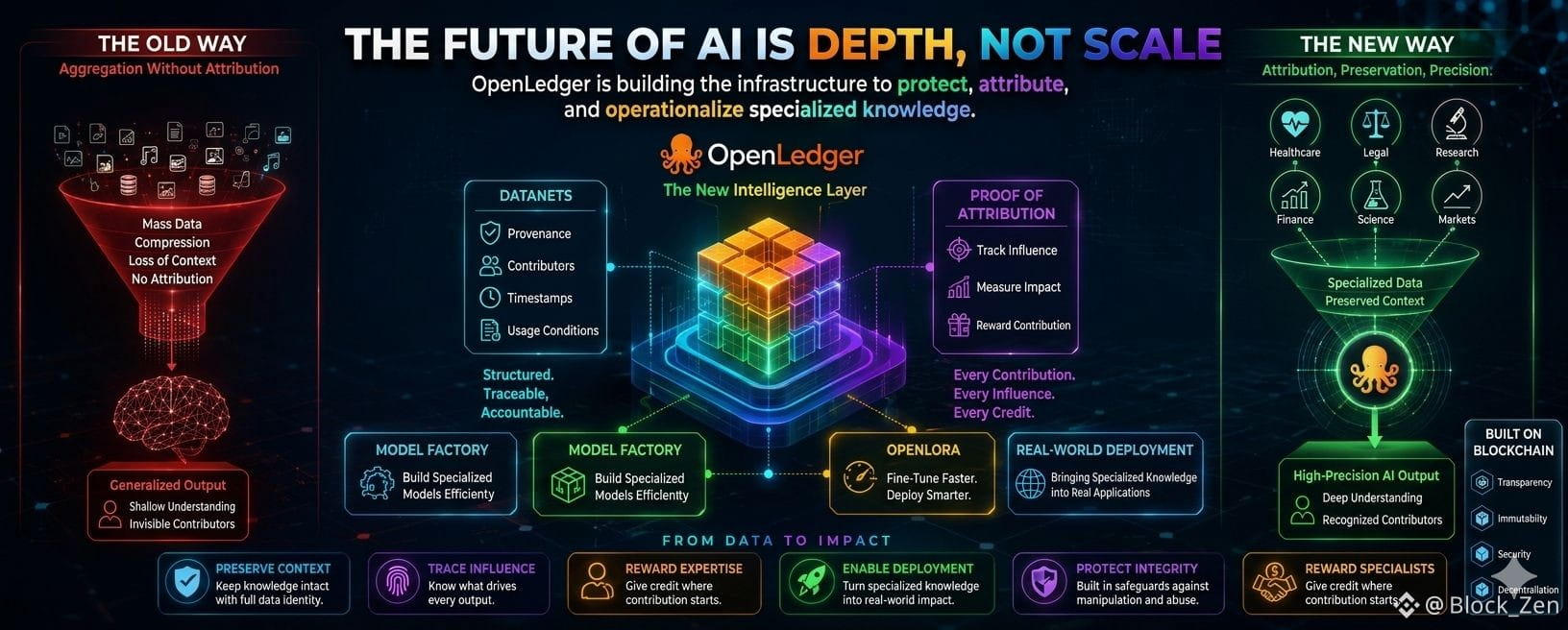
What caught my attention first was not the model layer. It was Datanets.
Many AI Projects talk about data as if collecting more of it automatically creates better intelligence. But niche knowledge does not work through quantity alone. Real accuracy comes from structure, context, labeling, timing, and provenance. Openledger seems to approach data less like raw fuel and more like infrastructure with identity.
That difference changes everything.
Once datasets carry contributors, timestamps, usage conditions, and traceable origins, data stops becoming disposable input. It becomes an accountable layer of intelligence. Suddenly the conversation shifts away from “Which AI is smartest?” toward “What knowledge actually created that intelligence?”
That is where Proof of Attribution becomes the most important part of the entire structure to me.
I think the AI market has spent years rewarding aggregation while ignoring contribution. Everyone sees the polished output, but very few systems recognize the invisible layer underneath, the researchers, domain experts, labelers, and specialized contributors whose work actually creates precision.
And maybe that is the uncomfortable truth sitting underneath this entire industry, some of the most valuable Intelligence in the world has been quietly disappearing inside systems too large to remember where understanding came from.
Openledger is trying to expose that hidden layer instead of burying it deeper.
And that is not an easy challenge.
Tracking influence across model pipelines becomes incredibly difficult once data passes through multiple stages of training and fine tuning. But that difficulty is exactly what gives the idea value. If Openledger can genuinely connect outputs back to meaningful contributors, it changes the Economics of AI completely. Expertise would finally carry measurable weight instead of dissolving into massive systems that absorb everything without distinction.
What makes the architecture stronger is that Openledger is not only trying to preserve specialized knowledge, it is also trying to operationalize it.
That is where Model Factory and OpenLoRA become critical.
A lot of strong ideas fail because the distance between data and deployment becomes too exhausting. Builders lose momentum. Costs rise. Infrastructure becomes too heavy. Openledger seems focused on shortening that gap so specialized knowledge can move into fine tuned models and real applications without dying halfway through the process.
But I do not look at this story blindly either.
Any System that rewards attributed influence will eventually attract manipulation. People will flood pipelines with low quality data just to enter the attribution chain. Others will optimize for visibility instead of truth. That means Openledger’s real challenge is not only technological capability, but maintaining strict filtering and quality discipline over time.
And honestly, that may become the defining test for the entire project.
Still, what makes Openledger stand apart for me is the direction of its thinking. While most of the industry is racing to build systems that understand everything, Openledger quietly argues that some forms of intelligence should remain specialized instead of being forced into averages.
The more I think about it, the more I feel the AI market may have been mispricing value from the beginning. The loud aggregation layers receive most of the attention, while the narrow knowledge creating real precision stays invisible underneath.
Openledger is trying to rebalance that structure.
And if it succeeds, the next AI revolution may not come from Systems trying to know everything, but from systems finally learning how to Protect what should never be averaged away.