
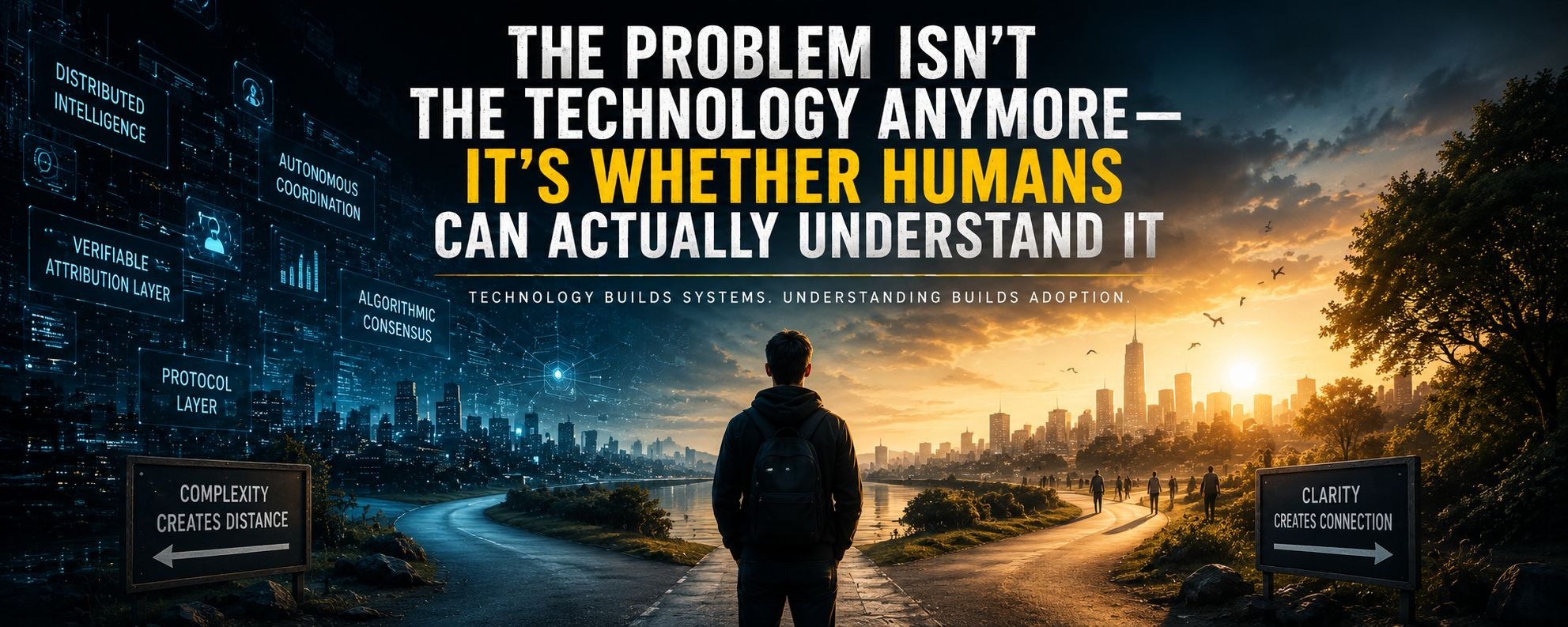
I’ve been noticing something lately that I can’t really ignore anymore. The more advanced this space becomes, the harder it feels to separate real progress from carefully packaged presentation.
Every cycle introduces a new vocabulary, new frameworks, new theories, and somehow the conversations keep sounding more intelligent while becoming less understandable at the same time.
Sometimes I read through project discussions and realize halfway through that I’m not even learning anything anymore. I’m just watching people perform sophistication for each other.
That’s probably why one particular post stayed in my head longer than most.
At first, it looked like every other deeply technical explanation I’ve seen over the years.
Complex terminology, layered ideas, polished phrasing designed to sound futuristic enough that nobody wants to admit they’re confused.
I’m used to that by now. In this market, complexity almost became a signal of legitimacy. The harder something is to explain, the more people assume it must be important.
But then I noticed something interesting.
The exact same concept was explained again in a completely different way.
Not simplified technically, but translated culturally. Instead of trying to sound academic, it sounded human. Internet-native. Almost casual.
And weirdly enough, that second version made the entire idea click faster than the long technical explanation ever did.
That contrast stayed with me because it made me realize how many projects quietly fail at the translation layer.
Most teams focus entirely on building systems, infrastructure, protocols, coordination mechanisms, or whatever terminology is trending during the current cycle.
But very few stop to think about how normal people are actually supposed to mentally connect with any of it. There’s this assumption that adoption automatically happens once the technology becomes advanced enough, but I honestly don’t think that’s true anymore.
People don’t adopt systems because they’re technically impressive.
They adopt systems when interaction starts feeling intuitive enough that understanding becomes natural instead of exhausting.
That’s part of why I stopped dismissing $OPEN completely after ignoring it for months. Not because I suddenly became convinced by the technical side overnight, and definitely not because I think every ambitious narrative deserves blind trust.
If anything,
I’ve become more skeptical over time, not less. I’ve watched too many projects promise revolutionary infrastructure only to disappear once real pressure exposed weak execution underneath the story.
But something about this felt slightly different.
Not necessarily because the ideas themselves are new. Most ideas in this space are recycled in some form anyway. Coordination, attribution, intelligence layers, decentralized systems every cycle repackages similar concepts with updated language.
After enough years, you start recognizing the patterns almost immediately.
What caught my attention instead was the possibility that they understand something many others still ignore: technology alone rarely creates cultural adoption.
The systems that survive long term are usually the ones that reduce psychological friction, not just technical friction. They make interaction feel socially understandable. They create familiarity before demanding expertise. And honestly, that part matters far more than people admit.
I think the market underestimates how important communication really is.
Not marketing in the shallow sense, but genuine interpretability.
The ability for an idea to survive simplification without collapsing completely.
If a project only sounds valuable when described through extremely dense terminology, then I start questioning whether the value is actually there or whether the language itself is carrying the illusion.
That’s become one of my biggest filters lately.
Because over time, I’ve noticed that polished narratives are everywhere now. Every project has cinematic branding, intellectual wording, carefully engineered positioning, and communities repeating phrases that sound profound enough to spread quickly online. But when you look closely, the gap between ambition and real-world usage almost never closes.
That gap is what I keep watching for now.
Not hype. Not aesthetics. Not perfectly written threads trying to convince me the future already arrived.
Just whether something can survive outside its own narrative.
Whether people naturally understand how to interact with it without needing a dictionary beside them.
Whether the system still feels useful after the branding fades away.
That’s honestly the only part that still interests me anymore.