
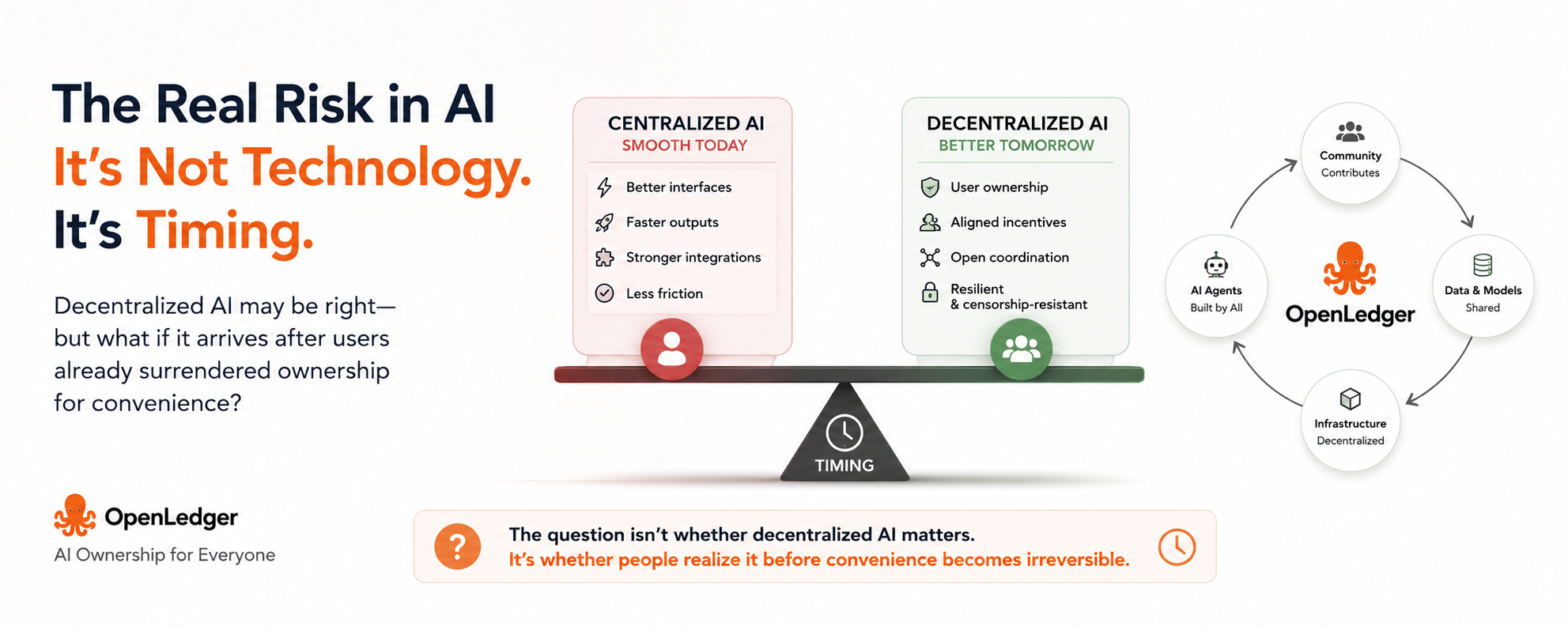
It may be arriving after users already surrendered ownership for convenience.
That’s the uncomfortable thought I keep coming back to when I look at projects like OpenLedger.
Most conversations around $OPEN focus on infrastructure, decentralization, contribution layers, aligned incentives, and open coordination. And honestly, the vision itself makes sense to me.
What feels harder to understand is human habit.
Because centralized AI systems are already becoming part of everyday life.
You use one tool for a small task.
Then another.
Then suddenly your workflows, decisions, and thinking patterns begin organizing themselves around platforms you don’t control.
And most people barely notice it happening.
Convenience usually wins long before ideology enters the conversation.
That’s why I keep wondering whether projects like OpenLedger are actually competing against technology — or against behavioral lock-in.
And behavioral lock-in is much harder to break.
Most people won’t move toward decentralized systems simply because decentralization sounds ethically better. They’ll move when centralized systems become too restrictive, too expensive, too politically influenced, or too extractive to ignore.
But are we really there yet?
I’m not sure we are.
Right now the centralized AI experience still feels smoother almost everywhere: better interfaces, faster outputs, stronger integrations, less friction.
Even people who fully understand the risks still continue using those systems daily because the productivity upside feels immediate.
I do too.
I catch myself defaulting to centralized AI tools constantly, even while thinking about this.
And that’s what makes this space difficult to evaluate honestly.
Because the thesis behind $OPEN feels increasingly important long term.
If AI becomes deeply integrated into economic activity, then ownership over intelligence infrastructure becomes a massive issue.
Whoever owns the dominant intelligence layer eventually shapes the economy built on top of it.
Once companies, creators, and institutions build workflows around centralized AI providers, switching stops being a philosophical decision and starts becoming operationally painful.
Eventually, concentration of intelligence infrastructure becomes impossible to ignore.
The part I still can’t figure out is timing.
Do decentralized AI systems mature before that pressure arrives?
Or after centralized ecosystems become too embedded to realistically challenge?
That timing gap changes everything.
And maybe that’s why projects like OpenLedger feel so difficult to price correctly right now.
The idea feels increasingly relevant.
The adoption curve still feels uncertain.
And markets are usually terrible at pricing uncertainty early.
The real question may not be whether decentralized AI matters.
It’s whether people realize it before convenience becomes irreversible.
