
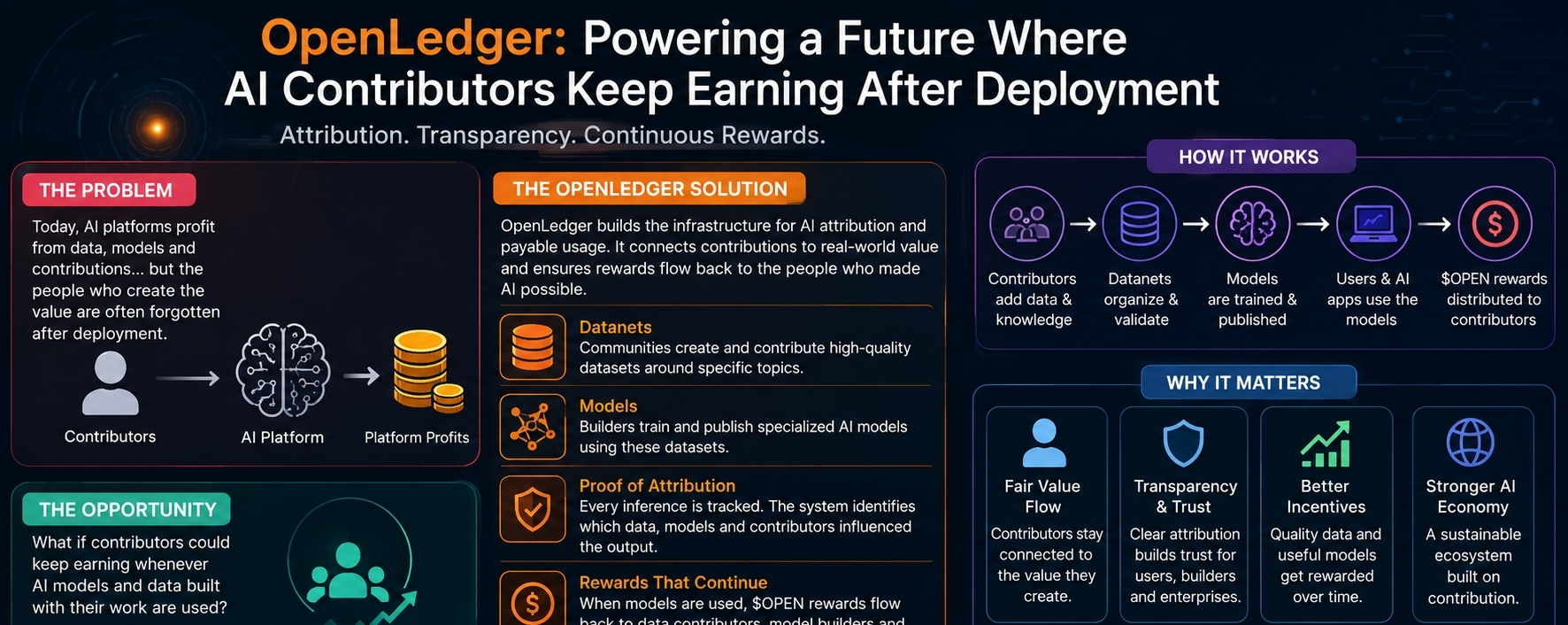
OpenLedger because it is one of the few AI crypto projects that makes me think about what happens after the hype, after the launch, and after the model is already being used.
Most projects want attention at the start. OpenLedger is more interesting to me because it is trying to answer a quieter question: if people, data, and builders help make AI useful, can they keep earning from that value after deployment?
That is the part I keep coming back to.
AI does not become useful on its own. It needs data. It needs people who understand a topic deeply. It needs builders who can organize information, train models, improve outputs, and turn raw knowledge into something useful. But in most systems, once the AI product is live, those early contributors slowly disappear from the money flow.
The platform keeps growing.
The product keeps earning.
The contributors get forgotten.
OpenLedger is trying to change that pattern.
The project is built around the idea that AI value should be traceable. If a dataset helps a model perform better, that should not be invisible. If a contributor adds useful knowledge, that contribution should not disappear once the model is deployed. If a builder creates a model that people keep using, the reward should not stop at launch.
That sounds simple, but it is actually a big shift.
Most crypto narratives are loud at the beginning. A new sector gets attention, everyone starts using the same words, and suddenly every project sounds important. AI crypto has gone through this too. There are agents, models, compute networks, data markets, automation tools, and endless claims about the future. Some of them are real. Many are just riding the trend.
OpenLedger feels different because it is not only trying to sell the idea of AI. It is trying to fix one of the economic problems underneath AI.
The problem is contribution.
Who helped create the intelligence?
Who provided the data?
Who improved the model?
Who made the system more useful?
And when that system starts generating value, who keeps getting paid?
That is where OpenLedger’s idea becomes important. The project focuses on attribution, Datanets, specialized AI models, and rewards connected to real usage. In plain words, it wants to build a system where AI contributors are not treated like temporary workers who help once and vanish. Instead, their contributions can remain connected to the value they create over time.
I like that because it feels more honest.
If someone contributes useful data, that data may keep helping long after the first upload. If someone builds a specialized model, that model may keep serving users again and again. If a community creates a strong Datanet around a specific topic, that Datanet can become a real asset inside the AI economy.
So why should the reward only happen once?
That is the question OpenLedger keeps pushing forward.
And to me, that question matters more than a lot of the noise around AI crypto.
I’ve made the mistake before of paying too much attention to what was loud. It is easy to do in crypto. The loud thing looks alive. It has engagement. It has big claims. It makes people feel like something important is happening right now. But sometimes the loud thing is just temporary attention.
The quieter thing can be more important.
Infrastructure usually starts quietly. It does not always look exciting at first. It can look too technical, too early, or too difficult to explain. But later, when the market grows up, everyone realizes that the boring layer was actually necessary.
That is how I look at OpenLedger.
It is not just trying to be another AI project with a token. It is trying to become part of the payment and attribution layer for AI contribution. That means the project is thinking about how value moves inside AI systems, not only how AI products look on the surface.
That matters because the future of AI will probably not be built by one model alone.
It will be built from many datasets, many contributors, many specialized models, many developers, and many agents using those models in different ways. Some AI systems will need legal data. Some will need health data. Some will need finance knowledge. Some will need gaming data. Some will need crypto-native information. Some will need very specific human expertise.
That kind of AI economy needs better accounting.
It needs to know where value came from.
It needs to know which contribution mattered.
It needs to know who should earn when the system is used.
OpenLedger is trying to build around that need.
This is where the project becomes more interesting than the average AI narrative. It is not only saying, “AI will be big.” Everyone already knows that. It is asking how the people behind AI can be rewarded in a fairer and more continuous way.
That is a better question.
Because if AI keeps growing while contributors remain invisible, then the same old internet problem repeats again. People create value. Platforms collect the upside. Contributors get small rewards, temporary attention, or nothing at all.
OpenLedger’s thesis is that AI contribution can become something more permanent.
A contributor should not only be useful before deployment. A contributor can remain useful after deployment if their data or model continues to shape outputs. A builder should not only earn because they launched something. They should earn because people keep using what they built.
That makes the whole system feel more alive.
It also creates a better reason for people to contribute quality.
If rewards are connected to real usage, then the goal changes. It is not just about uploading anything. It is about contributing something that actually helps. It is not just about farming activity. It is about building value that lasts.
That is the kind of incentive AI needs.
Of course, this is not easy.
OpenLedger still has to prove the system works in practice. Attribution is hard. AI models are complex. It is not always simple to say exactly which data influenced which output. Bad actors may try to spam low-quality data. Some people may join only for rewards. Some reward systems may be gamed. The project has to show that quality can beat noise.
That is the honest risk.
But I would rather watch a project trying to solve a hard real problem than a project selling an easy story.
And OpenLedger is working on a real problem.
The more AI grows, the more important this becomes. When AI agents start doing more work, using more models, making more decisions, and creating more value, the question of contribution will not stay small. People will want to know what data was used. Developers will want to know how models are rewarded. Enterprises will want provenance. Communities will want ownership. Contributors will want to know why their work helped build something valuable while they received nothing from its long-term success.
That pressure is coming.
OpenLedger is positioning itself before that pressure becomes obvious to everyone.
That is why I think the project deserves a serious look.
Not because it is perfect.
Not because every part is guaranteed.
Not because $OPEN automatically captures everything.
But because the project is building around a problem that feels early today and necessary tomorrow.
That is usually where interesting crypto infrastructure begins.
The best crypto projects are not always the ones that explain themselves easily in the first five seconds. Sometimes they are the ones solving the ugly problem underneath the market. The problem nobody wants to talk about yet. The problem that sounds boring until it becomes unavoidable.
For OpenLedger, that problem is simple to say but difficult to solve:
How do AI contributors keep earning after deployment?
If OpenLedger can help answer that, then it is not just another AI token story. It becomes part of a deeper shift in how AI value is tracked, shared, and rewarded.
That is the real reason I’m watching it.
I’m not watching only for price action. I’m not watching only for campaign noise. I’m not watching because AI crypto is a popular category.
I’m watching because OpenLedger is focused on the people behind the intelligence.
The data providers.
The model builders.
The communities.
The contributors who make AI useful before anyone else sees the final product.
If those people can stay connected to the value they create, AI starts to feel less extractive and more open. It becomes less about one platform capturing everything and more about a network where contribution can keep earning.
That is a powerful idea.
Still early, still unproven, but powerful.
And in crypto, some of the strongest opportunities appear exactly like that at first. Quiet. Technical. A little hard to explain. Not fully appreciated by the market yet.
Then one day, the market finally finds the language for it.
OpenLedger is one of those projects I’m watching because it may be early to a question the whole AI sector will eventually have to answer. When AI creates value after deployment, who gets paid?
If the answer is only the platform, then nothing really changed.
But if OpenLedger helps make contributors part of the long-term reward system, then the project is working on something much bigger than a trend.
It is working on a fairer economic layer for AI.
And that is the kind of quiet infrastructure I would rather study before the market fully understands why it matters.