
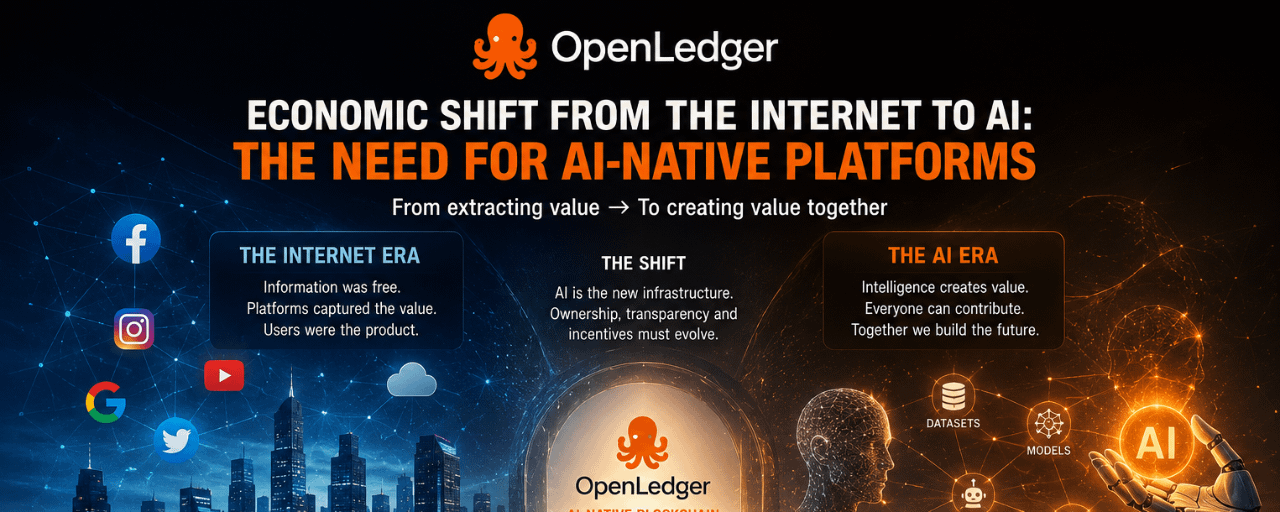
For more than twenty years, the internet has been the foundation of the global digital economy. It transformed communication, commerce, entertainment, education, finance, and culture in ways previous generations could never have imagined. Entire industries were rebuilt around online interaction, while companies that mastered digital infrastructure became some of the most powerful organizations in modern history. The internet age created trillion-dollar corporations, changed the speed of information flow, and connected billions of people into one global network. But despite all of its innovation, the internet economy was fundamentally built around one central idea: humans interacting with information.
Every major system of the web was designed around clicks, searches, advertisements, websites, applications, and user attention. Human behavior became the fuel that powered the digital economy. Platforms competed for engagement, data collection became the dominant business model, and centralized companies emerged as gatekeepers controlling access to digital services. For years, this system appeared unstoppable. However, a new transformation is now beginning to emerge, one far larger than the transition from desktop computers to smartphones or from physical stores to e-commerce. The world is moving from the internet economy into the AI economy, and this shift changes the entire structure of digital infrastructure itself.
Artificial intelligence is not simply another software upgrade or a temporary technology trend. It represents a complete restructuring of how value is created in the digital world. Unlike traditional internet systems that focus primarily on delivering information to humans, AI systems are designed to process information, generate decisions, automate actions, and interact autonomously with both humans and machines. In the internet era, humans searched for answers. In the AI era, systems themselves can produce answers, generate strategies, automate workflows, analyze massive datasets, and even create entirely new forms of digital production.
This difference is enormous because it transforms technology from a passive tool into an active participant in economic activity. AI is no longer limited to assisting users; it is becoming capable of performing tasks that once required teams of workers, analysts, researchers, designers, and operators. As AI systems continue improving, they will increasingly become part of the core operational layer of industries across finance, healthcare, logistics, education, research, media, cybersecurity, and government infrastructure.
This transition creates a critical problem that most existing internet platforms are not prepared to solve. The infrastructure of the internet was not designed for autonomous intelligence. Traditional web systems were created to support human interaction, not machine-to-machine economies. Websites, applications, social media platforms, and cloud systems were all optimized for user behavior, advertising models, and centralized control structures. AI systems require something entirely different.
They need access to large-scale structured data, transparent computational systems, automated coordination, scalable compute layers, real-time execution, verification mechanisms, and economic frameworks that allow intelligent systems to interact continuously without relying on centralized intermediaries. The architecture supporting the internet economy struggles to meet these demands because it was never intended to power an AI-native world.
As a result, the global economy is entering a period where new infrastructure must be built specifically for artificial intelligence. This is where the concept of AI-native platforms becomes essential. AI-native platforms are not simply internet products with AI features added on top. They are ecosystems designed from the ground up to support intelligent systems, decentralized coordination, data contribution, autonomous execution, and machine-driven economic activity.
These platforms recognize that the future internet may no longer revolve primarily around humans manually interacting with websites. Instead, much of the future digital economy may involve intelligent agents communicating, negotiating, transacting, learning, and optimizing processes continuously behind the scenes. In this new environment, the platforms controlling AI infrastructure will hold enormous influence over economic productivity, information access, and technological development.
This is precisely why projects like OpenLedger and the broader $OPEN ecosystem are becoming increasingly important in discussions surrounding the future of technology. OpenLedger represents more than another blockchain project or speculative crypto ecosystem. Its broader significance lies in its attempt to help build infrastructure for the AI economy itself. While much of the digital asset industry continues focusing on short-term market narratives, meme speculation, and transactional speed improvements,
OpenLedger is positioned around a much larger thesis: the future global economy will depend heavily on decentralized intelligence infrastructure, and the systems coordinating AI must remain open, transparent, collaborative, and economically accessible. This vision directly addresses one of the most important challenges emerging in the modern technology landscape—the growing concentration of power within centralized AI ecosystems.
Today, a small number of major corporations dominate the AI industry. These companies control large-scale computational infrastructure, proprietary datasets, cloud distribution networks, advanced models, and massive capital resources. As AI development accelerates, the gap between centralized technology giants and smaller builders continues widening. Access to compute is expensive; high-quality data is increasingly locked inside private systems.
and advanced model development often requires enormous financial investment. This creates a dangerous imbalance where the future of intelligence risks becoming concentrated in the hands of a few dominant entities. If this trend continues unchecked, the AI economy could evolve into a closed ecosystem controlled by centralized monopolies capable of shaping information access, economic productivity, digital governance, and even cultural influence.