
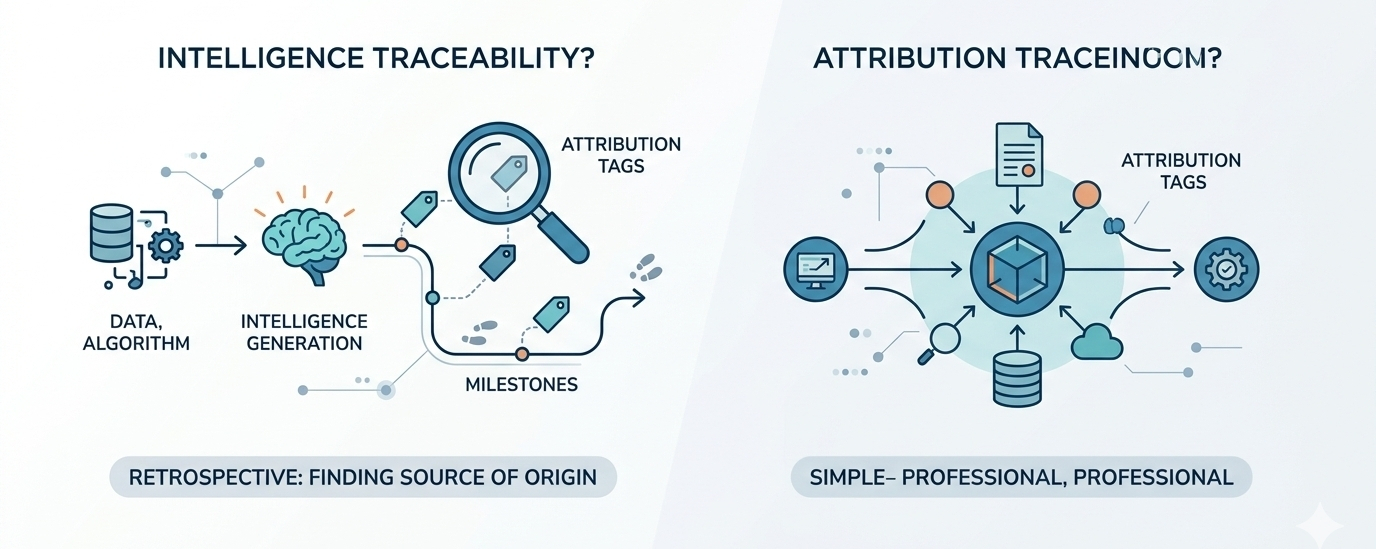
Something about this kept bothering me…
Not in the obvious way where a new system feels unfamiliar, but in the quieter sense where familiar ideas start losing their edges. Where you think you understand what a ledger is doing, until you notice it is no longer just recording activity it is beginning to reorganize how activity is even interpreted.
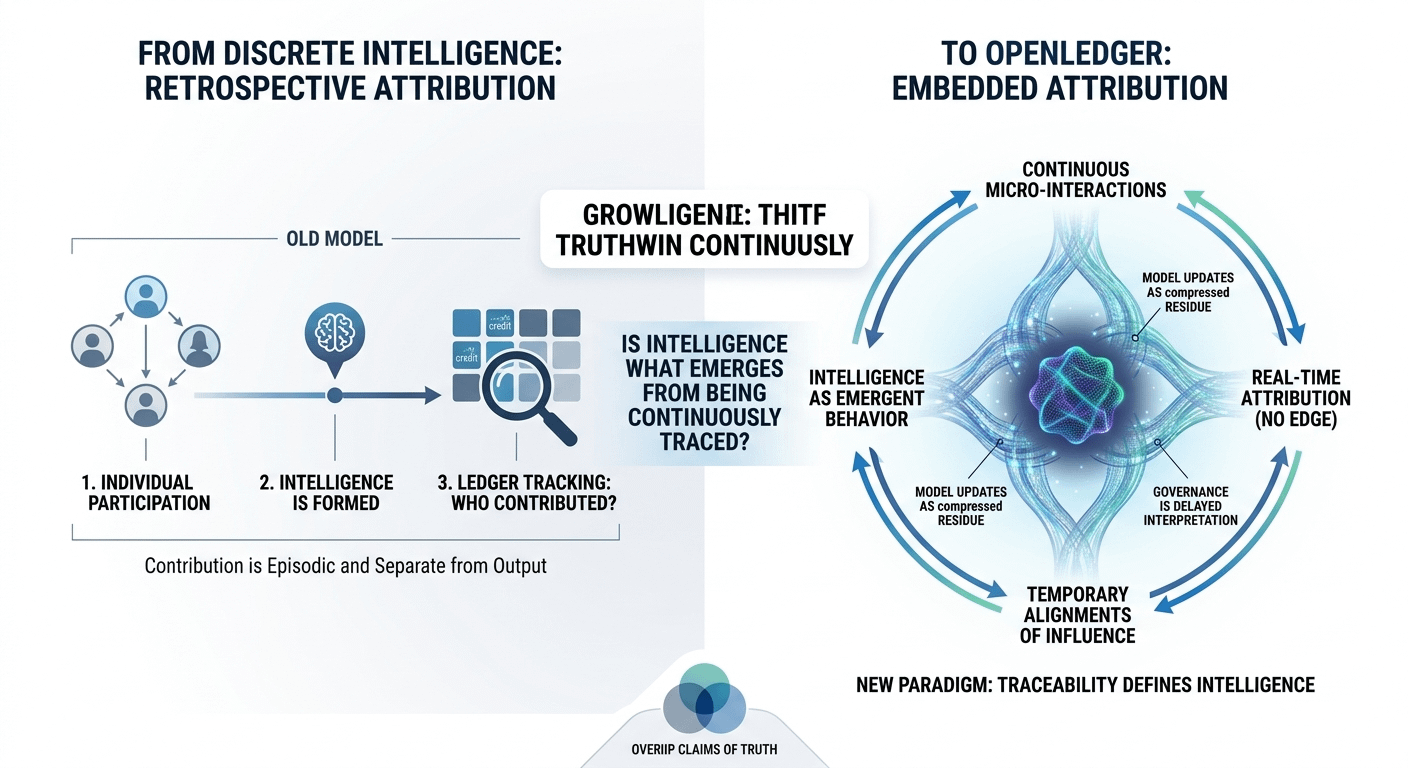
At first I treated OpenLedger like infrastructure. Just another coordination surface in the growing stack of crypto systems trying to make contribution measurable. Clean. Familiar. Almost predictable.
But that framing stopped holding.
Because what is being surfaced here is not just transactions or assets. It is something more unstable the slow accumulation of contribution underneath intelligence itself. And even “underneath” feels misleading, like there is a clear hierarchy. There isn’t. It is more entangled than that.
The problem is not intelligence. It is attribution.
Or maybe the real shift is that attribution is no longer arriving after intelligence is formed. It is starting to sit inside the formation process itself.
That thought is hard to make stable.
Inside systems like $OPEN , data stops behaving like passive input. It leaves traces that don’t settle neatly into ownership or authorship. A model update doesn’t feel like a single decision anymore it feels like a compressed residue of countless micro-interactions that never fully close.
And once you see it that way, intelligence stops looking like a product.
It starts looking like a temporary alignment of distributed influence.
Still early obviously, but that change in framing matters more than it seems at first.
Because once attribution becomes continuous, the system stops asking “who contributed?” in a clean sense. It starts asking something closer to: what mixture of influences made this outcome even possible to appear as a single outcome?
And that question never resolves cleanly.
It only expands.
Rewards, in this kind of environment, begin to shift meaning too. They are no longer just incentives for discrete participation validators, contributors, events. Those categories still exist, but they blur at the edges when contribution itself becomes continuous rather than episodic.
A reward becomes less about action and more about proximity to influence over time.
That’s a subtle but uncomfortable change.
Governance follows a similar pattern. It no longer feels like rule-setting in advance. It feels more like delayed interpretation a system trying to describe behavior after behavior has already redistributed itself into new structures.
Rules arrive slightly late.
Not because the system is broken, but because it is moving faster than the language used to describe it.
And I keep circling this tension.
The more precisely everything is tracked, the less clear it becomes what is actually being stabilized.
Contribution becomes visible, yes. But visibility does not simplify reality. It multiplies it. It creates overlapping claims of truth that all feel partially correct, but none feel complete on their own.
Maybe I’m overstating it.
Still early obviously.
But there is a difference between clarity and legibility that keeps appearing here. A system can become more legible without becoming more understandable. More structured without becoming more stable.
And that is where things become slightly uncomfortable.
Because if intelligence is being reconstructed through traceable fragments dataset pieces, model adjustments, interaction histories then recording is no longer neutral.
It becomes part of intelligence formation itself.
Not just observation, but participation.
A loop starts to appear, though it is hard to locate its beginning. Intelligence generates traces. Traces reshape how intelligence is evaluated. Evaluation feeds back into what future intelligence looks like. And slowly, the boundary between “what happened” and “how it is recorded as happening” starts to blur.
Maybe that is the real shift.
Not that intelligence is becoming traceable.
But that traceability is starting to define what intelligence is allowed to look like in the first place.
And I’m not fully convinced where that leads.
If this actually works, it could create a far more precise map of contribution than anything we’ve had before something closer to real attribution instead of approximate credit.
Or it could do something more complicated.
It might compress too many partial truths into structured signals that look clean from the outside, while remaining fundamentally layered underneath.
Hard to know yet.
But the question that stays with me is not about OpenLedger specifically anymore.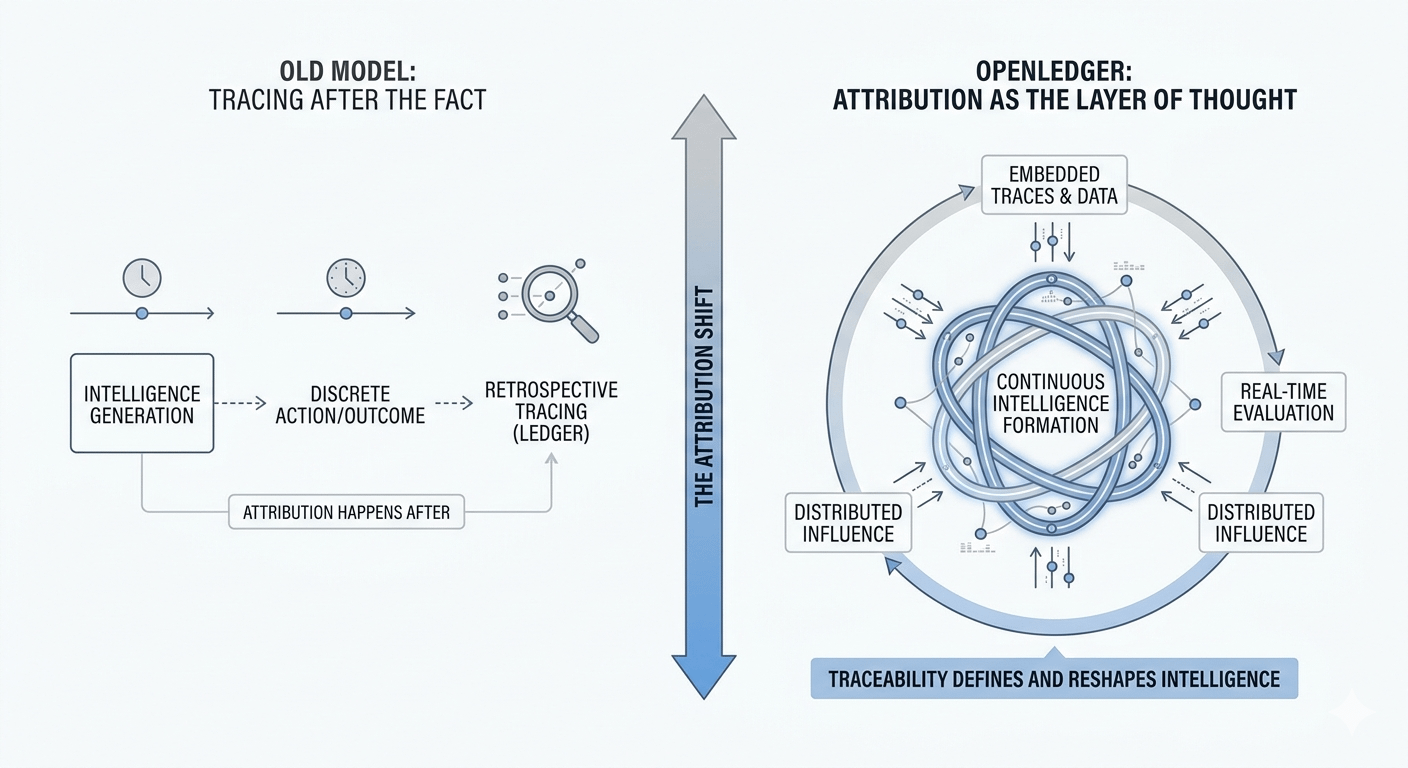
It is this:
When attribution becomes continuous, distributed, and embedded inside the formation of intelligence itself… are we still tracking intelligence after it happens?
Or are we slowly entering a system where intelligence is just what emerges from being continuously traced?
And if that is true…
then what exactly are we looking at when we say we are “understanding” it?