
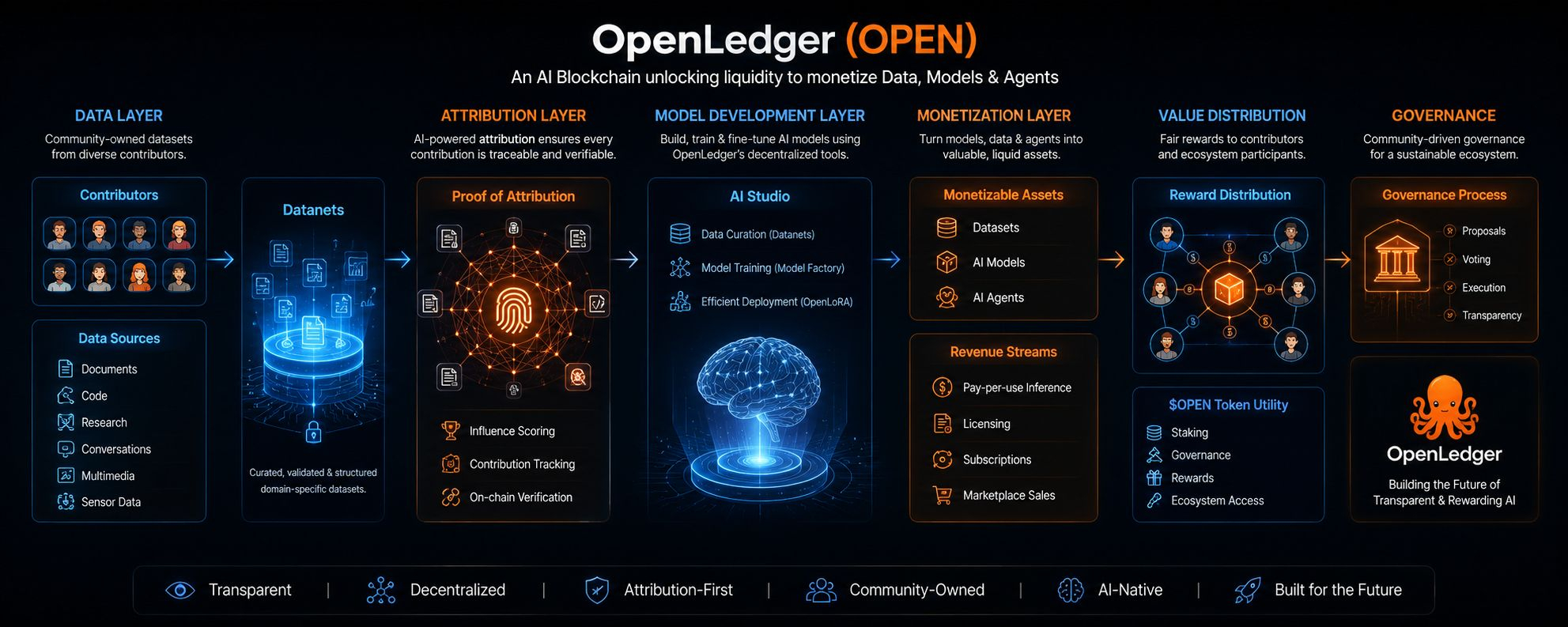
There’s something slightly exhausting about reading AI x crypto projects in 2026.
Not because the ideas are always bad. Some are genuinely interesting. But after surviving DeFi cycles, GameFi explosions, NFT empires, modular chain wars, restaking narratives, and now whatever this current “autonomous agent economy” phase is supposed to become, your brain develops a kind of defensive instinct.
You start filtering everything automatically.
Every project claims to be infrastructure.
Every protocol is “redefining ownership.”
Every whitepaper says the market is broken right before introducing a token designed to fix civilization itself.
So when I first opened OpenLedger, I expected the usual pattern.
AI blockchain.
Data monetization.
Agent economy.
Alright. Seen this movie before.
But somewhere around the middle of reading through the architecture docs and attribution design, I realized the project was circling around a question that actually feels uncomfortable in a real way.
Not uncomfortable like market volatility.
Uncomfortable philosophically.
Because OpenLedger is basically asking:
If AI systems are built from massive amounts of human contribution, why does almost none of the value flow back toward the people behind that intelligence?
And weirdly, I don’t think the industry has a convincing answer to that yet.
That’s the part that stayed with me.
Not the chain itself.
Not the token.
The question underneath it.
Because once you strip away all the AI marketing language, most modern models operate like extraction engines. Data gets absorbed from everywhere — research, writing, codebases, conversations, niche expertise, public knowledge, community labor — and eventually compressed into systems that become economically valuable at enormous scale.
But after the compression happens, attribution disappears.
Contributors dissolve into the model.
The system remembers the patterns but forgets the people.
And the scary part is how normal that already feels.
OpenLedger seems obsessed with fixing that layer.
Or at least attempting to.
I’m careful with the wording there because this is one of those ideas that sounds elegant conceptually and becomes terrifyingly complicated the moment you think about implementation seriously.
Attribution inside machine learning is messy.
Really messy.
Anyone pretending otherwise probably hasn’t spent enough time around actual model architecture discussions.
Trying to trace outputs back toward meaningful contribution across enormous datasets is not some clean accounting exercise. Models do not “remember” information in neat little compartments. Influence spreads probabilistically across parameters in ways researchers themselves still struggle to interpret properly.
Which honestly made me trust OpenLedger slightly more.
Not because they solved it.
But because they at least seem to understand the scale of the problem they’re touching.
Most crypto projects avoid hard problems entirely. They operate in narrative-safe territory where everything sounds revolutionary as long as nobody asks technical follow-up questions.
OpenLedger feels different in that sense.
The project almost reads like a team that became less interested in AI hype itself and more interested in the economics forming underneath AI systems.
That distinction matters.
A lot.
Because I increasingly suspect the next infrastructure battle around AI won’t revolve entirely around model intelligence. It’ll revolve around provenance, attribution, licensing, contribution tracking, and trust.
Who trained the system?
Where did the data come from?
Who deserves compensation?
Who remains invisible inside the pipeline?
Those questions become unavoidable once AI starts generating serious economic value at scale.
And honestly, I think the market is still underestimating how politically explosive that conversation eventually becomes.
Especially once autonomous agents start interacting with capital, businesses, research, media, and real economic systems.
At that point, provenance stops being an academic concern.
It becomes infrastructure.
The Datanet idea inside OpenLedger was probably the first moment where I stopped reading the project as another speculative AI token and started reading it more like an experiment in economic coordination.
Because the core idea isn’t really “decentralized AI.”
That phrase barely means anything anymore.
The more interesting idea is treating datasets like productive digital assets with traceable contribution histories attached to them.
That changes the framing completely.
Normally data contribution on the internet is passive. Platforms absorb user behavior and monetize it invisibly. The relationship ends there.
OpenLedger is testing whether contribution itself can become economically visible.
And if that works — even imperfectly — it changes how intelligence systems are valued.
Suddenly datasets are not just fuel.
They become economic networks.
Contributors become participants instead of raw material.
That’s a much bigger shift than people realize.
And strangely enough, blockchain infrastructure might actually make sense here.
Not because chains magically improve AI models.
They don’t.
But blockchains are good at recording ownership, coordinating incentives, distributing rewards, and preserving transparent contribution histories across decentralized systems.
Crypto has spent years searching for use cases where decentralization feels structurally necessary instead of artificially attached.
This might be one of the first AI-related areas where the fit feels natural instead of forced.
Still, skepticism feels healthy here.
Necessary even.
Because crypto is incredibly good at turning legitimate long-term ideas into short-term speculative theater. We’ve seen it happen repeatedly. DeFi was supposed to rebuild finance. NFTs were supposed to redefine ownership. DAOs were supposed to reinvent governance.
Some pieces survived.
Most narratives collapsed under excess speculation long before the infrastructure matured.
AI probably goes through the same cycle.
That’s why I’m hesitant whenever people talk about “the future” with too much certainty.
OpenLedger might matter.
Or it might become another ambitious experiment that discovered how difficult attribution really is at scale.
Both outcomes are possible.
But I do think the project is asking a more important question than most AI crypto protocols currently are.
And after reading too many whitepapers lately, that alone stands out.
Because most projects today still feel focused on attention extraction.
OpenLedger feels more focused on value attribution.
That difference sounds subtle until you realize those are almost opposite philosophies.
One extracts intelligence.
The other tries to map where intelligence came from in the first place.
And honestly, I can’t tell yet whether that vision is ahead of its time or impossibly difficult.
Maybe both.
But somewhere around 3 AM, after enough architecture diagrams and tokenomics models and governance explanations, I realized something strange:
The part of OpenLedger that interested me most had almost nothing to do with crypto markets.
It was the realization that AI is quietly creating one of the largest invisible labor economies in history.
And almost nobody has figured out how that economy should work yet.