
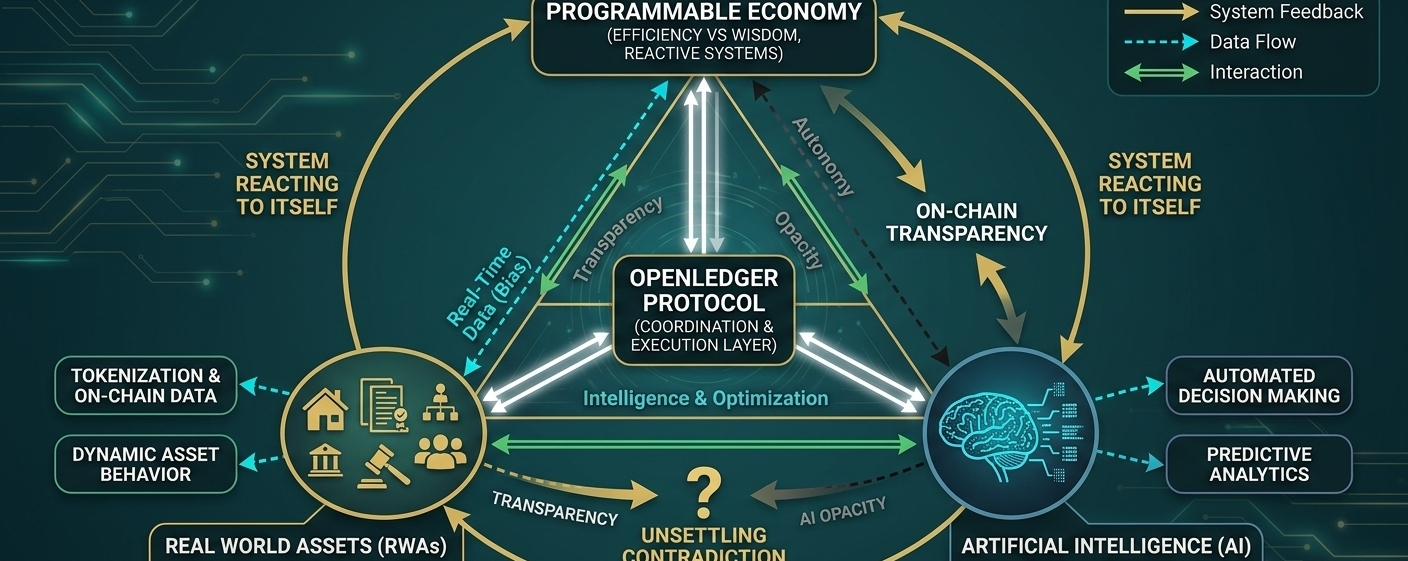
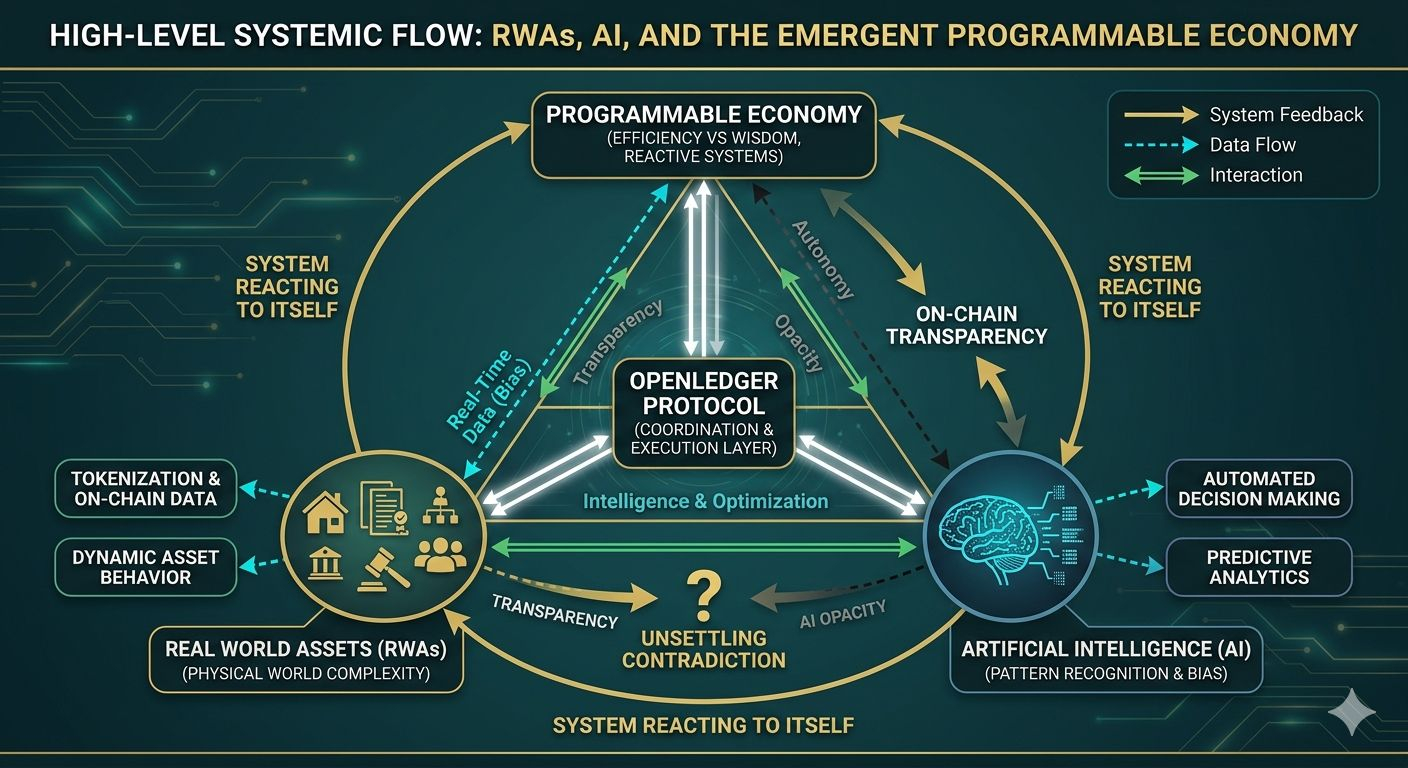
There is something deeply unsettling about the way the future is being explained to us lately
Especially in crypto
Everything sounds so clean
So organized
So certain
A few lines appear on the screen and suddenly an entirely new economic system feels understandable
RWAs bring the assets
AI brings the intelligence
Together everything becomes programmable
At first glance it sounds brilliant
But the longer you sit with those words the stranger they begin to feel
Because real life has never been programmable
That is the part people rarely talk about
Projects like [OpenLedger](https://www.openledger.xyz?utm_source=chatgpt.com) are trying to connect two worlds that were never naturally built to fit together
The physical world full of human emotion laws conflict uncertainty and imperfection
And the digital world where everything wants to become measurable automated and optimized
It sounds futuristic when people say real world assets are coming on chain
But a house is not just an asset
A building carries memories
Families
Debt
Repairs
Legal disputes
Neighborhood decline
Economic pressure
Human attachment
You can tokenize ownership
But you cannot tokenize human reality
And maybe that is where the discomfort begins
Because somewhere inside this movement there is an unspoken assumption that enough technology can simplify the chaos of the real world
As if code can eventually organize everything humans struggle to manage
But the real economy was never rational to begin with
People panic
People speculate
People make emotional decisions
Markets move on fear long before logic arrives
No algorithm fully captures that
Then AI enters the picture and suddenly the narrative becomes even bigger
AI brings intelligence
That sentence sounds powerful until you stop and ask a simple question
Whose intelligence
Because AI does not think the way humans think
It learns patterns from data
And data itself is never neutral
Data carries bias
Blind spots
Missing context
Historical inequality
If the system learns from flawed information then the intelligence built on top of it inherits those same flaws
Only faster
Only at scale
And still despite all of that something important is happening here
You can feel it
Not because these systems are perfect
But because they are changing the speed at which economies react to themselves
That may actually be the real transformation
Not artificial intelligence
Not tokenization
Coordination
Imagine a tokenized building connected to live market conditions
Rent demand changes
Maintenance costs rise
Energy prices fluctuate
Tenant behavior shifts
Traditionally all of this moves slowly through paperwork meetings approvals and delays
But AI does not sleep
It keeps watching
Continuously
Not like a human mind
More like a permanent layer of observation attached to economic activity itself
And that changes the behavior of assets
An asset no longer just sits there waiting to be bought or sold
It starts reacting
Adjusting
Responding
Quietly becoming dynamic
That sounds exciting until another question appears
Who controls those reactions
Because the more automated systems become the further decisions move away from ordinary people
This is the contradiction nobody fully resolves
Blockchain promised transparency
But AI introduces opacity
You may see every transaction happening on chain and still have no idea why the system made the decision it made
That changes power
Slowly at first
Then all at once
The people who understand the models begin understanding the economy itself better than everyone else
And history has never handled that imbalance particularly well
That is why projects like [OpenLedger](https://www.openledger.xyz?utm_source=chatgpt.com) feel bigger than another crypto narrative
They are trying to build environments where intelligence ownership data and economic activity operate together inside the same system
Not separate worlds
One connected structure
And maybe that is what people are truly sensing underneath all the hype
We are moving away from static economies
Toward reactive economies
The current financial world still runs on delay
Delayed settlement
Delayed reporting
Delayed coordination
Delayed response
Programmable infrastructure compresses those delays
The system reacts to itself continuously
That creates efficiency
But efficiency is not the same thing as wisdom
And that distinction matters more than people realize
Because technology has always been very good at accelerating systems
Not necessarily improving human judgment inside them
Maybe that is why this entire moment feels emotionally confusing
Part of it feels exciting
Part of it feels cold
There is beauty in the idea of more open financial systems
But there is also something unsettling about turning more and more human activity into machine readable logic
Especially when even the builders themselves may not fully understand the long term consequences yet
And honestly that may be the most human truth in this entire conversation
Nobody truly knows where this leads
Not completely
We are watching pieces of a new economic architecture emerge in real time
AI
RWAs
Autonomous systems
Programmable ownership
But the full picture still feels blurry
Like standing too close to something enormous to properly see its shape
Maybe this really is the beginning of a programmable economy
Or maybe we are simply building a more sophisticated abstraction layer on top of an already complicated world
Right now both possibilities feel real
And perhaps the most important thing is resisting the urge to pretend the answers are already obvious
Because the systems that eventually reshape society rarely arrive fully understood
They evolve quietly
Then one day people wake up and realize the world has already changed underneath them
