
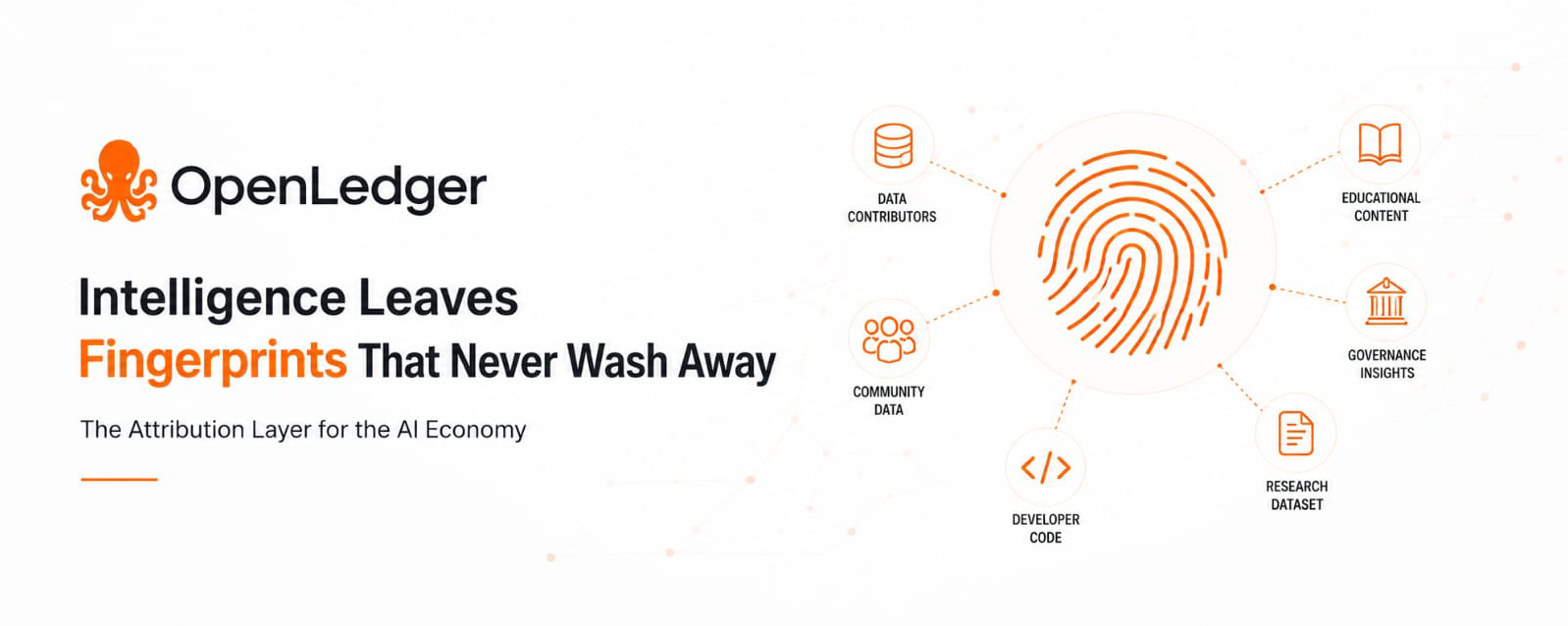
The strange thing I keep noticing about @OpenLedger is that it treats intelligence less like magic and more like something that should leave evidence behind.
The more I think about that idea, the more I realize how broken the current AI economy actually is. Right now, some of the world’s most powerful AI systems are trained on massive amounts of human-generated data, yet the people who created that knowledge rarely receive recognition, attribution, or economic participation. Forums, governance discussions, research threads, GitHub repositories, educational posts, social interactions, and online communities quietly became the raw material behind modern intelligence systems.
But somewhere along the way, the fingerprints disappeared.
That is the part that keeps pulling me back toward OpenLedger. Most AI projects focus on outputs. Better responses. Faster inference. More capable agents. Smarter models. OpenLedger feels focused on something deeper — the origin layer behind intelligence itself.
And honestly, I think that changes everything.
Because once intelligence becomes traceable, contribution becomes measurable. The conversation suddenly shifts from “Who built the model?” to “Who helped shape the intelligence behind the model?” That may sound like a small difference, but economically it creates an entirely new framework for AI.
Today, the AI industry largely behaves like a one-directional extraction system. Human knowledge flows into models. Models generate economic value. Platforms capture most of the upside. Contributors disappear into the background. OpenLedger’s infrastructure seems designed to challenge that structure directly.
Its Proof of Attribution system is especially important because it attempts to connect AI outputs back to the datasets and contributors that influenced them. Not symbolically, but economically. That means intelligence is no longer treated as a mysterious black box detached from its origins. Instead, intelligence starts behaving more like a traceable economic network.
I think this is why OpenLedger feels different from most AI narratives in crypto right now. It is not simply trying to create another decentralized AI platform. It is trying to build memory into intelligence systems themselves.
That idea becomes much more important when you look at where AI is heading over the next few years.
We are rapidly moving toward an internet filled with autonomous AI agents, synthetic media, AI-generated research, machine-generated code, and automated decision systems. Some estimates already suggest that AI-generated content could dominate large portions of the internet in the future. The problem is no longer whether AI can create content. The problem is whether anyone will still know where intelligence came from.
That is where OpenLedger’s vision starts feeling extremely relevant.
Because in a world flooded with synthetic outputs, provenance becomes valuable. Attribution becomes valuable. Verifiable contribution becomes valuable. People will increasingly want to know what data shaped a system, which communities contributed to its intelligence, and whether those sources can actually be trusted.
OpenLedger’s concept of Datanets feels designed specifically for this future. Instead of centralized entities quietly controlling datasets behind closed doors, Datanets create structured environments where communities can contribute data transparently and developers can access specialized datasets for training domain-specific models.
That changes the economics of AI participation entirely.
The current system rewards whoever owns the platform. OpenLedger appears to be building toward a system where contributors themselves become part of the value layer. Data stops behaving like invisible fuel and starts behaving like an attributable economic asset.
I think many people still underestimate how important that shift could become.
Historically, industries transform whenever contribution becomes measurable. Social media exploded once engagement became measurable. Streaming platforms changed entertainment once attention became measurable. Blockchain transformed finance once digital ownership became measurable.
OpenLedger is attempting to make intelligence contribution measurable.
And if that model succeeds, it could fundamentally reshape how AI economies operate.
Another part of OpenLedger that keeps standing out to me is its focus on specialized intelligence systems rather than only giant generalized AI models. Through infrastructure like OpenLoRA and decentralized model development, the project seems to understand that the future AI economy may revolve around highly specialized intelligence layers trained on targeted datasets.
That matters because specialized intelligence requires specialized data.
Financial AI needs different data than healthcare AI. Governance agents require different context than coding agents. Research systems need trusted domain-specific information. OpenLedger’s infrastructure appears designed for exactly this type of modular AI ecosystem where data attribution remains visible instead of disappearing into centralized systems.
The deeper I look into the project, the more OpenLedger feels less like a traditional crypto narrative and more like infrastructure for accountable intelligence economies.
And infrastructure narratives are usually misunderstood early.
People naturally focus on visible consumer applications first. The invisible coordination layers underneath them only become important once the ecosystem scales. That pattern repeated itself with cloud infrastructure, internet payment rails, and blockchain networks. I suspect the same thing could happen with AI attribution systems.
Especially because the internet is approaching a trust crisis.
As synthetic content scales aggressively, authentic human-generated signal may become one of the most valuable resources online. Verified expertise, trusted research, community intelligence, and high-quality datasets could become premium assets in an environment increasingly filled with synthetic noise.
OpenLedger seems positioned around that exact reality.
Not around hype.
Not around temporary AI excitement.
But around the long-term problem of how intelligence itself should function economically.
And honestly, I think that is why the project keeps becoming more interesting the deeper I study it.
Because beneath all the AI terminology, infrastructure discussions, and blockchain architecture, OpenLedger is really asking one massive question the internet has avoided for years:
What happens when intelligence finally remembers where it came from?
If OpenLedger succeeds, the answer could reshape how AI ownership, contribution, and value distribution work for the next generation of the internet.