
Something about the current AI economy keeps bothering me lately.
Not the technology itself.
Not even the speed of progress.
The incentives.
For years the internet operated on a fairly simple social contract. People shared ideas publicly, and in return they received some form of visibility. Sometimes it was money.
Sometimes reputation. Sometimes attention. But the relationship was understandable. If your work created value, people could usually trace that value back to you.
At least loosely.
That structure shaped the entire psychology of the online world. Creators optimized for reach. Researchers optimized for recognition.
Writers optimized for engagement. Even anonymous accounts quietly chased some form of visibility because visibility itself became economic gravity on the internet.
But I think AI may be changing that relationship in ways people still haven’t fully processed.
Because now knowledge doesn’t necessarily stay attached to the person who created it.
It dissolves.
Quietly.
A niche research thread.
A technical breakdown.
A strange dataset uploaded somewhere years ago.
A pattern recognized by some anonymous contributor nobody noticed at the time.
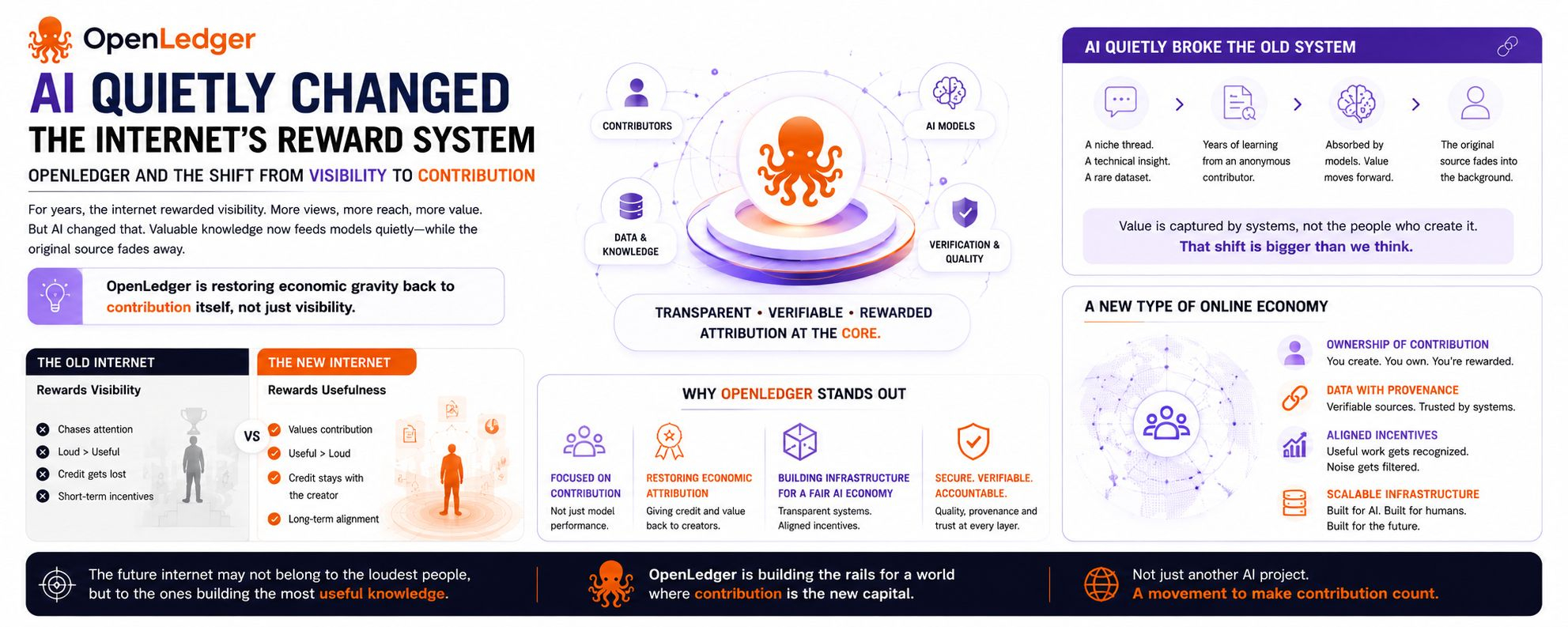
All of it can slowly become embedded inside machine systems without the original source remaining economically visible afterward.
And strangely, the internet still behaves as if the old reward structure exists.
I don’t think it fully does anymore.
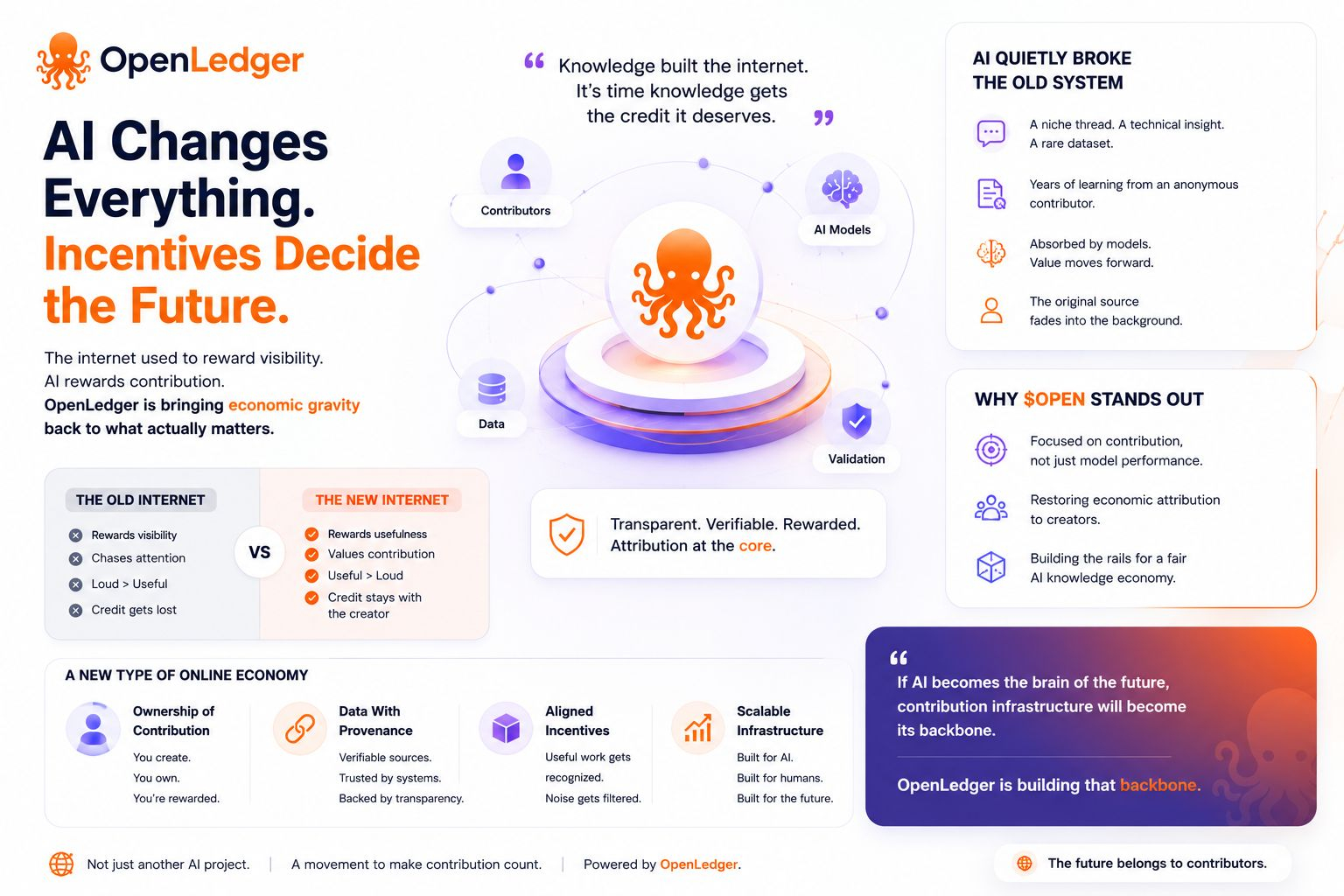
That’s probably why @OpenLedger started standing out to me recently in a way most AI projects don’t. Not because it promises smarter models or louder automation narratives.
Honestly, the market already has enough of those. Every week there’s another project claiming AI will transform everything while quietly avoiding the harder questions underneath.
But OpenLedger seems unusually focused on contribution itself.
That difference matters more than it initially sounds.
People describe AI infrastructure as a competition between models.
Bigger models.
Faster models.
More intelligent systems.
But I think the more important question might eventually become:
who gets recognized when intelligence becomes collective infrastructure instead of individual output?
That feels like a much deeper economic shift.
Because once machine systems absorb human knowledge at scale, visibility may stop being the main mechanism for value creation online.
The people generating genuinely useful information may no longer be the loudest people in the room. They may become invisible contributors sitting underneath larger systems entirely.
And this is where things become uncomfortable.
The current internet rewards attention extremely well.
It does not necessarily reward usefulness well.
Those are different things.
A person can generate enormous visibility without creating durable informational value. At the same time, someone quietly producing highly useful datasets, technical corrections, or operational insights may receive almost no recognition at all.
Until an AI system consumes the output.
Then the value compounds elsewhere.
That creates a strange asymmetry the market still seems psychologically unprepared for.
Because AI changes the economics of contribution itself.
The old internet rewarded performance publicly. The emerging AI economy may reward utility privately through system integration instead.
Look And if that transition accelerates, online behavior could shift dramatically over time.
Less focus on visibility.
More focus on feeding infrastructure.
Maybe.
At least that seems directionally possible.
And OpenLedger appears to be positioning itself somewhere inside that transition by trying to reconnect economic attribution back to contributors through verifiable systems rather than pure social visibility.
Whether that works at scale is another question entirely.
Actually, that’s probably the hardest part.
Because contribution-based economies sound elegant conceptually but become messy operationally very quickly. The moment rewards exist, manipulation appears.
Low-quality uploads. Synthetic data farming. Incentive gaming. Coordinated spam behavior disguised as participation.
Open systems always attract noise eventually.
Sometimes overwhelming amounts of it.
That’s why I keep coming back to the strange tension inside OpenLedger’s design philosophy.
On one side there’s decentralization and open contribution. On the other side there’s heavy emphasis on validation, structured participation, acceptance systems, and controlled quality layers.
Almost like they understand unrestricted openness eventually destroys informational reliability.
And maybe that’s true.
The internet already learned this lesson once through social platforms. Unlimited visibility incentives slowly optimized people toward engagement extraction instead of informational quality.
Outrage scaled faster than usefulness. Attention became more profitable than accuracy.
AI systems trained on that environment inherit those distortions too.
That creates another layer of complexity people don’t talk about enough.
Because future AI systems may not simply reflect intelligence.
They may reflect incentive structures.
That possibility feels important.
Especially when looking at enterprise adoption later.
Markets tolerate noisy environments longer than institutions do.
Institutions eventually require provenance, traceability, attribution, and accountability. Once AI systems start entering regulated financial systems, healthcare workflows, procurement environments, legal infrastructure, or operational decision-making layers, invisible sourcing becomes much harder to justify.
Someone will eventually ask:
Where did this information originate?
Who contributed it?
Can it be verified?
Can it be audited?
Can ownership be traced?
Those questions feel boring right now because the market is still intoxicated by capability growth.
But infrastructure conversations usually begin quietly before suddenly becoming unavoidable.
And maybe contribution attribution becomes one of those conversations.
Not because it sounds philosophical.
Because it becomes economically necessary.
Still, I’m not fully convinced any system has solved this properly yet.
The coordination complexity alone is enormous. Building transparent contribution economies without creating exploitative incentive loops is incredibly difficult. Even defining “useful contribution” becomes subjective once systems scale globally across different domains.
And there’s another uncomfortable possibility too.
Maybe people simply prefer visibility economies emotionally.
The internet trained users for years to associate public attention with personal value.
Contribution systems that reward invisible infrastructure participation instead might feel psychologically colder even if they are economically fairer underneath.
Humans don’t only optimize for compensation.
They optimize for recognition.
That distinction matters.
So I don’t think the transition, if it happens, will be clean or immediate.
There will probably be friction between social identity systems and machine-integrated contribution systems for a long time.
One rewards perception publicly. The other rewards utility structurally.
Those incentives create very different online behaviors.
But perhaps that is exactly why OpenLedger feels interesting right now.
Not because it guarantees success.
Not because the model is fully proven.
But because it seems to be exploring a deeper shift most people are still looking past entirely.
The possibility that the AI economy may eventually reorganize around contribution infrastructure instead of attention infrastructure.
That’s a much bigger change than another AI narrative cycle.
And maybe much stranger too.
Because if that transition actually accelerates, the future internet may not belong to the people attracting the most attention…
but to the people quietly feeding systems with the most useful knowledge underneath the surface.
Something about that possibility keeps staying in my mind.
It feels subtle.
But not small.