🧠 AI AGENTS AREN’T AN EDGE
Everyone on CT keeps acting like AI agents are some magical alpha machine.
I think that framing is completely wrong.
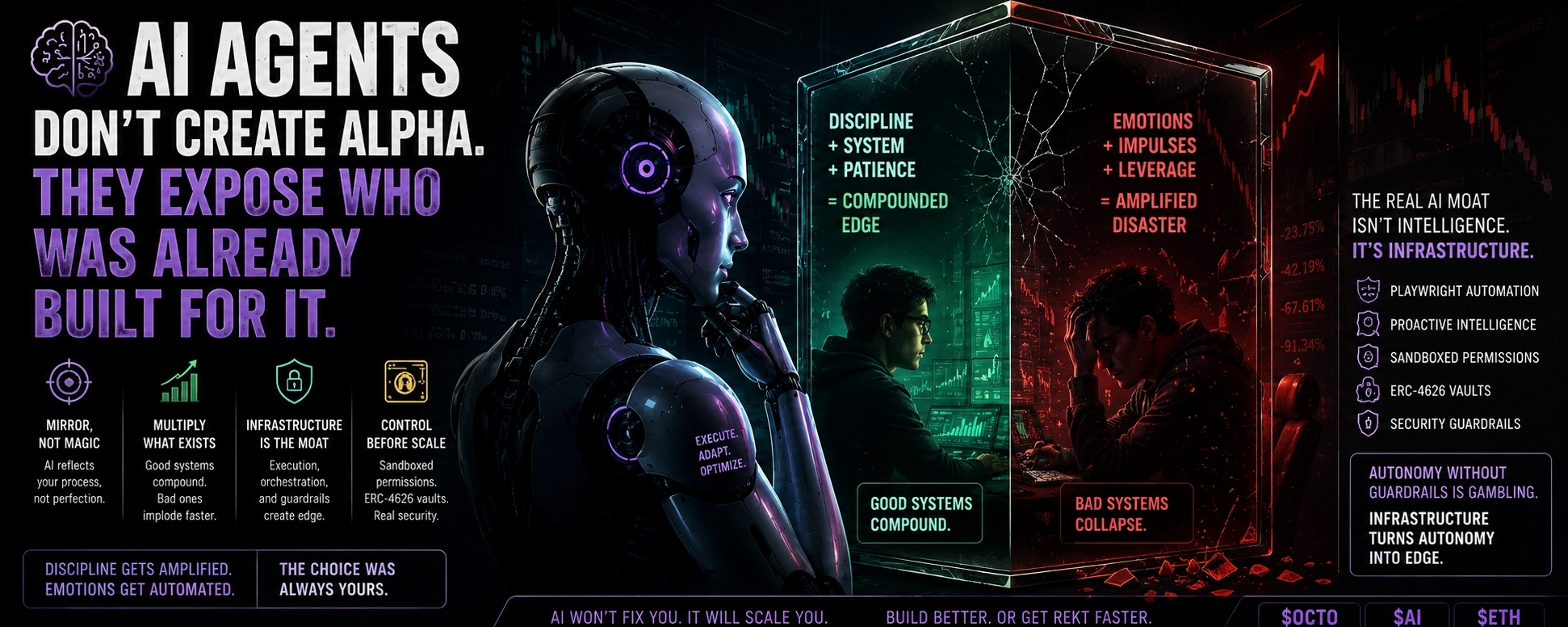
AI agents like OctoClaw don’t create discipline.
They expose whether you already had it.
That’s the uncomfortable part nobody wants t0 admit.
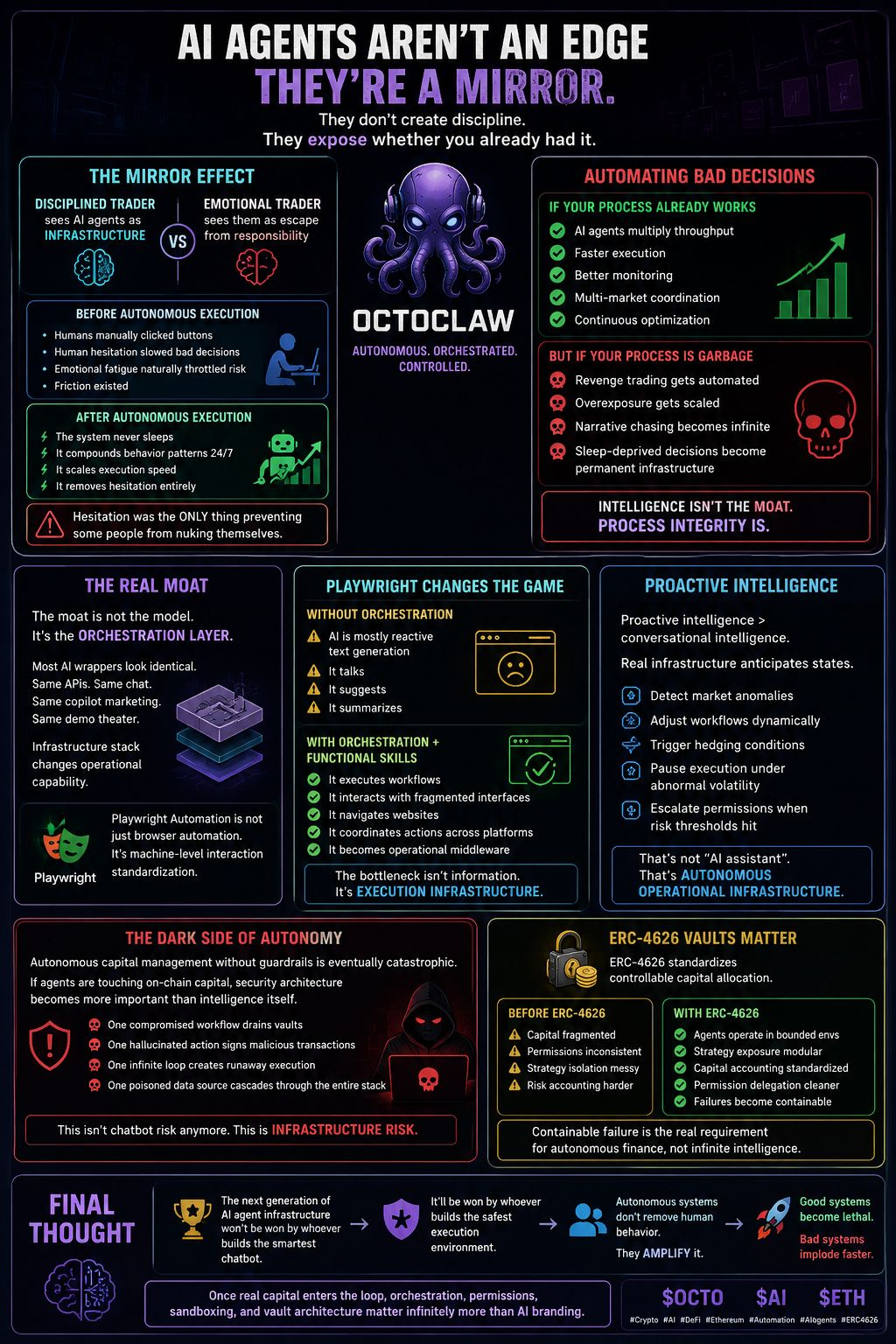
🧠 THE MIRROR EFFECT
A disciplined systematic trader sees AI agents as infrastructure.
An emotional trader sees them as escape velocity from responsibility.
Completely different outcome.
Same tool.
Before autonomous execution:
🧠 Humans manually clicked buttons.
⚠️ Human hesitation slowed bad decisions.
⚠️ Emotional fatigue naturally throttled risk.
⚠️ Friction existed.
After autonomous execution:
⚡ The system never sleeps.
⚡ It compounds behavior patterns 24/7.
⚡ It scales execution speed.
⚡ It removes hesitation entirely.
That sounds bullish until you realize hesitation was the ONLY thing preventing some people from nuking themselves.
That’s the real psychological shift here.
AI agents don’t remove human flaws.
They industrialize them.
💀 AUTOMATING BAD DECISIONS
People think AI agents replace traders.
I think they replace operational latency.
Huge difference.
If your process already works:
📊 AI agents multiply throughput.
📊 Faster execution.
📊 Better monitoring.
📊 Multi-market coordination.
📊 Continuous optimization.
But if your process is garbage:
💀 Revenge trading gets automated.
💀 Overexposure gets scaled.
💀 Narrative chasing becomes infinite.
💀 Sleep-deprived decisions become permanent infrastructure.
This is why most retail users are going to misunderstand agentic systems completely.
They think intelligence is the moat.
It isn’t.
Process integrity is.
👀 THE REAL MOAT
I’m increasingly skeptical of pure LLM hype.
Most AI wrappers look identical now.
Same APIs.
Same chat interface.
Same “copilot” marketing.
Same demo theater.
The actual moat is not the model.
It’s the orchestration layer.
That’s where projects like OctoClaw get interesting.
Not because the AI is smarter.
But because the infrastructure stack changes operational capability.
Playwright Automation is a perfect example.
Most people think it’s just browser automation.
Wrong.
It’s machine-level interaction standardization.
⚙️ PLAYWRIGHT CHANGES THE GAME
Without orchestration:
⚠️ AI is mostly reactive text generation.
⚠️ It talks.
⚠️ It suggests.
⚠️ It summarizes.
With orchestration + functional skills:
⚡ It executes workflows.
⚡ It interacts with fragmented interfaces.
⚡ It navigates websites.
⚡ It coordinates actions across platforms.
⚡ It becomes operational middleware.
That’s a completely different category.
The real bottleneck in crypto isn’t information anymore.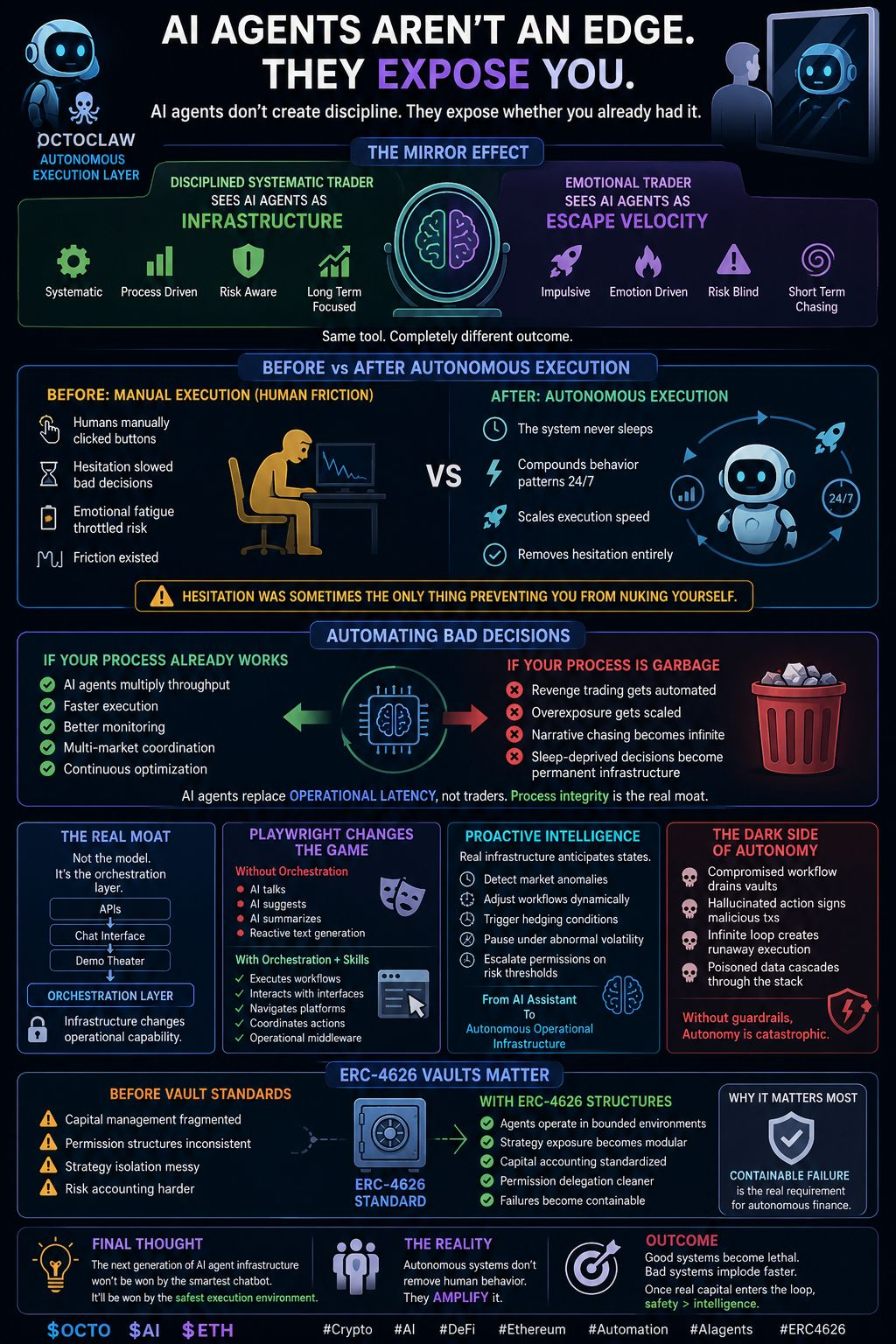
Everyone has information.
The bottleneck is execution infrastructure.
Whales already understand this.
Retail still thinks in terms of “which AI is smartest.”
That’s surface-level thinking.
The deeper layer is:
Who controls the action pipeline?
Who controls automation permissions?
Who controls multi-step execution logic?
Who controls capital routing?
That’s where the moat compounds.
📊 PROACTIVE INTELLIGENCE
Another thing people underestimate:
Proactive intelligence matters more than conversational intelligence.
Most chatbots wait for instructions.
Real infrastructure anticipates states.
That changes everything operationally.
A good agent stack should:
👀 Detect market anomalies.
👀 Adjust workflows dynamically.
👀 Trigger hedging conditions.
👀 Pause execution under abnormal volatility.
👀 Escalate permissions when risk thresholds hit.
That’s not “AI assistant” territory anymore.
That’s autonomous operational infrastructure.
Huge difference.
⚠️ THE DARK SIDE OF AUTONOMY
Autonomous capital management without guardrails is eventually catastrophic.
Not maybe.
Eventually.
If agents are touching on-chain capital, security architecture becomes more important than intelligence itself.
This is why sandboxed permission layers matter so much.
Without them:
💀 One compromised workflow drains vaults.
💀 One hallucinated action signs malicious transactions.
💀 One infinite loop creates runaway execution.
💀 One poisoned data source cascades through the entire stack.
People underestimate how dangerous autonomous agents become once wallet permissions are involved.
This isn’t chatbot risk anymore.
This is infrastructure risk.
🛡️ ERC-4626 VAULTS MATTER
ERC-4626 vault architecture is actually one of the most important hidden pieces here.
Not because it’s flashy.
Because it standardizes controllable capital allocation.
That matters enormously for AI systems.
Before tokenized vault standards:
⚠️ Capital management was fragmented.
⚠️ Permission structures were inconsistent.
⚠️ Strategy isolation was messy.
⚠️ Risk accounting was harder.
With ERC-4626 structures:
⚡ Agents can operate inside bounded environments.
⚡ Strategy exposure becomes modular.
⚡ Capital accounting becomes standardized.
⚡ Permission delegation becomes cleaner.
⚡ Failures become containable.
That last point matters most.
Containable failure is the real requirement for autonomous finance.
Not infinite intelligence.
Traditional CT narratives obsess over upside.
Systematic operators obsess over blast radius.
That’s the mindset difference.
🧠 FINAL THOUGHT
I think the next generation of AI agent infrastructure won’t be won by whoever builds the smartest chatbot.
It’ll be won by whoever builds the safest execution environment.
The projects that survive will understand one thing:
Autonomous systems don’t remove human behavior.
They amplify it.
Good systems become lethal.
Bad systems implode faster.
And once real capital enters the loop, orchestration, permissions, sandboxing, and vault architecture matter infinitely more than AI branding.
That’s the layer most people still aren’t looking at.