
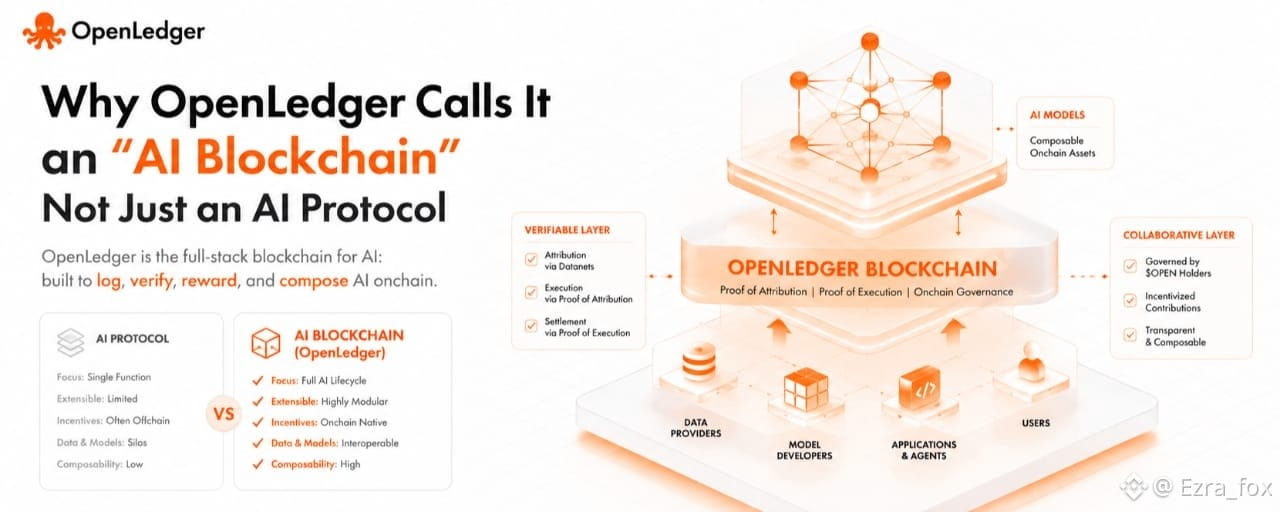
There’s something that keeps bothering me whenever I see OpenLedger describe itself as an “AI Blockchain.”
Not an AI protocol. Not AI infrastructure. Not just another tooling layer attached to the crypto-AI narrative.
At first, I assumed it was mostly branding — a larger label designed to fit the current market cycle. Crypto has always loved oversized terminology before the product fully exists.
But the deeper I look into OpenLedger’s architecture, the more I feel the term wasn’t chosen casually.
What they seem to be building is not simply an AI tool running on-chain, but an economic system centered around the ownership of intelligence itself.
And that changes the framing entirely.
Most of the market still treats AI like software: better models, cheaper inference, more autonomous agents.
But very few people ask the more uncomfortable question: if AI becomes foundational infrastructure, who owns the data that trains it? Who receives attribution? Who captures value when intelligence emerges from collective human behavior?
OpenLedger appears to begin from that question rather than from the model layer.
That’s likely why they use the word “blockchain.”
Not because of consensus mechanisms. Not because of tokens. But because blockchains are ultimately systems for coordinating ownership.
The deeper I examine the idea, the more OpenLedger feels like an attempt to turn data into an asset with provenance — something that carries lineage, contribution history, and attribution beneath every interaction feeding the AI system.
Technically, it sounds abstract.
But underneath, it’s actually a very human story.
The first internet let people create content freely. Web2 transformed that content into raw material for platform economies. The AI era may push this even further, where language, behavior, attention, and collective knowledge become fuel for machine intelligence.
And that’s where the tension begins.
Most people still contribute data to AI systems the same way they once uploaded their lives to social media: for free, without attribution, without visibility into where the value ultimately accumulates.
From my perspective, OpenLedger isn’t trying to solve that through ideology alone. They’re trying to solve it through economic structure.
Data contributors. Model builders. Validators. Inference consumers.
All connected through a shared incentive graph where intelligence is no longer produced by a single corporation, but by coordinated participation between many actors.
What interests me most may not even be the model architecture itself.
It’s the idea that data is starting to resemble labor.
That’s a massive psychological shift.
For most of internet history, data was treated as exhaust — a byproduct of using platforms. But if AI transforms data into a primary economic resource, attribution begins to look increasingly similar to intellectual property rights.
And blockchain, in that context, starts resembling an accounting system for cognition rather than merely a financial ledger.
Maybe that’s also why they avoid calling themselves an “AI protocol.”
A protocol sounds replaceable. Middleware. A technical layer.
But “AI Blockchain” suggests something deeper: a native social infrastructure where intelligence is created, tracked, and economically distributed from the beginning.
Of course, there are still unresolved questions.
Can attribution truly scale? Will people care about data ownership before they experience direct economic loss? Can token incentives preserve quality without collapsing into spam-driven behavior like earlier social mining systems?
I still have doubts.
But OpenLedger reminds me a lot of early DePIN narratives.
At first, DePIN looked like crypto attached to hardware. Over time, people realized it was really about tokenizing the coordination of physical infrastructure.
OpenLedger may be attempting something similar for intelligence infrastructure.
Where tokens don’t simply represent usage — they represent participation in the creation of cognition itself.
And maybe that’s the unsettling part.
Because if AI blockchains evolve the way they envision, the future internet may not revolve around how intelligent AI becomes, but around who gets recognized when intelligence is generated collectively.
At that point, the line between user, worker, trainer, and data source starts fading.
It begins to resemble culture more than software.
An economy where every interaction quietly becomes part of a larger machine humans are collectively training.