
A months ago I noticed something odd while moving between crypto projects related to AI.
The hardest part was not understanding the technology. It was figuring out where trust actually was.
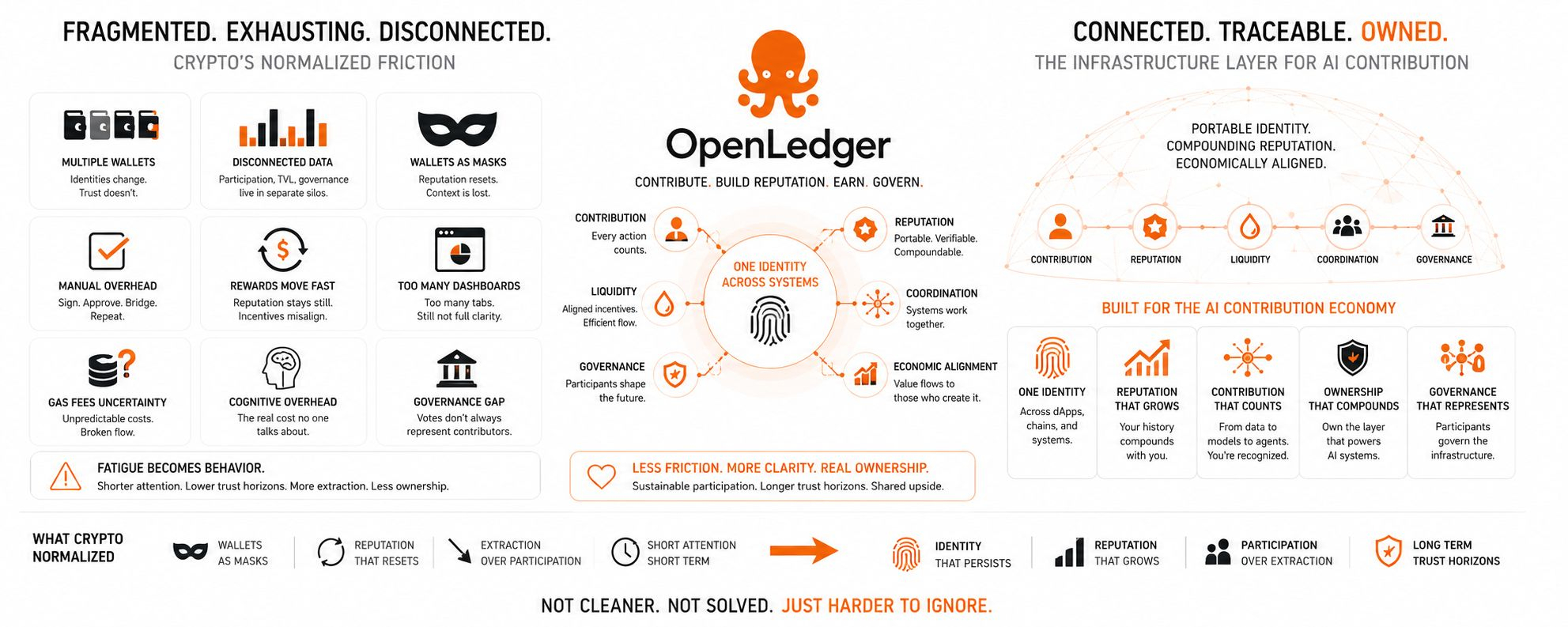
One dashboard showed how many people were participating. Another showed how much money was moving around.. I had to look somewhere else to see how people were making decisions. My identity changed depending on which wallet I used that week. Rewards moved fast. My reputation did not. It felt like the ecosystem was better at tracking money than people.
That started to feel important.
Crypto spent years trying to be decentralized.. It built systems that broke user behavior into tiny pieces that were hard to understand. Wallets became like masks. People moved their money around a lot. It was hard to tell if people were participating because they wanted to or just for the rewards.
Most people got used to this without thinking about it much.
They opened tabs.
Used wallets.
Signed approvals.
Moved assets through bridges.
Checked many dashboards to confirm one balance.
Getting tired of all the work slowly became crypto behavior.
Big AI labs seemed fine with one thing not changing.
That contributing data would stay mostly invisible.
Not invisible technically. Invisible economically.
The people producing patterns were scattered across systems. In crypto the ownership layer around AI activity feels incomplete.
That was the part OpenLedger made me think about.
Not because it solved fragmentation. I do not think anyone has solved that yet.
Because it seems focused on the layer underneath the visible product experience. The part where contribution, reputation, liquidity and coordination affect each other over time.
Most crypto infrastructure still acts like financial surfaces.
You move assets here.
Stake else.
Vote through another interface.
Build reputation in places that cannot travel with you.
Then start over again under a wallet.
People rarely question this anymore because crypto normalized reconstruction of identity.
OpenLedger feels like it noticed that this fragmentation was becoming useful for centralized AI structures.
If contributors remain disconnected then ownership remains blurry.
If participation cannot add up across systems then users stay replaceable.
If reputation constantly resets, then platforms retain most of the power.
That does not mean decentralization disappears. It just becomes shallow.
What I find interesting is that OpenLedger does not try to dominate attention. The behavior around it feels quieter. More like an attempt to reduce coordination loss that users stopped noticing.
Crypto has always had a strange relationship with familiar friction.
People complain about gas fees.
They rarely talk about cognitive overhead.
The fatigue of execution.
The constant wallet switching.
The uncertainty of whether governance actually represents participants.
The subtle psychological effect of never knowing where your digital identity actually lives.
Over time those things change how people behave inside networks.
They shorten attention spans.
They reduce trust horizons.
They encourage extraction over participation.
That may be why much on-chain behavior still feels transactional.
I think OpenLedger may have noticed that before a lot of players wanted to admit it.
Because once contribution becomes traceable, portable and economically connected the balance around AI infrastructure starts shifting.
The question is not just who builds models.
It becomes who owns the layer feeding them.
Crypto has never been very good at answering ownership questions.
Maybe that is why this area feels different lately.
Not cleaner.
Not solved.
Just harder to ignore.
Most users probably will not describe it this way. They will just notice that some systems feel less mentally exhausting than others.
After years inside crypto that alone starts standing out.
People quietly adapted to broken coordination for long that even small reductions, in friction now feel psychologically noticeable.
Maybe that is what OpenLedger understood early.
Not that users wanted complexity.
That they were getting tired of rebuilding themselves every time they touched a new system.