

The market has felt oddly calm this week. It is not the good kind of calm—more like that quiet stretch between a narrative cycle cooling down and the next major risk catalyst forming. With prices chopping sideways, I took some time to dig into the documentation on @OpenLedger ($OPEN ) to pressure test its core mechanics.
On the surface, the narrative is highly compelling: decentralized AI infrastructure, Proof of Attribution, and data contributors finally capturing value for raw inputs. But as I pulled up the token omics and supply charts, a distinct structural friction caught my attention.

Right now, the public discourse around $OPEN is entirely focused on supply-side metrics. Bulletins highlight milestones like nodes registered, datasets uploaded, or new models deployed inside the Model Factory. It creates a great visual pipeline of growth, but it overlooks a fundamental catch in the network's financial architecture.
For the protocol's Proof of Attribution model to function as a self-sustaining loop, external enterprise or application demand must submit inference requests and pay fees natively in OPEN. Those real utility fees are what should flow back to the network's data contributors.
However, looking at the current layout, that circuit does not appear to be closed.
The marketplace currently faces a demand gap. Because true external enterprise query fees are not yet matching the pace of network emissions, the rewards flowing to data contributors are effectively subsidized directly from the treasury bootstrap allocations. The network is not yet running on actual usage fees; it is running on a time-limited marketing runway.
A serious timeline constraint when paired with the token's structural macro schedule:
Emissions Reality: The circulating supply has already expanded significantly from its initial 215.5 million tokens at the September 2025 Token Generation Event (TGE) to over 290 million tokens today.
The Cliff: The token has stabilized in the $0.18–$0.23 range, recovering from its post-TGE lows but sitting well below its original launch-day highs. The critical variable is September 2026. That is when the 12-month cliff on early investors and core team allocations expires.
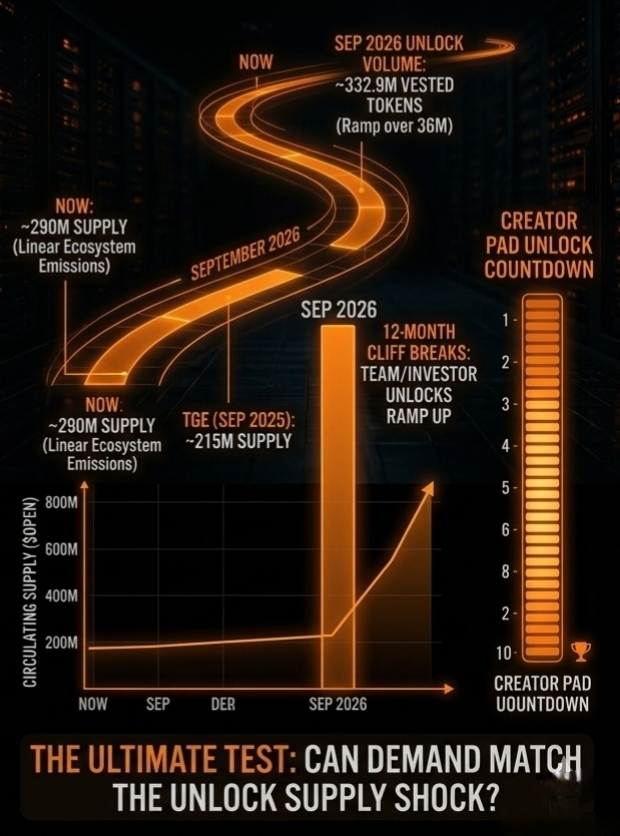
The Math: Once that cliff breaks, the monthly token unlocks will dramatically ramp up as a combined 332.9 million investor and team tokens begin their linear 36-month release.
The fundamental test for OpenLedger over the next quarter is entirely on the demand side. The supply infrastructure is fully built out and running, but it is currently operating in only one gear.
The real metric to watch between now and the end of Q3 is whether any major external developers or commercial applications integrate with a Datanet to pay real, ongoing inference fees. If those integrations materialize, the project has a framework capable of absorbing the upcoming structural unlocks. If they lag, the treasury bootstrap will face a steep uphill battle against incoming cliff inflation.
I am sitting on the sidelines for a bit longer to see if the demand metrics materialize before the cliff hits.