
I’ve been staring at OpenLedger for hours now and I still can’t decide whether it’s early infrastructure or just another beautifully packaged AI narrative designed for a market desperate to believe something new is happening.
Maybe both.
That’s the annoying part about this cycle. After enough years in crypto, your brain automatically filters out certain phrases. “AI blockchain” is probably near the top of that list now. Right beside “redefining ownership” and “next-generation decentralized economy.” You read enough whitepapers and eventually every project starts sounding like a remix of the last one.
But OpenLedger keeps pulling me back into the docs for one specific reason:
It doesn’t seem obsessed with AI itself.
It seems obsessed with attribution.
And honestly, that feels more important than most people realize.
The current AI economy is weird when you slow down and actually think about it. Models absorb unimaginable amounts of human contribution — data, writing, labeling, workflows, behavioral patterns, conversations, code, research — and somehow the economic layer underneath all of that remains almost invisible.
The model gets monetized.
The contributors disappear.
That structure has worked so far because AI still feels experimental to most people. But what happens when these systems become real economic infrastructure? Not toys. Not demos. Actual productive systems generating meaningful revenue.
Who owns the value then?
That’s the question OpenLedger seems to be circling around beneath all the AI-chain branding.
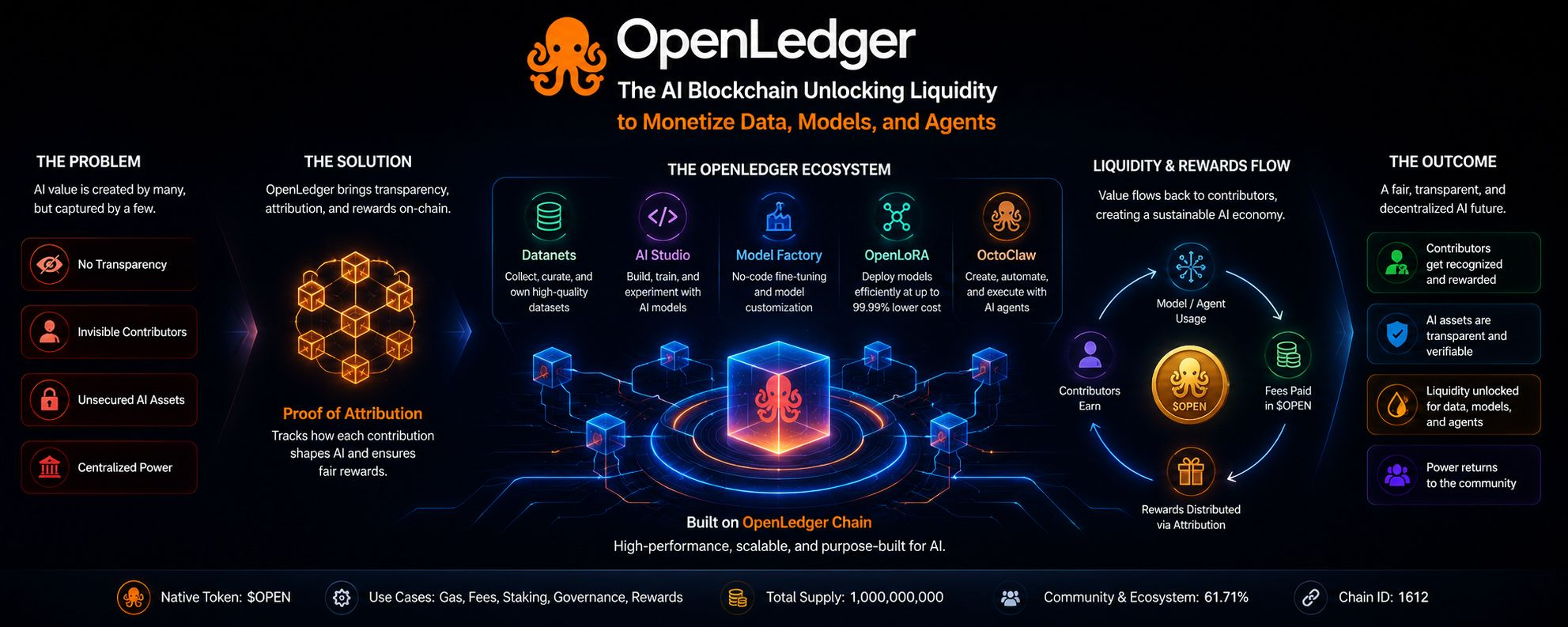
The project talks constantly about monetizing data, models, and agents through something called Proof of Attribution. At first I brushed past that phrase because crypto loves inventing new “proof” systems every six months. But the more I looked into it, the more it started feeling less like branding and more like the core thesis holding the entire project together.
The idea is fairly straightforward conceptually: contributions to AI systems should remain traceable and economically connected to downstream value creation.
Simple sentence.
Massive implications.
Because if AI eventually becomes an economy — and I think it probably does — then attribution becomes infrastructure.
Not morally.
Financially.
That distinction matters.
Most AI projects in crypto still feel focused on compute markets or inference layers. GPUs, decentralized processing, agent tooling, all the obvious things. OpenLedger feels different because it’s trying to solve the accounting problem underneath intelligence itself.
And maybe that sounds dramatic, but I genuinely think the industry is underestimating how important that layer becomes later.
Right now the internet runs on hidden labor. People casually feed systems every day without realizing they’re participating in future economic models. Every niche tutorial. Every community answer. Every dataset refinement. Every interaction online gradually becomes part of machine intelligence somewhere.
Then the value compounds upward into a few closed systems.
OpenLedger seems built around the assumption that eventually this becomes unsustainable.
Not technically.
Socially.
The project’s architecture reflects that thinking too. AI Studio, Datanets, Model Factory, OpenLoRA — at first the ecosystem reads like standard crypto product sprawl, but underneath it there’s actually a coherent direction emerging. They’re trying to create an environment where datasets, models, agents, and contributors remain economically linked instead of collapsing into opaque black boxes after deployment.
In other words, intelligence stays traceable.
At least in theory.
And yeah, theory is where crypto projects usually look their best.
That’s probably why I’m still skeptical.
I’ve watched too many cycles now. DeFi promised parallel finance. NFTs promised digital ownership revolutions. GameFi promised player-owned economies. Modular chains promised infinite scalability. AI now promises autonomous economies and intelligent infrastructure.
Most narratives contain a real insight somewhere inside them. The problem is usually timing, adoption, or human behavior.
People consistently underestimate how much convenience beats ideology.
That’s the challenge OpenLedger eventually runs into too. Even if attribution matters philosophically, will developers actually choose systems optimized around transparent contribution tracking if centralized alternatives remain easier, cheaper, and faster?
I honestly don’t know.
But I do think OpenLedger is asking a more serious question than many projects in this sector.
Because the uncomfortable truth sitting underneath modern AI is that nobody really knows how ownership works anymore once intelligence becomes collective and machine-amplified at scale.
Who deserves compensation when a model trained on millions of fragmented contributions generates commercial output?
The company?
The infrastructure layer?
The data providers?
Everyone?
Nobody?
Right now the industry mostly avoids the question entirely.
OpenLedger doesn’t seem to be avoiding it.
And maybe that’s why the project feels more substantial than the average AI narrative floating through crypto right now. It’s not pretending decentralization alone magically fixes intelligence markets. Instead, it’s focusing on provenance, attribution, and economic traceability as foundational infrastructure.
That feels more grounded.
Still risky. Still uncertain. Still vulnerable to all the usual crypto problems — token speculation, weak adoption, incentive misalignment, infrastructure complexity. None of that disappears because the thesis sounds intellectually interesting at 2AM after too many whitepapers.
But at least there’s an actual thesis here.
Not just “AI on blockchain.”
Honestly, I think the deeper idea underneath OpenLedger is that the internet accidentally scaled information before it solved attribution. AI is now accelerating that imbalance fast enough that eventually someone has to build systems where contribution remains visible.
Maybe OpenLedger becomes that layer.
Maybe it doesn’t.
But the project at least understands something important:
Once intelligence becomes monetizable infrastructure, attribution stops being philosophical and starts becoming economic infrastructure itself.
And that shift probably changes more than people are ready for yet.