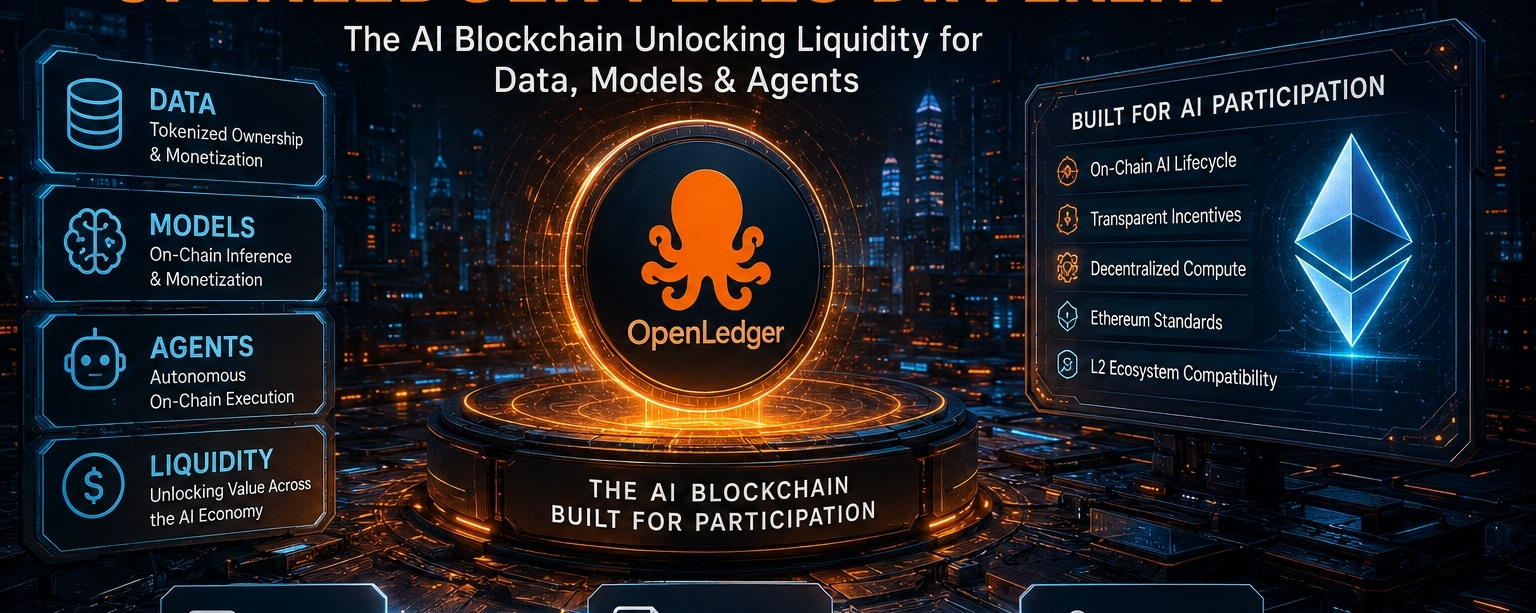
The market has spent the last two years obsessing over AI narratives, but most of what I’ve seen still feels disconnected from the actual infrastructure required to support an AI-native economy. A lot of projects talk about artificial intelligence as if adding “AI” to a pitch deck automatically creates value. Meanwhile, the real problems remain unresolved: who owns the data, who gets paid when models are used, how agents transact autonomously, and where liquidity actually forms around machine-driven activity. That’s why OpenLedger caught my attention earlier than most AI-focused crypto projects I’ve researched recently. It wasn’t simply because it positioned itself as another AI chain. What stood out to me was the idea of treating AI participation itself as a first-class economic primitive on-chain rather than just building another marketplace for GPU speculation or chatbot integrations.
I’ve been watching the intersection between AI and blockchain very closely because I think the market is still underestimating how large the infrastructure layer could become if autonomous agents eventually handle meaningful economic activity online. Most current blockchains were not designed with AI agents in mind. They were built primarily for human-triggered financial transactions, token transfers, or DeFi interactions. OpenLedger approaches the problem differently by designing an environment where models, datasets, and autonomous agents can all operate as native economic participants. In my view, that distinction matters more than many people realize because the future AI economy probably does not look like humans manually clicking wallets every few minutes. It likely looks like thousands of automated systems interacting continuously, training models, purchasing data, executing logic, and settling value across decentralized infrastructure in real time.
After spending time analyzing the ecosystem architecture, what impressed me most was the way OpenLedger tries to unify fragmented AI infrastructure into a coherent economic layer. Right now, AI development is deeply siloed. Data providers rarely capture fair long-term value, model creators struggle with monetization outside centralized platforms, and agents lack efficient on-chain coordination mechanisms. OpenLedger’s thesis appears to revolve around unlocking liquidity across these fragmented components. That sounds abstract at first, but the implications are actually enormous. If datasets become tokenized economic assets, if models can monetize inference directly on-chain, and if autonomous agents can transact independently without relying on centralized gatekeepers, then blockchain starts becoming more than a financial settlement layer. It becomes the operating system for machine economies.
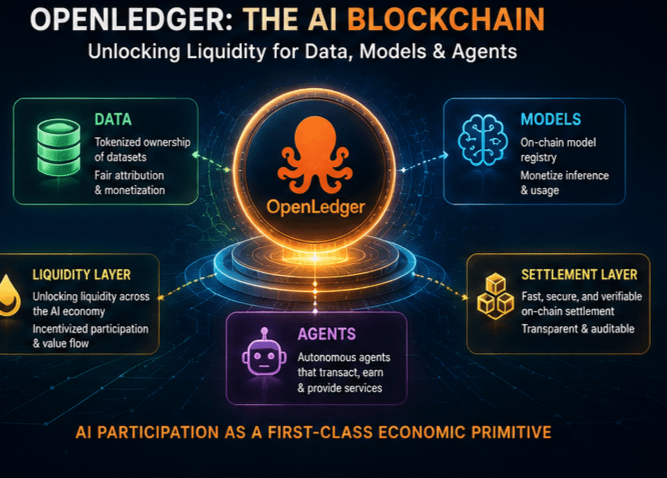
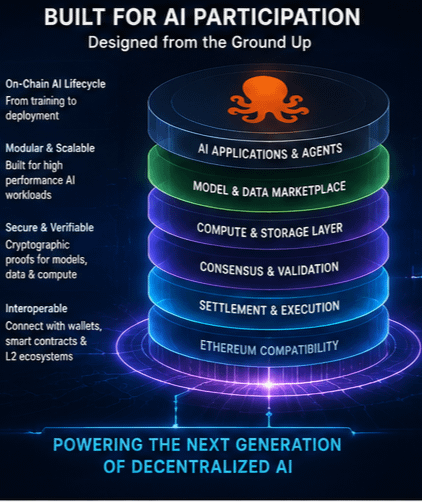
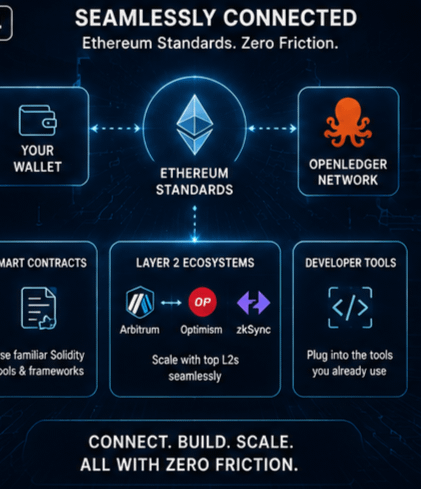
One thing I noticed while researching OpenLedger is how heavily the project emphasizes compatibility with Ethereum standards and broader EVM ecosystems. I think this is strategically important because infrastructure projects often fail when they force developers into isolated environments. Crypto history is full of technically impressive chains that struggled because they demanded entirely new tooling, new wallets, or unfamiliar standards. OpenLedger seems aware of that friction problem. By maintaining compatibility with Ethereum wallets, smart contracts, and Layer 2 ecosystems, the project lowers the psychological and technical barriers for adoption. Developers already comfortable inside Ethereum infrastructure can theoretically integrate AI-native functionality without rebuilding everything from scratch. In a market where developer attention is one of the most valuable resources, reducing friction matters as much as raw technical innovation.
The broader timing of this narrative also feels significant. AI has become one of the dominant macro themes across both traditional markets and crypto, but the infrastructure supporting decentralized AI remains immature. Centralized AI companies currently control the majority of compute resources, training pipelines, distribution channels, and monetization frameworks. That concentration creates vulnerabilities that crypto participants increasingly recognize. Data ownership becomes opaque, revenue sharing becomes asymmetrical, and censorship risks become unavoidable. OpenLedger positions itself against that backdrop by attempting to decentralize economic participation around AI itself rather than merely decentralizing token speculation tied to AI branding.
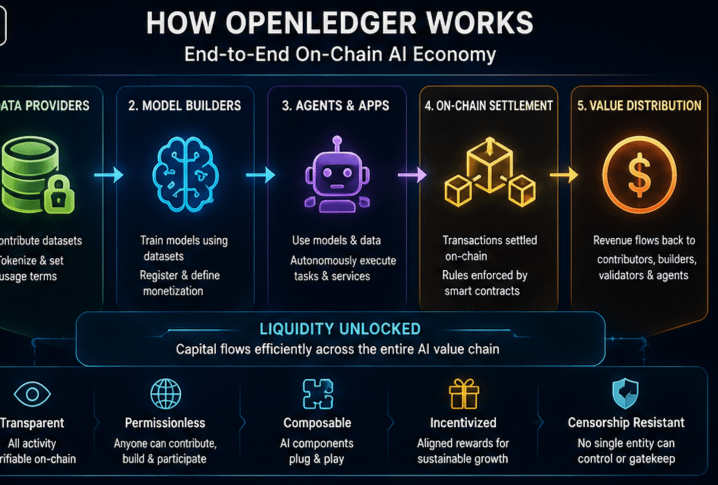
I think the monetization angle is where the project becomes particularly interesting. Data has historically been extracted without fair compensation for contributors, while model developers often operate under centralized licensing structures that favor platforms over creators. OpenLedger appears to envision an environment where contributors across the AI value chain can capture programmable revenue streams directly on-chain. If executed properly, that changes incentive structures dramatically. Instead of centralized entities absorbing most economic upside, value can theoretically flow to dataset providers, model creators, validators, and agent operators in a transparent and composable way. In many ways, it reminds me of how DeFi unlocked dormant liquidity in crypto assets years ago. OpenLedger is essentially attempting to unlock dormant liquidity within AI ecosystems.
At the same time, I don’t think investors should underestimate how difficult execution will be. Building AI-native infrastructure is not comparable to launching another DeFi protocol or NFT marketplace. The computational demands are enormous, the coordination challenges are complex, and user expectations around performance are significantly higher than typical blockchain applications. One concern I keep coming back to is whether decentralized AI systems can realistically compete with centralized hyperscalers on efficiency and scale. OpenAI, Google, and Anthropic operate with massive infrastructure advantages, deep capital reserves, and vertically integrated ecosystems. OpenLedger’s challenge is not only technological but economic. It has to prove decentralization creates enough incentive alignment and liquidity efficiency to offset the raw power advantages centralized incumbents already possess.
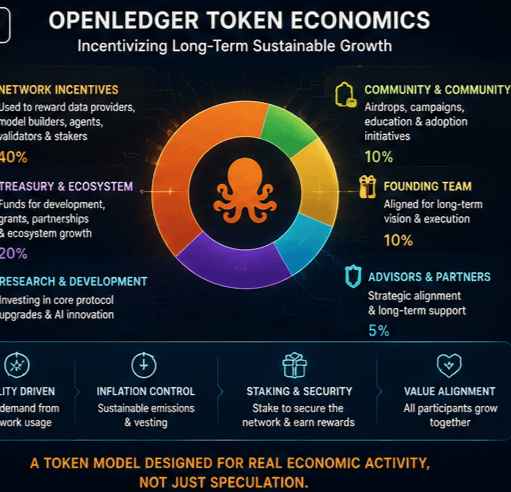
The tokenomics side also deserves deeper examination because AI narratives can attract speculative capital extremely quickly, often faster than underlying utility develops. I’ve seen countless crypto sectors where valuation expansion outpaced actual network activity, and AI could easily become another example if investors stop separating narrative momentum from sustainable economics. From what I’ve observed, OpenLedger’s long-term success likely depends on whether token demand emerges organically from network participation rather than purely speculative trading cycles. If models, agents, and datasets genuinely require tokenized incentives for coordination, staking, access, or settlement, then the token can develop structural utility beyond short-term speculation. But if activity remains dependent on narrative-driven liquidity without sustained ecosystem usage, inflation pressure and liquidity fragmentation could become serious risks over time.
What caught my attention positively was the emphasis on economic participation rather than superficial AI integrations. Too many projects simply attach AI-generated interfaces onto existing blockchain products and market them as innovation. OpenLedger appears to focus instead on creating programmable incentive systems around the AI lifecycle itself. That distinction matters because sustainable crypto infrastructure usually emerges from coordination efficiency rather than marketing narratives. Ethereum succeeded because it enabled programmable settlement. DeFi expanded because it unlocked capital efficiency. Similarly, OpenLedger’s future probably depends on whether it can unlock economic coordination efficiency for AI ecosystems at scale.
I also think the project sits at the intersection of several powerful narratives simultaneously. AI is obviously the dominant one, but there are also elements of DePIN, modular infrastructure, decentralized compute, and even aspects of real-world digital labor markets embedded within the thesis. Autonomous agents participating economically on-chain could eventually create entirely new categories of activity. Imagine AI agents renting compute, purchasing specialized datasets, executing DeFi strategies, or negotiating services autonomously while settlement occurs transparently through blockchain infrastructure. That sounds futuristic today, but parts of that transition are already beginning to emerge across the market. OpenLedger seems positioned around the assumption that these systems will require native blockchain coordination layers rather than relying entirely on centralized cloud platforms.
Still, I think skepticism remains healthy here. One thing I’ve learned from years in crypto is that infrastructure narratives often develop faster than user demand. Many technically sophisticated ecosystems struggle because real adoption takes far longer than anticipated. AI agents transacting on-chain sounds compelling conceptually, but actual large-scale adoption requires reliable tooling, developer ecosystems, affordable execution costs, and meaningful economic incentives. OpenLedger may have a strong conceptual framework, but translating that into sustainable network activity is an entirely different challenge. I’d be more confident over time if I start seeing measurable developer migration, increasing agent activity, and genuine data monetization flows occurring consistently on-chain rather than isolated demonstrations.
Another risk worth discussing is liquidity sustainability. AI tokens can experience violent capital rotation cycles because narratives evolve rapidly. We’ve already seen how quickly markets move from infrastructure hype to application hype to compute hype within the AI sector alone. OpenLedger will likely need long-term ecosystem stickiness to avoid becoming dependent on speculative momentum. In my experience, the strongest crypto ecosystems create durable economic loops where users remain active regardless of broader market sentiment. That usually requires real revenue generation, compelling applications, and infrastructure developers genuinely depend on. Narrative alone rarely sustains value indefinitely.
Despite those concerns, I think OpenLedger represents one of the more intellectually coherent attempts I’ve seen in the AI-blockchain sector recently. What impressed me was not aggressive marketing or exaggerated promises, but the recognition that AI economies require entirely new coordination mechanisms around ownership, incentives, liquidity, and autonomous participation. The project feels less focused on retail hype cycles and more focused on infrastructure positioning for where digital economies may eventually evolve. Whether the market is ready for that vision today is another question entirely, but strategically, I understand why serious builders are paying attention to this sector now.
In many ways, OpenLedger reminds me of how early modular blockchain discussions initially sounded overly ambitious before the market gradually recognized the necessity of specialized infrastructure layers. AI may follow a similar trajectory. Right now, most people focus on consumer-facing applications because they are easy to understand visually. But over time, infrastructure tends to capture enormous value if it becomes foundational to ecosystem coordination. If decentralized AI economies eventually become viable, then the chains enabling agent participation, data monetization, and model liquidity could become critically important layers beneath the surface.
After spending time researching OpenLedger, I walked away with cautious optimism rather than blind excitement. I think the vision is ambitious, the timing aligns with major macro narratives, and the infrastructure thesis makes logical sense within the direction AI ecosystems appear to be moving. At the same time, execution risks remain extremely high, competition will intensify rapidly, and sustainable adoption is far from guaranteed. But in a market increasingly crowded with shallow AI branding, I find projects more compelling when they attempt to solve structural coordination problems instead of chasing temporary engagement metrics. OpenLedger, at least from my perspective, feels like one of the few AI-blockchain projects genuinely thinking several years ahead rather than simply optimizing for the current cycle’s attention economy.
Narratives come and go fast in crypto, but infrastructure narratives tend to matter most when the market finally catches up to the underlying need. That’s why I’ll keep watching how OpenLedger evolves from concept into actual on-chain AI economic activity over time.