
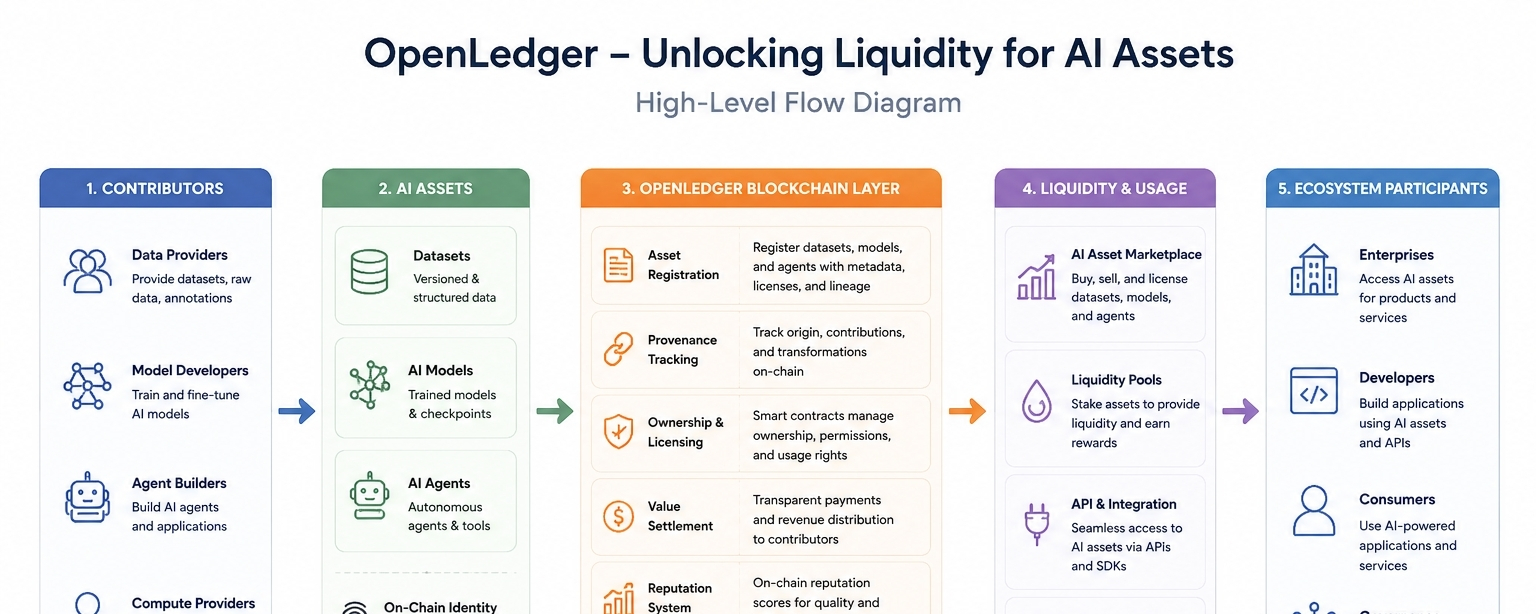
I did not expect to spend this much time thinking about OpenLedger.
At first, it looked like another project trying to combine AI and blockchain into a clean narrative. I have seen enough of those to become naturally cautious. Usually the language is polished, the promises are oversized, and after a few hours of reading, everything starts sounding strangely identical. Faster systems. Smarter infrastructure. Decentralized intelligence. Unlimited scalability. The words blur together.
But OpenLedger stayed in my mind for a different reason.
The more I looked into it, the more it felt less like a hype-driven AI project and more like an attempt to confront a problem the industry quietly avoids talking about: AI depends on enormous amounts of invisible contribution, yet the people and systems creating that value rarely remain connected to it once money starts moving.
That disconnect matters more than most people realize.
Right now, the AI world runs on layers. Datasets are collected, models are trained, feedback loops improve performance, agents execute tasks, and somewhere on top of all that, a polished product appears for the end user. But by the time the final result reaches people, almost all the underlying labor becomes invisible. The infrastructure disappears behind the interface.
And honestly, I think we have normalized that too quickly.
OpenLedger seems to be built around a simple but important idea: what if the value flowing through AI systems could remain connected to the people, data, models, and agents contributing to it?
Not in a perfect or idealistic way. Just in a more traceable way.
That distinction is important because a lot of projects in this space immediately fall into exaggerated claims about ownership and tokenization. OpenLedger feels slightly different to me because the deeper issue is not really about tokens. It is about attribution. It is about whether AI systems can become more transparent about where intelligence actually comes from and how value moves across those layers.
The more I thought about it, the more I realized how messy that problem really is.
A single AI output can involve multiple datasets, different model architectures, outside fine-tuning, human correction, and increasingly, autonomous agents making decisions across systems. Trying to track those relationships without turning the whole experience into something painfully complicated is extremely difficult. And that is probably where most infrastructure projects either succeed quietly or collapse completely.
Because theory is easy.
In theory, everyone wants fair contribution systems. In theory, transparent AI economies sound reasonable. In theory, creators, developers, and contributors should participate more directly in the value they help create.
But real systems are never that clean.
People choose convenience over ideology all the time. Companies centralize because it simplifies coordination. Users rarely care about infrastructure unless something breaks. And markets tend to reward simplicity even when simplicity hides uncomfortable truths underneath.
That is why I cannot fully buy into the optimistic version of this story yet.
OpenLedger still has difficult questions to answer. Can attribution systems work at scale without becoming bloated? Can economic incentives stay aligned once speculation enters the picture? Can decentralized AI infrastructure remain usable for normal people instead of becoming another ecosystem designed mostly for insiders?
I do not know.
But I think the project is asking more serious questions than many others in the same category.
What stayed with me most was the realization that AI infrastructure is slowly becoming a trust problem, not just a technology problem. As AI systems grow more autonomous, people will inevitably start asking harder questions. Where did this model learn its behavior? Who shaped its decisions? Which datasets influenced its outputs? Who is responsible when an agent acts incorrectly? Who benefits financially from the intelligence being produced?
Most current systems are surprisingly weak at answering those questions clearly.
That is where OpenLedger becomes interesting beyond crypto narratives. It is not simply trying to build another AI platform. It appears to be experimenting with the economic structure underneath intelligence itself.
And maybe that sounds overly philosophical, but I do not think it is.
Every major technology wave eventually runs into the same issue: once systems become important enough, people start caring less about what they can do and more about who controls them, who benefits from them, and whether the underlying structure is fair or extractive.
AI is approaching that stage very quickly.
I think that is why OpenLedger held my attention longer than I expected. Not because it promises certainty, and not because I think the model is already proven, but because it is focused on a layer of the AI conversation that still feels unresolved.
Most people are busy talking about smarter outputs.
Very few are talking about the invisible economy underneath those outputs.
And honestly, that might end up being the more important conversation.