
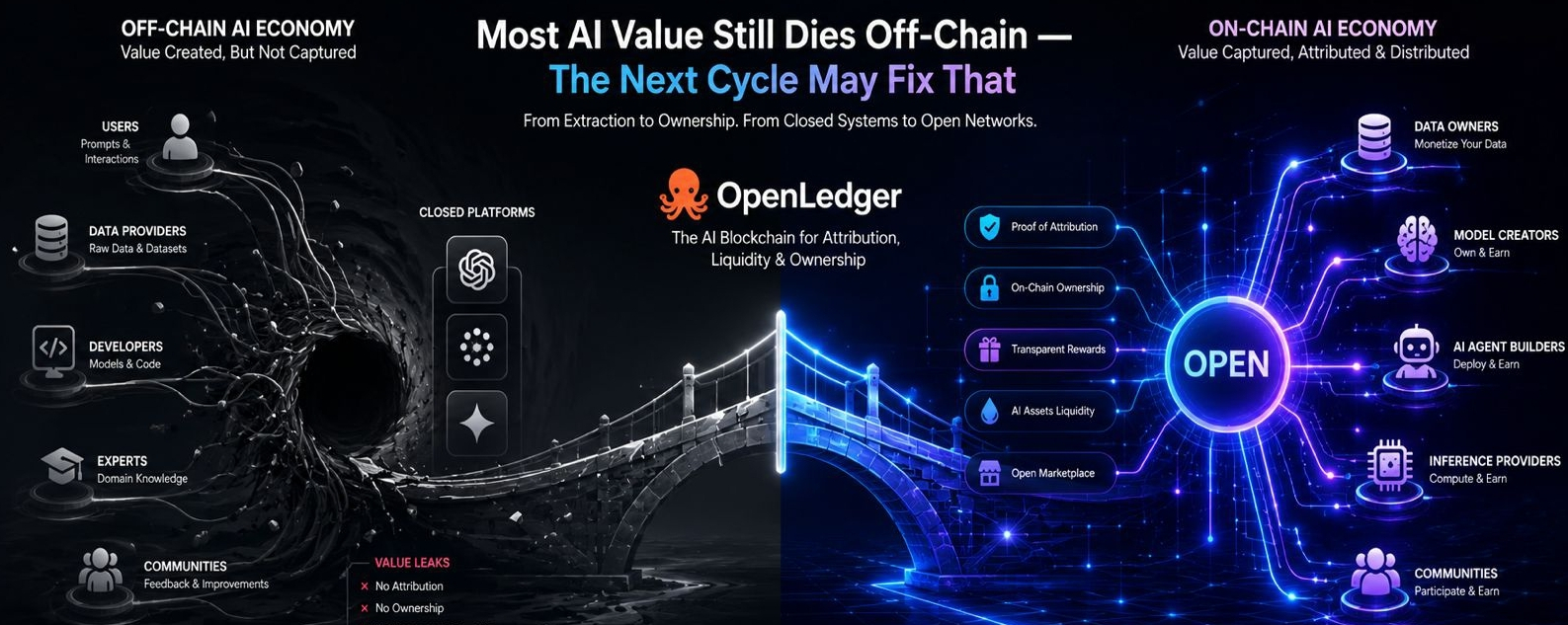
I keep thinking about how strange the current AI market really is when you look past the excitement for a minute. Everyone talks about intelligence like it is the final product, but intelligence by itself is not an economy. A model generating impressive answers does not automatically create a fair system around the people, data, and infrastructure that made those answers possible.
That is the part that still feels broken to me.
Most of the value inside AI today disappears into systems that nobody outside the platform can really see. People contribute information constantly without realizing it. Developers improve workflows. Communities refine outputs. Users train behavior patterns through interaction. Specialized datasets quietly shape model quality behind the scenes. Yet the economic rewards rarely flow back toward the edges where the value actually came from.
Everything moves inward.
That is why I think the conversation around AI and crypto has been slightly wrong for a while now. The market keeps focusing on who has the smartest model or the fastest inference or the most impressive demo, but the bigger issue may be ownership itself. Who owns the intelligence economy once AI becomes deeply embedded into everyday systems? Who gets compensated when models improve from collective participation? Who captures value when autonomous agents start operating across digital markets?
Right now, most of that value still dies off-chain.
And honestly, the longer I watch this space, the more I think the next crypto cycle around AI will revolve around fixing exactly that problem.
This is where OpenLedger started feeling different to me.
Not because “AI blockchain” is some new narrative. The market has already heard every version of that phrase imaginable. Most projects throw AI and blockchain together like branding ingredients and hope speculation fills the gaps. What caught my attention with OpenLedger was that the project seems more focused on the economic structure underneath AI rather than simply trying to build another AI product.
That distinction matters.
The way I see it, OpenLedger is trying to treat data, models, and AI agents less like invisible backend components and more like economic assets that can actually carry attribution and liquidity around them. Instead of value disappearing into closed systems, the idea is to create infrastructure where contribution itself becomes measurable and monetizable on-chain.
That sounds technical at first, but the more I sat with it, the more it started feeling like one of the more realistic directions for AI infrastructure.
Because if AI eventually becomes part of everything, then attribution becomes incredibly important. Not just morally, financially too.
The current internet was built around extraction. Platforms collect value from users, aggregate it at scale, and monetize the network effects centrally. AI accelerates that process even more because intelligence systems become stronger the more interaction they absorb. The result is an economy where millions of people contribute indirectly while ownership stays concentrated in very few places.
I do not think that structure survives forever.
At some point, contributors will want visibility into how value moves through AI systems. Developers will want transparent reward mechanisms. Communities will want ownership around the data economies they help create. Businesses will want auditable intelligence layers instead of opaque dependency chains.
That is where blockchain starts making more sense to me again.
Not because blockchain magically improves AI intelligence.
But because blockchain is good at tracking economic relationships.
And AI is heading toward a future where economic relationships around data and intelligence become impossible to ignore.
One thing I find interesting about OpenLedger is the way it leans into specialized AI ecosystems rather than pretending one giant universal model will dominate everything forever. Their broader direction around Datanets and attribution infrastructure feels closer to how the market may actually evolve over time.
I do not think the future belongs entirely to massive generalized AI systems answering every possible question on earth. More likely, we end up with thousands of specialized intelligence layers built around finance, healthcare, legal systems, logistics, trading, gaming, research, and regional knowledge environments.
When that happens, high-quality niche data becomes extremely valuable.
So do the people providing it.
And suddenly the question is no longer just “Which AI is smartest?” The question becomes “How does value flow between the people building these intelligence systems?”
That is a much bigger economic conversation than most AI projects are currently having.
OpenLedger’s whole “Proof of Attribution” direction feels connected to that shift. The idea that contributions inside AI systems can be tracked, rewarded, and economically linked back to participants changes the structure of the market itself. Instead of AI behaving like a black hole for value, it starts behaving more like a programmable network economy.
That may sound subtle, but I think it changes everything long term.
Because eventually AI agents themselves will become economically active. Trading agents, automated research systems, customer-service agents, autonomous content systems, machine-to-machine coordination layers — all of these environments will require infrastructure for payments, attribution, incentives, and settlement.
The traditional internet was never really designed for that kind of economy.
Crypto was.
Imperfectly, obviously. But conceptually, this is exactly the type of coordination problem blockchain networks were built to handle.
That is also why I pay more attention when projects tie token utility directly to actual network activity instead of abstract governance narratives. With OPEN, the token is positioned around staking, payments, AI-related transactions, contributor incentives, and broader ecosystem participation rather than existing purely as a speculative asset floating above the system.
Whether the ecosystem scales successfully is another question entirely. Infrastructure stories always sound cleaner before real adoption pressure arrives. But at least the direction feels connected to an actual problem instead of recycled market hype.
And honestly, that already makes it more interesting than most AI narratives I see circulating through crypto.
A lot of projects today still feel obsessed with monetizing attention. OpenLedger feels more focused on monetizing contribution.
That difference matters to me because I think the internet is slowly moving toward a point where contribution itself becomes the scarce asset.
Not content.
Not noise.
Not engagement farming.
Actual contribution.
The more AI expands, the more valuable trusted data, specialized knowledge, and verifiable participation become. If those things eventually gain transparent economic rails underneath them, then the infrastructure powering attribution and liquidity could end up becoming more important than the models everyone is currently chasing.
And maybe that is the real shift starting underneath the surface right now.
Not AI replacing people.
Not crypto replacing finance.
But blockchain becoming the accounting layer for intelligence itself.
Because at the moment, most AI value still disappears into closed systems before anyone outside the platform can meaningfully participate in it.
Eventually, I think the market starts demanding something more open than that.