
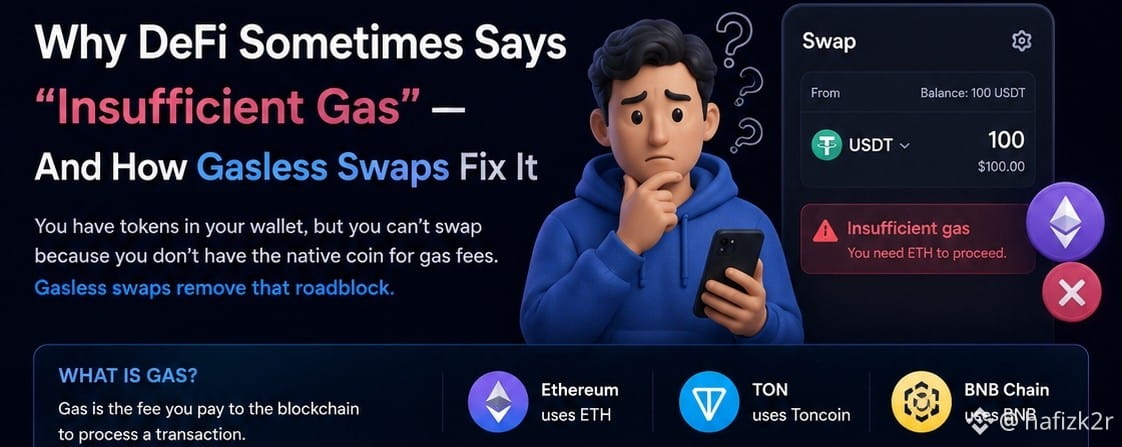
You open your wallet, ready to swap tokens.
You already have USDT sitting there. The market is moving. You click “swap”…
…and suddenly you see:
“Insufficient gas.”
For many beginners, this is one of the most confusing parts of DeFi.
“How can I have tokens but still not be able to use them?”
The answer comes down to gas fees — and a newer system called gasless execution is trying to solve that problem.
First, what is “gas” in crypto?
Every blockchain charges a transaction fee for processing actions on the network.
That fee is called gas.
Different chains use different coins for gas:
Ethereum uses ETH
TON uses Toncoin
BNB Chain uses BNB
So even if you already hold another token like USDT, you still need the network’s native coin to actually move or swap it.
That’s why someone can have $500 worth of tokens in a wallet and still be unable to make a transaction.
Why this becomes frustrating in DeFi
This issue gets worse in cross-chain environments.
Imagine this:
you have USDT on Ethereum,
but you don’t have enough ETH left for gas,
and you want to move into another ecosystem like TON.
In a normal DeFi flow, the swap simply fails before it even starts.
You now have to:
buy or transfer ETH,
wait for confirmation,
and only then continue the swap.
For beginners, this can feel unnecessarily complicated.
What gasless swaps change
New execution systems are starting to remove that friction.
One example is the new execution model introduced by ston.fi.
Instead of forcing users to submit every transaction themselves, the system allows users to simply sign an authorization message inside their wallet.
A resolver then:
submits the actual blockchain transaction,
pays the gas fee,
and completes the execution on-chain.
In simple terms:
The user signs intent.
The resolver handles execution.
That’s what people mean when they say “gasless UX.”
So how does it actually work?
Here’s the simplified version:
Step 1 — You approve the action
Inside your wallet, you sign a message authorizing the swap.
This signature proves you approved the transaction.
Step 2 — The resolver takes over
A resolver — essentially a network participant handling execution — receives the signed order.
Step 3 — The resolver pays gas
Instead of you paying ETH or another native gas coin, the resolver submits the transaction and covers the network fee.
Step 4 — Smart contracts verify everything
The blockchain contract checks your signature to confirm the action was genuinely authorized by you.
Step 5 — The swap completes
Once verified, the assets move according to the signed instructions.
A real-world example
Let’s say:
you hold USDT on Ethereum,
but your ETH balance is nearly zero.
Normally, you wouldn’t be able to swap or bridge those funds.
With a gasless execution model:
you sign the swap request,
the resolver handles the gas payment,
and the transaction proceeds without you manually funding ETH first.
The process feels much closer to using a regular app instead of managing blockchain mechanics yourself.
Why this matters
Gasless execution may sound like a small improvement, but it solves one of the biggest usability problems in DeFi.
For users, it means:
fewer failed transactions,
less confusion,
smoother onboarding,
and easier cross-chain interactions.
For builders, it creates cleaner user experiences where people focus on what they want to do instead of worrying about gas balances on multiple chains.
One important detail
At the moment, Omniston’s gasless scenarios work when the source chain is EVM-based, such as Ethereum-compatible networks.
TON-originated flows still require gas for now.
That limitation comes from how different blockchain systems handle transaction mechanics underneath.
Final thoughts
For years, interacting with DeFi has required users to constantly manage gas coins across different networks.
Gasless execution changes that experience.
Instead of forcing users to think about transaction mechanics every step of the way, newer execution layers aim to handle that complexity in the background.
The result is simple: DeFi starts feeling less like infrastructure management — and more like using an actual product.
For more info check the official blog https://blog.ston.fi/omnistons-new-execution-model-gasless-scenarios/
or the official channels 👇
STON.fi DEX: https://ston.fi/
Discord: https://discord.gg/bdmaGV6qUw
Twitter: https://twitter.com/ston_fi
Guides: https://guide.ston.fi/ru/
ENG Telegram: https://t.me/stonfidex