
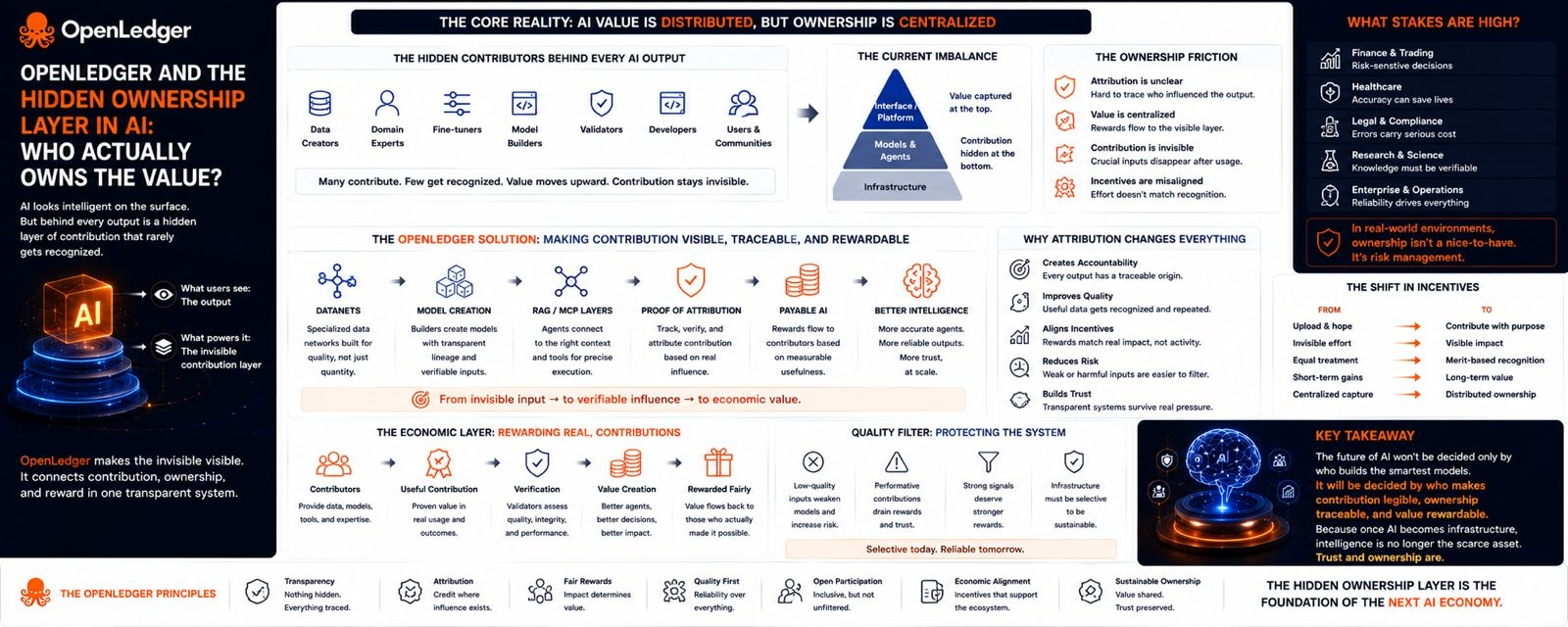
At first, @OpenLedger looked like another AI-blockchain idea trying to organize data, models, and agents into a more useful system. It looked practical. Almost straightforward. AI needs data. Models need improvement. Contributors need rewards. Blockchain can make records traceable. The structure seemed easy to understand from the outside.
But the more I looked at it, the more one thing became difficult to ignore. The real issue is not only whether AI models become more powerful. The deeper issue is who owns the value that makes them powerful.
That is where the hidden layer appears.
AI systems look intelligent on the surface, but they rarely show the full chain of contribution behind that intelligence. A model response may appear clean, fast, and complete. But behind it are datasets, human feedback, validators, fine-tuners, builders, domain experts, communities, and repeated interaction patterns. The output feels singular. The contribution is distributed.
That imbalance matters.
The issue is not simply model performance. It is ownership, attribution, and value recognition. Most AI systems absorb contribution quietly. Data improves the model. Feedback sharpens the system. Builders create utility. Communities generate context. But once the final product becomes useful, the economic value usually moves toward the most visible layer.
The interface wins. The model wins. The platform wins.
The contributor often disappears.
That is the friction OpenLedger is trying to expose. Not by treating AI as only a technical product, but by treating data, models, and agents as economic assets that need clearer ownership logic. That changes the meaning of the system. It is not just asking how AI can become smarter. It is asking how AI value can become traceable.Different thing.
I noticed this most clearly when thinking about how a specialized AI model actually becomes useful under pressure. Imagine a builder creating an AI agent for market research. At the start, the agent looks like a normal tool. It receives data, retrieves context, generates analysis, and produces answers. But after repeated use, differences begin to appear. Some datasets improve the agent’s judgment during uncertain market conditions. Some expert inputs help it avoid shallow conclusions. Some community signals add useful context. Other inputs only create noise.
On the surface, all of these contributions may look similar. Just information entering a system. But operationally, they are not equal. Some contributions improve reliability. Some increase risk. Some reduce ambiguity. Some make the agent more fragile.
Not broken Not obvious. Just revealing the real cost.
This is where Proof of Attribution becomes more than a reward mechanism. It becomes a way of making influence visible. If a specific dataset, model component, validator, or contributor improves an AI output, the system needs a way to recognize that influence. Not emotionally. Structurally. Because without attribution, AI turns distributed contribution into centralized value capture.
That distinction matters.
The obvious interpretation is that OpenLedger helps monetize AI assets. The deeper interpretation is that it tries to reorganize the ownership layer beneath AI. Data is no longer treated as passive input. Models are no longer treated as isolated products. Agents are no longer just tools. They become part of a value chain where contribution, usage, and reward are connected.
This naturally changes incentives. Once contributors know their data can be recognized, they behave differently. Once validators know quality matters, they become more selective. Once builders know useful models can carry economic value, they focus less on generic output and more on dependable performance. Repeated pressure forces the system to separate useful contribution from performative participation.
And honestly, some of that is rational.
AI infrastructure cannot scale if every input is treated equally. Open participation may attract activity, but reliability requires filtering. A serious system has to become opinionated about quality. It has to reward what improves outcomes and reduce what creates operational friction. Otherwise, the reward layer becomes noise, and trust becomes weak.
The central tradeoff is clear: do you reward broad participation or dependable contribution?
Broad participation gives the network energy. Dependable contribution gives it credibility. Too much openness can weaken quality. Too much selectivity can narrow access. That is the systemic tradeoff behind any ownership layer built for AI.
OpenLedger becomes more interesting once this tradeoff is visible. It is not only building infrastructure around AI. It is testing whether AI value can be distributed without losing reliability, speed, and trust. That is a difficult balance. Attribution can become messy. Governance can become political. Rewards can attract manipulation. Some valuable contributions may be missed, while some weak ones may be overvalued.
But these are not secondary problems. They are the real problems.
The future of AI will not only depend on who builds the largest model or the fastest agent. It will depend on who can make contribution visible enough to trust, traceable enough to audit, and valuable enough to reward fairly. Intelligence may create the output, but ownership decides who benefits from it.
Because once AI becomes infrastructure, the most important layer may not be the model itself.
It may be the hidden ownership layer beneath it.