
Most AI conversations today still feel stuck at the surface level. Every week the industry jumps from one model launch to another, one benchmark to another, one viral demo to another. Everyone keeps talking about how smart AI is becoming, but very few people are paying attention to the infrastructure quietly forming underneath all of it. That is honestly why OctoClaw caught my attention.
At first glance, it may look like just another AI tool connected to Web3, but the deeper I went into the concept, the more it felt like something much bigger. It no longer feels like AI that simply answers questions. It feels like AI slowly moving toward execution itself. And I think that is the part many people still underestimate.
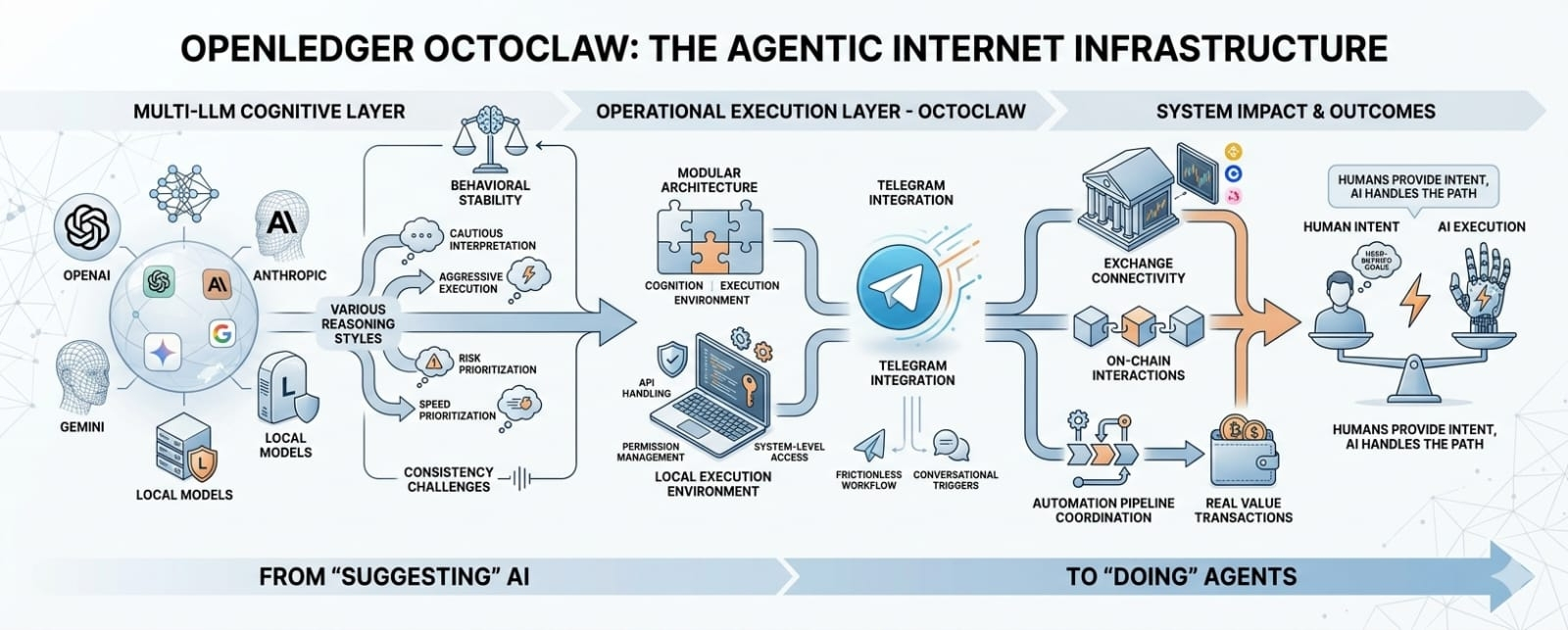
What OpenLedger seems to be exploring through OctoClaw is not just another chatbot or assistant. It feels more like an attempt to create an operational layer between AI, automation, and blockchain infrastructure. A place where AI does not only generate responses, but can actually trigger actions, interact with systems, coordinate workflows, and eventually execute things tied to real outcomes, real transactions, and real value.
And honestly… that changes the entire conversation.
Because once AI moves from “suggesting” into “doing,” the question becomes much more uncomfortable. Who actually holds the control at that point?
The whole idea behind OctoClaw appears deeply connected to what many people now call the “Agentic Internet.” A future where humans no longer manually handle every digital process themselves. Instead, humans provide intent while AI handles the path between intention and execution. Before, people used APIs directly. Now AI itself is beginning to call APIs, manage tools, connect systems, and potentially make decisions dynamically in real time. Seeing this shift happen feels strange because it almost feels like the internet itself is quietly changing shape underneath us.
One thing that stood out immediately was the multi-LLM architecture. Instead of depending entirely on one AI provider, the framework reportedly supports multiple models including OpenAI, Anthropic, Gemini, and even local models. On paper, this sounds extremely smart because the industry changes fast. One model dominates today, another dominates tomorrow. AI moves too quickly for long-term dependency on a single provider to feel safe.
But at the same time, this flexibility introduces another issue that people do not talk about enough: consistency.
Different models think differently. Even with the same prompt, one model may behave cautiously while another behaves aggressively. One prioritizes reasoning, another prioritizes speed. One interprets risk differently from another. In simple chatbot environments this may not matter much, but when execution enters the picture, consistency suddenly becomes extremely important.
Imagine AI interacting with financial systems, exchanges, wallets, or automation pipelines. Even a small difference in reasoning can completely change execution outcomes. That means the challenge is no longer just intelligence. The challenge becomes behavioral stability. And honestly, I think this is one of the biggest hidden problems the entire agentic AI industry will eventually have to solve.
Another thing that makes OctoClaw interesting is how modular the architecture seems. It does not appear to treat intelligence as fixed. Instead, the AI layer itself becomes replaceable and flexible. Almost like plug-and-play cognition. That sounds futuristic, but it also feels like a very realistic direction because AI systems are evolving too fast for static infrastructure to survive long-term.
The local execution design is another part that feels both impressive and slightly uncomfortable at the same time. Things like local API handling, local permissions, and even system-level access initially sound risky. Especially when sudo permissions or direct machine-level interactions become involved. Most users naturally become cautious the moment software requests deeper system access.
But there is another side to this.
If execution and data handling genuinely remain local instead of constantly passing through centralized servers, then privacy and ownership improve significantly. In a strange way, the system seems to push responsibility back toward the user instead of hiding everything behind centralized infrastructure. That aligns much more closely with the original philosophy behind Web3 than many projects currently operating in the AI space.
Still, this creates an important tradeoff. The more local power users receive, the more responsibility also falls onto them. And not every user is prepared for that level of operational awareness.
The Telegram integration honestly changes the feeling of the entire system even more. Because suddenly the user experience becomes extremely frictionless. Whether someone is sitting on desktop or mobile almost stops mattering. A simple message can potentially trigger actions, workflows, or even on-chain interactions.
And that is both powerful and dangerous at the same time.
Because financial systems were traditionally designed with friction intentionally built in. Confirmation screens, approval steps, multiple layers of verification — these things exist for a reason. They slow people down before money moves. But conversational AI removes friction aggressively. Sending a message feels casual. Executing trades should probably never feel casual.
That tension becomes very important.
As systems become simpler to use, they also become easier to misuse.
The exchange connectivity layer is probably where the entire concept becomes most serious. Once AI connects directly to trading infrastructure through APIs like Binance or similar systems, it stops being just an assistant. It becomes an active participant. Spot execution, margin interaction, conversions, automated actions — suddenly AI is no longer analyzing markets from the outside. It is operating inside them.
And that honestly creates one of the strangest questions in modern technology right now.
If AI can monitor markets, analyze conditions, make decisions, and execute trades automatically… then where exactly does the human role remain?
Is the human still the decision-maker?
Or is the human slowly becoming more of an observer supervising autonomous systems operating underneath?
I do not think the industry fully understands how important this psychological transition actually is.
What I found surprisingly positive though is that the warning sections around OctoClaw reportedly feel more honest than many other AI projects. Instead of pretending the system is perfectly safe, there seems to be direct acknowledgment of risks like API exposure, misuse possibilities, permission dangers, and execution vulnerabilities. That honesty matters because systems this powerful should never be presented like harmless productivity apps.
Once AI receives execution capability, security stops being a secondary issue. It becomes the core issue.
Because eventually users will not ask whether the AI is intelligent enough. They will ask whether it can be trusted when they are not watching.
And that may become the defining challenge of the entire agentic internet era.
The more I looked at OctoClaw, the less it felt like a finished product and the more it felt like an evolving coordination layer. A system attempting to merge AI, Web3, automation, user intent, APIs, and execution environments into one operational flow. That is much bigger than most current AI projects are attempting.
At the same time, it still feels early.
Very early.
Because even though the architecture sounds structured on paper, real-world systems always collide with friction, unpredictability, trust issues, security risks, and human behavior. Those things never disappear just because AI becomes more advanced.
And maybe that is the most important realization here.
Projects like OctoClaw should probably not be viewed as completed products yet. They should be viewed as experiments shaping the direction of future infrastructure. Because what OctoClaw is today may look completely different a year from now.
But the direction itself already feels clear.
AI is slowly moving beyond assistance.
It is moving toward action.
And once the gap between decision and execution becomes almost invisible, the internet itself starts changing in ways most people have not fully processed yet.
Maybe that future still feels far away.
But systems like this make it increasingly difficult to pretend it is not already beginning.
