
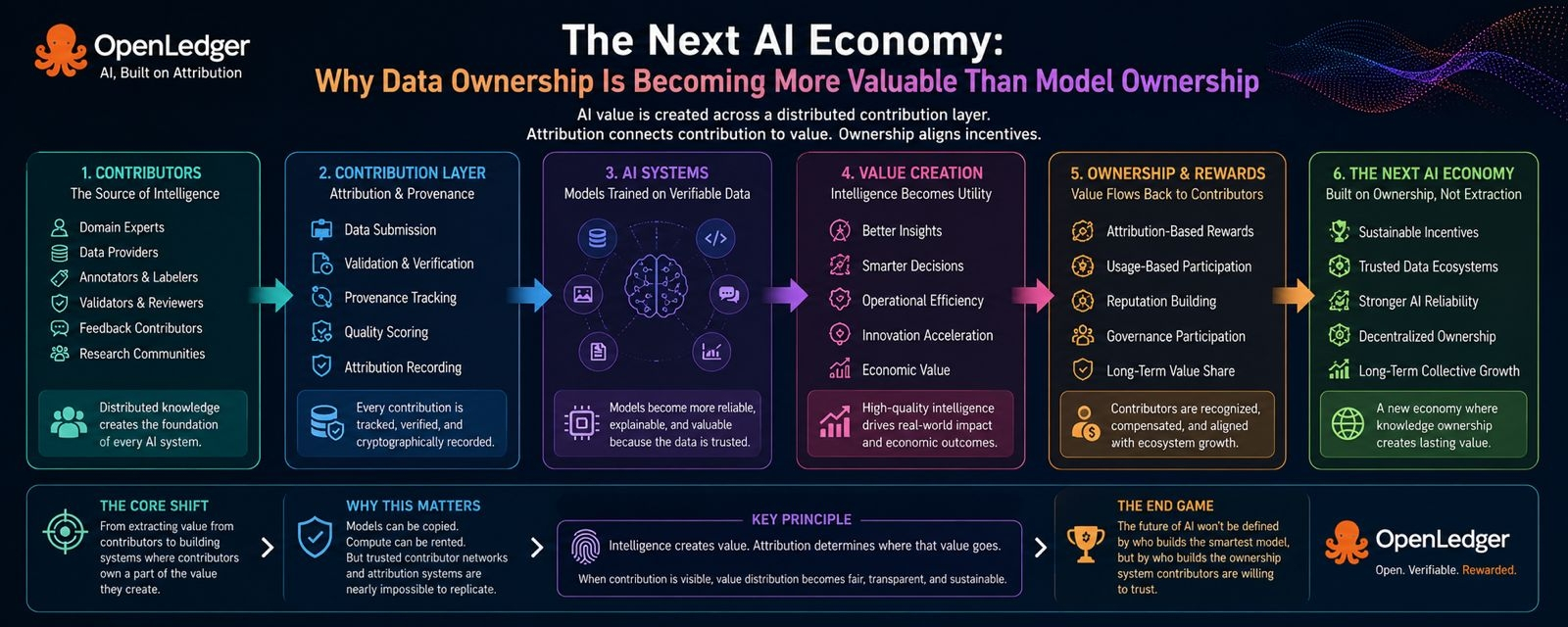
At first, AI looked like a competition of intelligence. Bigger models. Better outputs. More parameters. Faster inference. The assumption seemed obvious. Whoever built the most capable model would capture the most value. But the more I looked at the economics behind modern AI systems, the more a deeper asymmetry became difficult to ignore. The real issue is no longer intelligence alone. It is ownership.
AI’s rapid growth has created enormous value, yet most conversations remain focused on models, compute infrastructure, and algorithmic breakthroughs. Those things matter. They deserve attention. But they also sit on top of something that often receives far less scrutiny: the contribution layer.
Every AI model appears singular from the outside. A prompt goes in. An answer comes out. The interaction feels self-contained. It is not.
Behind every useful response sits an accumulation of datasets, human feedback, domain expertise, labeling decisions, correction cycles, and repeated interactions contributed by people who rarely appear in the final product. The intelligence looks centralized. The contribution is distributed. That hidden layer changes how the entire system should be interpreted.
The more I studied AI ecosystems, the more one thing became difficult to ignore. The biggest friction is not model capability. It is the growing gap between value creation and value ownership. Most AI systems are extremely efficient at absorbing contribution. They learn from data. They improve from feedback. They benefit from expertise. But the economic rewards rarely flow back through the same channels. Not broken. Not obvious. Just revealing the incentive structure underneath the system.
I noticed this most clearly when comparing different forms of AI development. Imagine two environments. In the first, thousands of contributors continuously provide domain-specific knowledge, corrections, validation, and training data. The model improves. The platform becomes more valuable. Usage grows. In the second, the same process occurs, but contributors can trace how their participation improves outcomes and can participate in the value generated by those improvements. The intelligence may look similar. The economics are not.
Over time, the first environment treats contribution as an input. The second treats contribution as an asset. That distinction matters.
Most discussions frame data as fuel. The metaphor sounds reasonable until you examine what actually happens under pressure. Fuel is consumed. Contribution is not. High-quality data often becomes more valuable after it has been used because its influence compounds across models, applications, and future iterations. Specialized expertise in healthcare, finance, law, engineering, or scientific research does not disappear when a model learns from it. Instead, it creates a persistent layer of economic value. What changes is who captures that value.
This is where attribution becomes important. Not because attribution is a technical feature. Because attribution changes incentives. Without attribution, contributors become invisible participants inside someone else’s economic system. Their knowledge creates value, but the connection between contribution and outcome gradually disappears. With attribution, the relationship changes. The system begins to recognize where intelligence originates rather than only where intelligence appears.Different thing.
Most people think attribution is primarily about transparency. I increasingly think it is about economic accountability. The issue is not simply knowing where data came from. The issue is understanding who should participate when that data repeatedly generates value. Once attribution becomes reliable, contribution becomes measurable. Once contribution becomes measurable, ownership becomes negotiable. And once ownership becomes negotiable, the economics of AI begin to change. The conversation moves beyond models. It moves toward incentives.
This shift becomes even more visible when observing specialized AI systems. General intelligence attracts attention. Specialized intelligence often creates the most economic value. A financial dataset curated over years. A medical dataset refined by experts. A research community continuously improving domain knowledge. These are not simply collections of information. They are coordinated networks of expertise. The model may deliver the answer. The network creates the advantage.
That distinction matters too.
What stood out to me is that many future AI economies may not be organized around models at all. They may be organized around data communities, attribution systems, validation networks, and ownership structures. The intelligence layer remains important. The coordination layer becomes strategic.
And honestly, some of that is rational.
AI systems need reliable inputs. They need trusted contributors. They need incentives that encourage quality rather than noise. A system that cannot distinguish between valuable contribution and low-quality contribution eventually struggles to scale. Reliability becomes difficult. Trust declines. Coordination costs increase. As pressure grows, systems naturally become more selective. Not because they want to exclude participation. Because they need dependable outcomes.
That creates a serious tradeoff.
Do you optimize for open contribution or verified contribution? Do you maximize participation or maximize reliability? Do you reward everyone equally or reward demonstrated value creation?
These are not technical questions. They are governance questions. Economic questions. Ownership questions. And the answers will likely shape the next generation of AI infrastructure.
The broader consequence is that AI begins to look less like a software industry and more like an ownership economy. The visible product remains intelligence. The invisible competition becomes value distribution. Who contributed? Who validated? Who improved the outcome? Who should participate when value is created? Those questions become increasingly difficult to avoid.
The more I look at modern AI systems, the less I see models as the final destination. I see them as coordination mechanisms sitting on top of larger contributor networks. That changes the meaning of ownership. It also changes the meaning of value.
For years, the assumption was that the most important asset in AI would be the model itself. I am no longer convinced that is true. Models can be replicated. Compute becomes more accessible. Techniques spread across the industry. But trusted contributor networks, high-quality data ecosystems, and reliable attribution systems are much harder to reproduce.
Intelligence creates value. Attribution determines where that value goes. And the next stage of the AI economy may not be defined by who builds the smartest model. It may be defined by who builds the ownership system that contributors are willing to trust.