
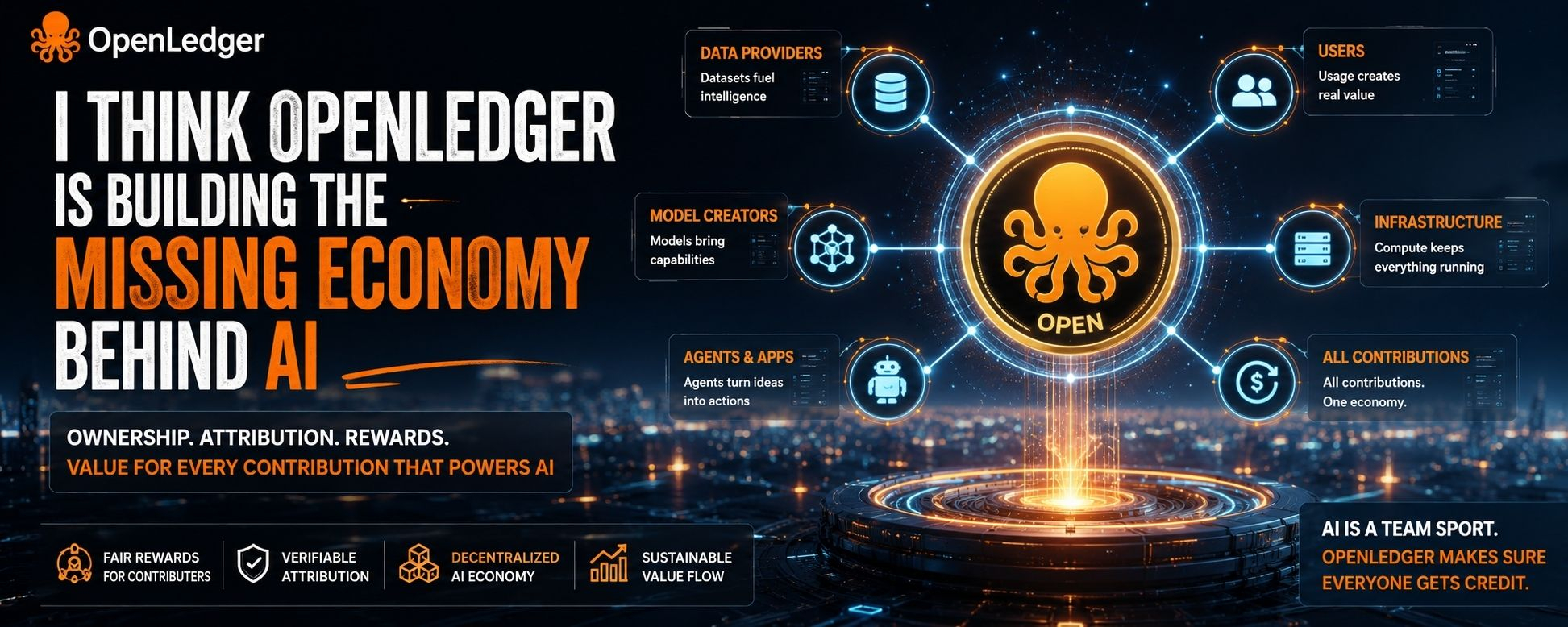
I kept thinking about one strange detail while researching OpenLedger: most AI systems today can tell you what they created, but almost none can tell you who actually helped create it.
That sounds like a small issue until you realize the entire AI economy is quietly built on invisible labor. Datasets are scraped from communities, models are refined by developers nobody remembers, prompts evolve through users, and infrastructure providers keep the system alive in the background. Yet once an AI product succeeds, value usually concentrates in one place while everyone upstream disappears from the story.
OpenLedger is trying to change that dynamic, and honestly, that is what makes it more interesting than the average “AI blockchain” narrative floating around crypto right now.
The easy way to describe OpenLedger would be to call it an AI-focused blockchain. But that framing feels incomplete. The deeper idea is that it wants to turn AI into something closer to an economic supply chain where contributions can be tracked, measured, and monetized instead of swallowed by black-box systems.
While reading through its architecture and ecosystem activity, I realized the project behaves less like a traditional Layer-1 and more like logistics software for machine intelligence. That may sound abstract, but history already gave us a similar example. Before shipping containers became standardized, global trade was chaotic and expensive because every port handled goods differently. Containers did not invent trade — they standardized coordination around it.
OpenLedger seems to be attempting a similar standardization layer for AI contributions.
Instead of asking only “which model produced this output,” the network asks a more uncomfortable question: “which people, datasets, agents, and systems made this possible, and how should value flow back to them?”
That is a very different direction from most AI crypto projects chasing compute narratives.
One thing that stood out recently was the launch of the OPEN Mainnet. A lot of projects announce infrastructure long before it exists in practice, but this moved OpenLedger from theory into an operational environment where attribution and settlement could actually happen on-chain. That matters because ideas around AI royalties and contributor economics sound attractive in presentations, but they only become meaningful once the accounting layer becomes real infrastructure instead of branding.
Around the same period, OpenLedger expanded deeper into model deployment and marketplace tooling through initiatives tied to modular AI serving systems like OpenLoRA. Most people looked at this as another ecosystem expansion update, but I think the bigger signal is what it says about the future structure of AI itself.
There is a growing assumption that AI will eventually consolidate into a handful of dominant mega-models. OpenLedger seems to be betting on the opposite outcome: thousands of smaller, specialized models interacting together like interconnected suppliers in an industrial economy. If that future arrives, attribution suddenly becomes far more important because value creation becomes fragmented across many contributors rather than centralized inside one system.
The partnership with Story Protocol also caught my attention for a reason that many traders probably overlooked. Everyone talked about licensing and intellectual property, but the more important implication may be regulatory survival. AI regulation is slowly moving toward transparency around training data and content provenance. If governments or enterprises eventually require verifiable attribution standards, networks already designed around provenance tracking could gain structural advantages.
Ironically, tighter regulation — something crypto usually fears — might actually strengthen OpenLedger’s positioning.
Another interesting detail was the project’s buyback initiative after reallocating ecosystem incentives. On the surface, buybacks are easy to dismiss because crypto has turned them into marketing tools. But in this case, the more revealing part was the shift in priorities. OpenLedger appeared more focused on attracting contributors and ecosystem participation than simply defending token optics. That tells me the team understands something many AI-token projects still ignore: without sustainable contributor incentives, decentralized AI ecosystems eventually become empty shells.
The numbers surrounding the network also reveal an unusual pattern.
Millions of nodes reportedly joined during testnet activity. Tens of millions of transactions flowed before the ecosystem fully matured. Thousands of AI models entered the environment early. The project also structured over 60% of supply toward community and ecosystem allocations instead of concentrating ownership narrowly.
Individually, these statistics are not revolutionary. Together, though, they point toward a system optimized for participation density rather than scarcity theater.
And that leads to the biggest misconception around OPEN.
Most people analyze it like a speculative AI token competing against other AI chains.
I increasingly think that comparison misses the real picture.
OpenLedger may actually compete more with data licensing systems, AI marketplaces, and attribution infrastructure providers than with blockchains themselves. The real product here is not “decentralized intelligence.” The real product is economic coordination around intelligence production.
That is why the token design matters.
OPEN is not only used for gas fees or transactions. It also acts as the settlement layer connecting datasets, inference usage, model deployment, and contributor rewards. In theory, when models generate value, the network routes incentives back toward the participants whose contributions enabled those outputs.
It almost resembles streaming royalties in music platforms, except applied to machine intelligence instead of songs.
But there is also risk hidden inside that vision.
Attribution sounds elegant conceptually, yet neural networks are messy systems. Measuring exactly how much influence a dataset or model component had on an output becomes increasingly difficult as architectures grow more complex. If attribution quality weakens, the fairness of the reward system weakens too.
That challenge is much harder than building another fast blockchain.
There is also the issue of token emissions and incentive sustainability. AI ecosystems require constant participation from developers, contributors, and infrastructure operators. Keeping those groups active often means distributing tokens aggressively. The difficult balance is whether genuine demand from AI usage can eventually absorb those emissions instead of depending on speculative momentum.
Personally, the most important signal going forward will not be price.
I would rather watch whether real paid inference demand grows inside the ecosystem. I would watch whether contributors begin bringing proprietary datasets instead of recycled public information. And I would pay close attention to whether enterprises start integrating attribution infrastructure into commercial AI workflows.
Those are the signals that would tell me OpenLedger is evolving from a crypto narrative into actual economic infrastructure.
After digging deeper into the project, I walked away thinking OpenLedger is less about AI itself and more about ownership inside AI economies. Most people still treat artificial intelligence as a software race. OpenLedger is operating as if the bigger opportunity lies in building the accounting rails underneath that race.
That distinction may end up mattering more than the market currently realizes.
