
There’s something unusual about the AI industry that became more obvious to me over time.
Most people focus on models, compute, inference speed, and which AI system is outperforming the others. But the deeper I look, the more it feels like those are only the visible layers of a much larger machine.
The real foundation of AI isn’t just computation.
It’s data.
And more importantly, the humans behind that data.
The modern AI economy is built on an enormous amount of invisible human labor: writers, labelers, posters, debaters, coders, responders, and ordinary internet users whose daily behaviors collectively shaped the datasets models learn from today.
Yet despite that, most of the value tends to accumulate at the model layer, while the people generating the underlying data almost disappear from the economic equation.
That’s what initially made me pay attention to OpenLedger.
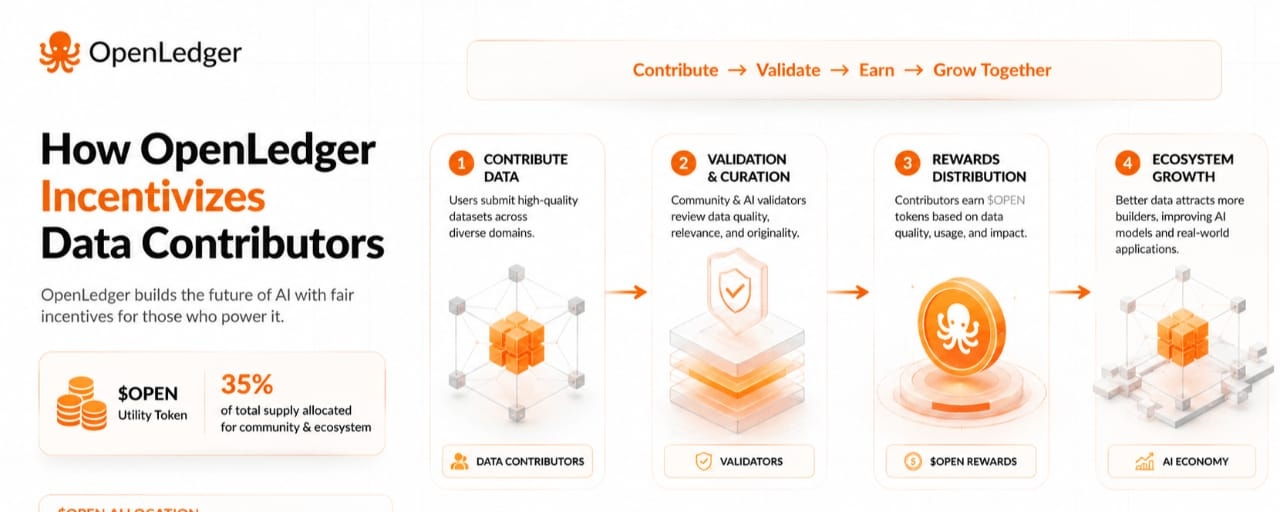
Not because they mention AI or blockchain together — the market has seen countless projects do that — but because they seem to approach data contributors as actual economic participants rather than passive sources of raw material.
And that’s a surprisingly radical shift.
For the last two decades, the internet has largely operated through silent extraction: users create data, platforms aggregate it, models absorb it, and value concentrates at the ownership layer while contributors themselves remain mostly invisible.
What OpenLedger appears to be exploring is a different structure entirely.
Not simply “paying for data,” but building attribution mechanisms capable of tracing how specific data contributes to model outputs or performance.
And that’s an incredibly difficult challenge.
Because once data enters a model, it often dissolves into the system like water poured into the ocean. After training, almost nobody can clearly determine which inputs created what value.
Without attribution, incentives inevitably become misaligned.
That’s why OpenLedger feels more interesting than a typical data marketplace narrative. Data marketplaces have existed for years, and most failed. The issue was rarely the availability of data — it was the absence of a credible system capable of redistributing value back to contributors.
From my perspective, OpenLedger seems to be trying to transform the data layer itself into an economy with stronger ownership and participation logic.
And once contributors become stakeholders rather than disposable resources, the dynamics of the system begin to change.
Data quality stops being purely a scaling issue and becomes tied to reputation, incentives, and long-term coordination.
The deeper I think about it, the more I feel OpenLedger isn’t simply building AI infrastructure in the traditional sense.
They may actually be trying to redefine the relationship between humans and the data they generate.
And that raises much bigger questions.
If data starts resembling labor, then who truly owns collective data?
If millions of people indirectly shape a model, how should the economic upside be distributed?
Can attribution systems ever become genuinely fair, or will they eventually be controlled by whoever owns the infrastructure?
And perhaps most importantly: do people actually want to live in a world where every online interaction becomes economically measurable?
That may be the most fascinating part of all.
For years, the Web2 internet conditioned people to contribute unconsciously — posting, reacting, commenting, and continuously training algorithms without ever thinking about the value being created.
But AI is making that hidden value increasingly impossible to ignore.
And once data becomes consciously recognized as an asset, the relationship between users, platforms, and AI systems changes entirely.
Whether OpenLedger succeeds or not may ultimately be secondary.
Because the larger issue is unavoidable: the AI industry will eventually have to solve the coordination problem at the data layer, not just the model layer.
In the end, models are simply large-scale reflections of human behavior.
And what may quietly be emerging beneath all of this is not just a new data economy, but a renegotiation between the internet and the people who unknowingly built it.