
I did not expect OpenLedger to stay in my head this long.
At first glance, it looked familiar. Another AI-meets-blockchain project. Another attempt to connect decentralized systems with machine intelligence. I almost moved past it quickly because, honestly, the space is full of ideas that sound profound for five minutes and then collapse into recycled marketing language.
But this one kept bothering me in a different way.
The deeper I read, the more I realized OpenLedger is not really trying to sell a futuristic fantasy. It is trying to solve a quiet problem that most people still do not fully acknowledge. If AI systems are built using human data, human behavior, shared knowledge, and distributed computational work, then who actually owns the value that comes out the other side?
Right now, the answer is messy.
A model gets trained using enormous amounts of information pulled from countless places. A dataset improves performance somewhere in the background. An AI agent produces useful outputs. Companies build products on top of all of it. Money flows upward. Meanwhile, the people and systems that contributed to the intelligence itself often disappear into the process entirely.
That imbalance is becoming harder to ignore.
And I think that is where OpenLedger becomes interesting.
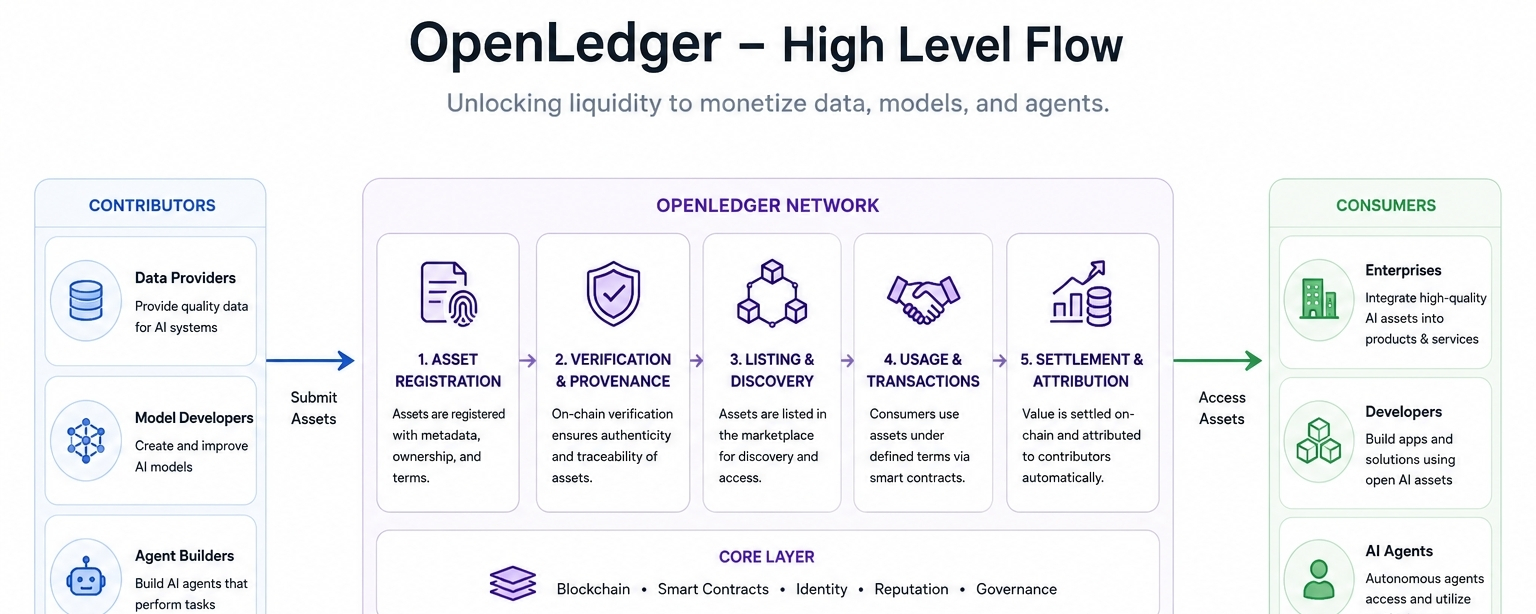
The project seems to revolve around a simple but difficult idea: AI assets should not remain invisible. Data, models, and agents should be trackable, attributable, and economically recognized instead of being absorbed into black-box systems where nobody can clearly explain where value originated.
The strange thing is that the more I thought about it, the less this felt like a blockchain conversation and the more it felt like a conversation about memory and fairness.
Because modern digital systems are surprisingly bad at remembering contribution.
The internet became enormous by turning participation into fuel. Social platforms grew from user content. AI systems now grow from collective information and interaction. But somewhere along the way, contribution became detached from ownership. Most people accepted that tradeoff because the systems were convenient, useful, and fast-moving.
AI makes that tension bigger.
Once intelligence itself becomes part of economic infrastructure, the question changes. It is no longer just about what AI can do. It becomes about who helped create its capabilities and who deserves to benefit from them.
I think OpenLedger is trying to build around that exact problem.
Not perfectly. Not completely. But seriously enough that it feels different from the usual surface-level narratives.
What stood out to me most is that the project treats AI components almost like economic building blocks instead of isolated technologies. Data is not just raw material. Models are not just software. Agents are not just tools. Each one becomes part of a system where contribution may eventually need to be measured, verified, and rewarded.
That sounds straightforward until you think about how complicated it actually is.
How do you measure the value of a dataset inside a massive AI model?
How do you prove which contribution mattered most?
How do you avoid turning attribution into a manipulated game?
And what happens when intelligence itself becomes collaborative in ways humans can barely untangle?
These are not technical side questions. They are the core problem.
Honestly, I do not think anyone has fully solved this yet.
That is why I find OpenLedger more intellectually interesting than emotionally exciting. The project feels less like a polished answer and more like an attempt to confront a difficult reality early before it becomes unavoidable later.
And maybe that matters more.
Because most of the current AI industry still operates through concentration. Data flows inward. Models stay controlled. Value accumulates around a small number of platforms. Even when companies talk about openness, the economic structure underneath often remains highly centralized.
OpenLedger appears to imagine a different structure where AI systems can exist inside a more transparent economic layer. A place where contribution is visible enough to matter.
Whether that vision fully works is another question.
I think skepticism is necessary here because the history of blockchain is full of projects that understood the philosophy better than the execution. Attribution sounds good in theory, but reality is messy. Human contribution is messy. Machine learning itself is messy.
There is also the risk that systems built around incentives eventually become overwhelmed by speculation instead of utility. Crypto has seen this happen repeatedly. Good ideas sometimes get buried under financial noise long before they mature into useful infrastructure.
And adoption itself may be one of the hardest parts.
Most people do not care about provenance until something breaks. Most companies prioritize speed before transparency. The market often rewards convenience long before it rewards fairness. So even if OpenLedger is directionally correct, it may still face the problem of arriving earlier than the broader ecosystem is ready for.
But even with all those uncertainties, I keep returning to the same thought.
The real significance of projects like this may not be whether they dominate markets. It may be that they are forcing people to think seriously about what happens when intelligence becomes an economic system instead of just a technological one.
Because once AI starts generating real value at scale, society eventually has to answer difficult questions about ownership, contribution, trust, and accountability.
Where did the intelligence come from?
Who shaped it?
Who benefits from it?
Who gets forgotten in the process?
Right now, the answers to those questions are surprisingly weak.
And maybe that is why OpenLedger stayed with me longer than I expected. Not because it promises certainty, but because it is trying to build around uncertainty honestly instead of pretending the problem does not exist.