
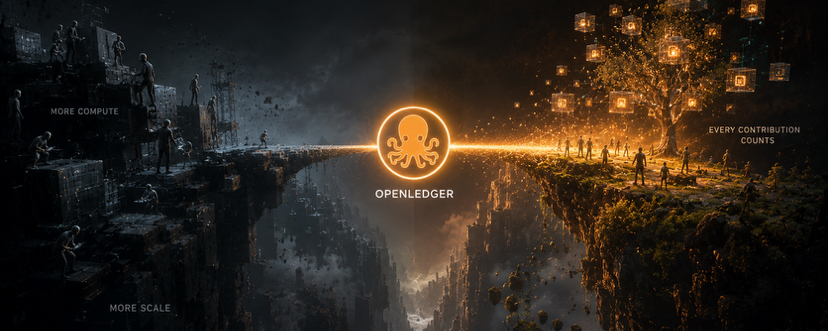
Most AI ecosystems are solving the wrong bottleneck.
The more time I spend exploring AI, the more uncomfortable that thought becomes.
Everywhere I look, the race seems identical.
More compute.
More powerful models.
More autonomous agents.
More infrastructure.
The assumption behind all of it feels obvious:
if intelligence keeps improving, everything else will eventually take care of itself.
But honestly, I’m starting to think intelligence may no longer be the hardest thing to scale.
Human coordination might be.
That realization didn’t come from reading a research paper.
It came from watching what happens inside growing ecosystems.
The technology improves.
The infrastructure expands.
Yet somehow the people underneath it become harder to see.
Contributors blend into the background.
Communities become more transactional.
Participation becomes temporary.
And slowly, the ecosystem starts feeling less like a community and more like a machine optimizing itself.
That disconnect feels bigger than most people realize.
Because intelligence creates value.
But coordination determines whether that value remains sustainable.
Without coordination, even powerful ecosystems start showing cracks:
• contributors lose visibility
• incentives become misaligned
• ownership becomes unclear
• trust weakens over time
The infrastructure may continue scaling.
The social layer underneath it doesn’t always scale with it.
And that’s the part I think many AI projects still underestimate.
That’s one reason OpenLedger stayed in my head longer than I expected.
Not because it promises the smartest AI.
Not because it claims to build the biggest ecosystem.
But because the project seems focused on problems most ecosystems treat as secondary:
attribution,
contribution visibility,
persistent participation,
decentralized datasets,
and coordination between humans, data, and systems.
At first, those topics sound less exciting than AGI.
They don’t generate dramatic headlines.
They don’t create the same hype as a breakthrough model.
But the more I think about it, the more important they seem.
Because future AI economies won’t only depend on intelligence.
They’ll depend on whether millions of contributors can remain connected to the value they help create.
And that’s where things get complicated.
What happens when datasets are built by thousands of people?
What happens when agents interact autonomously?
What happens when value is created across networks so large that nobody can clearly identify who contributed what?
Those questions feel much harder than simply making a model smarter.
In fact, they may become the defining challenge of the next phase of AI.
Maybe that’s why so many ecosystems already feel fragmented despite having impressive technology.
They’re solving for intelligence.
But they’re not solving for coherence.
And without coherence, growth eventually starts working against the ecosystem itself.
Maybe I’m wrong.
Maybe intelligence is still the only thing that matters.
Maybe coordination problems will solve themselves naturally.
But honestly, the deeper AI scales, the less convinced I become.
Because some ecosystems already look technologically advanced.
Yet socially fragile underneath.
And if coordination turns out to be the real bottleneck all along…
how many AI ecosystems are actually preparing for it today?