
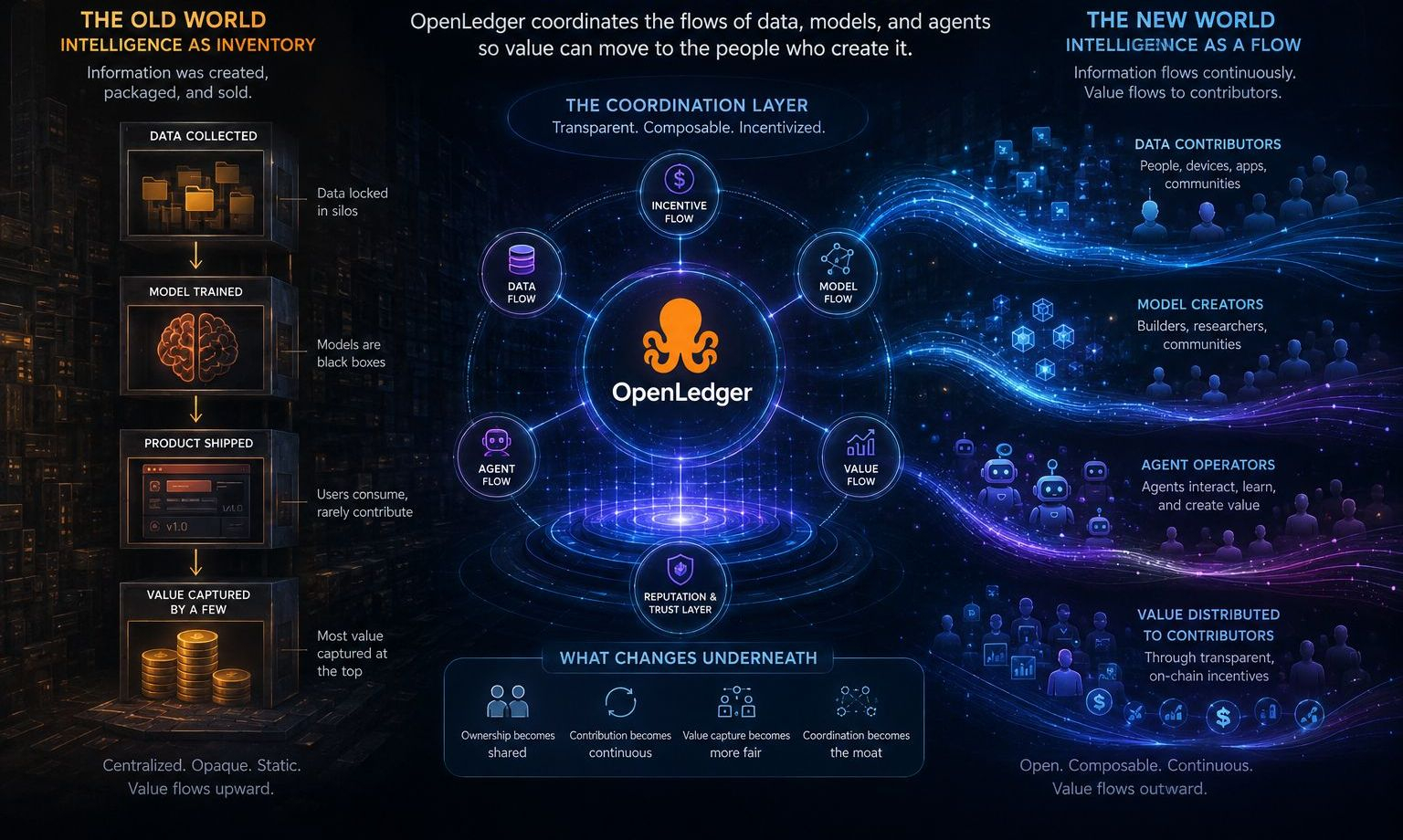
Information used to flow like physical goods, for a long time.
Only one newspaper was published each day. Scheduled information for television by hour. Software released info via versions. Even the internet which is much faster, mostly held the same assumption under it, make something, package it, distribute it.
The structure changed.
The logic stayed.
Today, not only does it seem weird, but intelligence doesn't seem to want to do it like that.
Information is constantly evolving. All models evolve or deteriorate over time. Every second AI agents communicate with other systems. There is a constant feedback from humans. However, a large portion of the modern infrastructure is functioning as if intelligence is something that can be captured in a product, shipped down the pipeline and offloaded onto the network.
Perhaps this is the new limitation.
Not compute.
Not models.
Not even adoption.
The problem might be that intelligence is becoming a flow and infrastructure around intelligence is still inventory.
That's where @OpenLedger is interesting.
With such projects, most people will naturally ask what features are there, what is being built or what makes the token valuable.
I believe this is a more important question to discuss.
What are the consequences when data, models, and agents are no longer discrete layers but work as economic flows?
When systems become continuous, a lot of things start to change below.
Data is no longer just a one-time set of data that would be stored forever.
Models are no longer finished products.
Agents become more than just solitary applications.
In a non-centralized way, intelligence is no longer being created, and production of value is becoming more difficult to find.
It is continuously generated all throughout.
This creates a coordination problem, which is not one that traditional systems were ever designed to solve.
Economically, the history of the world has been one of rewarding ownership.
You owned servers.
You owned software.
You owned databases.
You owned distribution.
However, intelligence systems generated from streaming data that is constantly updated can be more complex.
Information provider may not be the owner of the model.
The agents may not be under the control of the model creator.
Interactions between participants can be used by the agents to produce outputs without them actually observing the value that is generated.
One minute, it's yours and the next, it's not.
Contribution becomes blurry.
The value of capturing gets lost.
I feel like @OpenLedger is getting closer to this aspect of the problem.
Not at the application layer.
Not the Consuming layer.
The coordination layer.
What's interesting about coordination layers is that their significance increases with their opacity.
For most of the people who send messages they don't think about the internet routing.
When you're on the hunt for groceries, you don't really think about payment rails.
The beauty of infrastructure is that once it's gone, it's gone.
However, there is friction that can't be ignored with on-going intelligence systems.
Continual systems must be continually participated.
Incentives are needed for participation.
Incentives change behavior.
System quality is changed by behavior.
This establishes feedback loops which are not encountered in static software.
Information quality changes when the contributors stop contributing.
Intelligence is driven by economic incentives.
Whole ecosystems can lose momentum rather quickly if attention shifts elsewhere.
This equates to the point that the intelligence infrastructure could become more like an economic organism than a software organization.
That creates risks.
Continuous incentive systems can cost a lot.
Open coordination can get loud!
Reward systems can provide motivation for extraction rather than contribution.
The more important the data is becomes the more difficult it is to differentiate between participation that is useful and participation that is just for the money.
These are not trivial issues.
These are structural issues.
In structural matters, the new technology does not appear to put them away.
They typically are more noticeable.
The interesting thing is, crypto could have been preparing markets for this change even if they didn't realize.
Crypto educated people that liquidity is a form of infrastructure.
Open networks educated people on how to coordinate economically with strangers.
In this respect, token systems brought in the idea of participation as a part of production.
What is a situation where intelligence begins to function similarly?
Perhaps this is the larger issue with OpenLedger, though.
Not if AI grows.
Don't ask me if there are more agents showing up.
But will intelligence one day be more of a product of a simple routing system in the economy than a product of companies?
If intelligence becomes infrastructure instead of software, projects under these flows might not really matter as much as they do because of what they enable to keep moving.
Historically, systems with the basis of the product tend to change more than systems with the basis of movement.
