
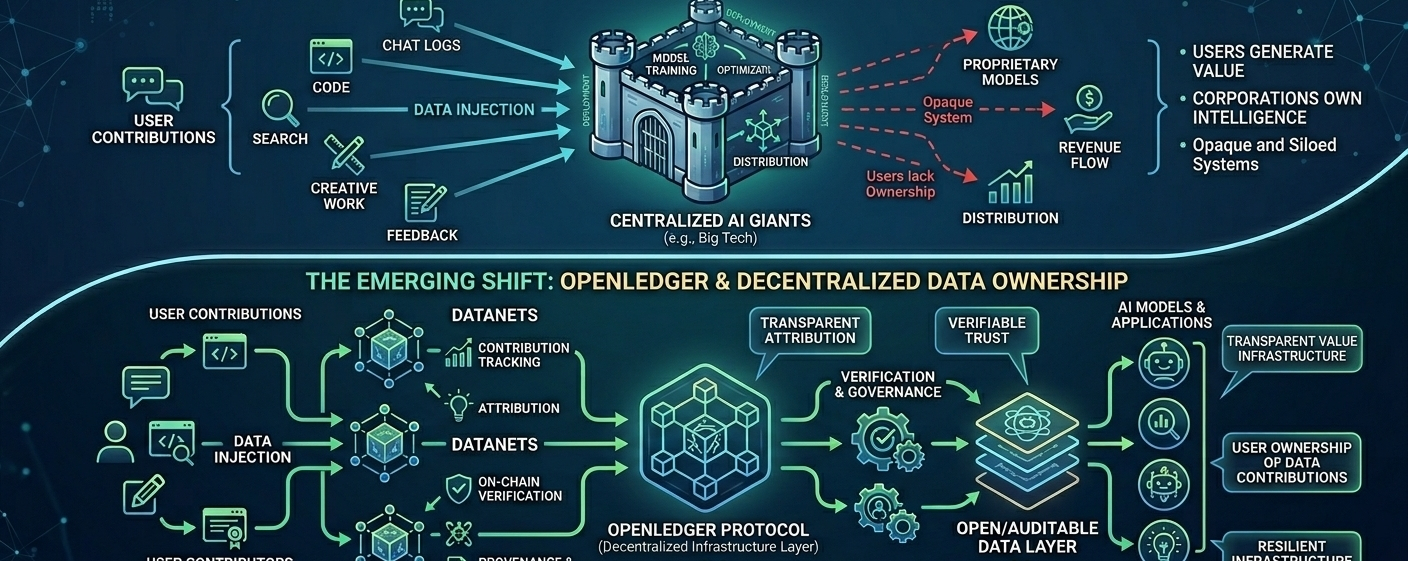
Most people still think the AI race is about intelligence
Who has the smartest model
Who responds faster
Who sounds more human
Who dominates the benchmark charts
That is the visible layer so naturally it gets all the attention
But lately I keep coming back to a different thought
What if the next major battle in AI is not about intelligence at all
What if it is about ownership
Because underneath all the excitement around AI assistants and generative models sits something most people barely notice
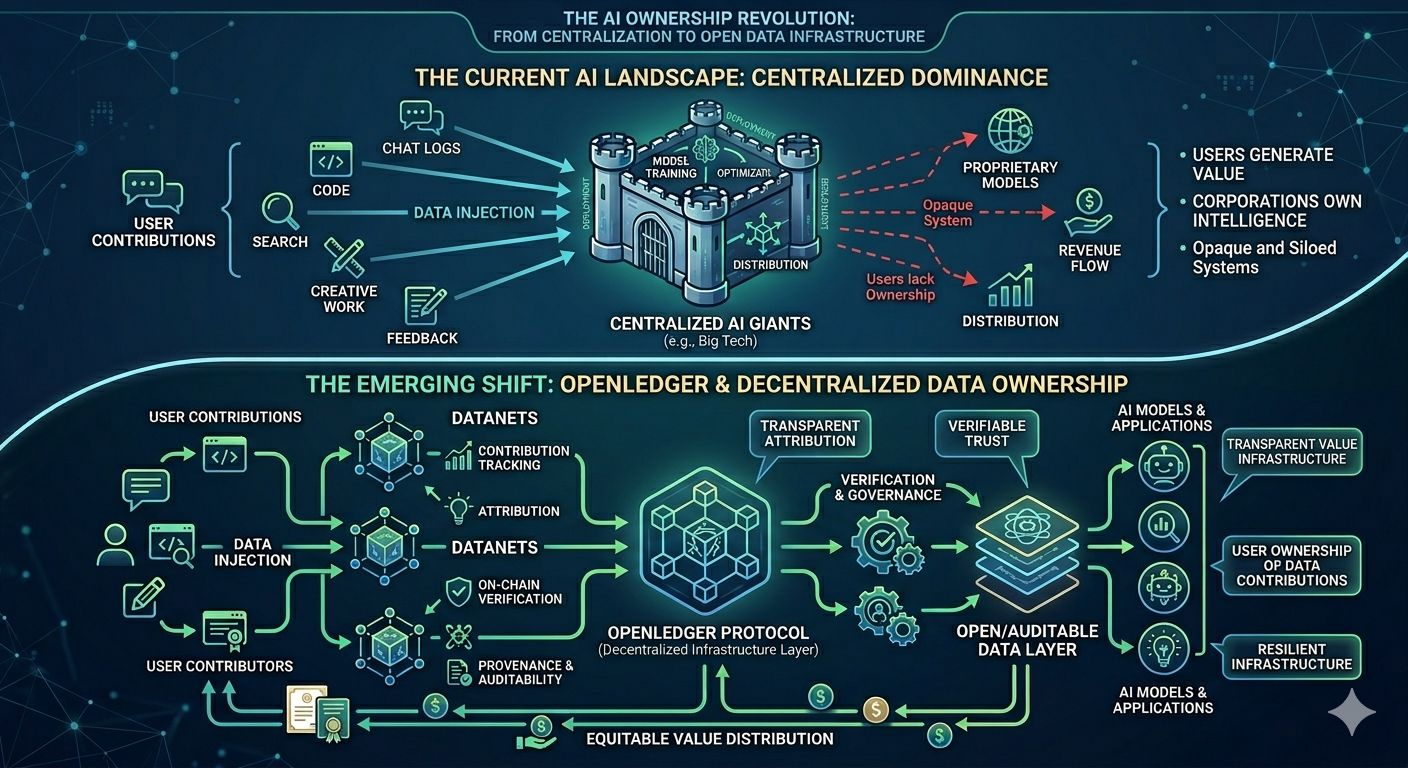
The system itself is still deeply centralized
A very small number of companies control the models
They control the infrastructure
They control distribution
And most importantly they control the data flowing underneath everything
That last part matters far more than people realize
AI models are often presented like magical machines appearing out of nowhere
But they are not independent from humans at all
They are reflections of us
Our conversations
Our behavior
Our creativity
Our corrections
Our habits
Our opinions
Our patterns
Our knowledge
People generate this value every single day without even thinking about it
And the strange part is most people never really own any part of the systems they are helping improve
That is the part that feels increasingly uncomfortable
Because once you notice it you cannot unsee it anymore
The internet already went through this once
People created enormous value through content culture attention and engagement while platforms absorbed almost all the ownership themselves
Now AI seems to be repeating the same structure except at a much larger scale
Only this time users are not just creating content
They are training intelligence itself
That changes everything
And honestly that is why OpenLedger caught my attention
Not because it calls itself decentralized AI
Almost every project says that now
The phrase has become so overused that it barely means anything anymore
What feels different is where OpenLedger is placing its focus
It is not obsessed with building the flashiest chatbot or the smoothest interface
It seems far more interested in the invisible layer underneath AI systems
The data layer
The part most people ignore completely
And the more I think about it the more I believe that may actually be where the real power exists
Because AI models are only as valuable as the data feeding them
That is the uncomfortable truth underneath the entire industry
Data is not a side component
It is the foundation
Without human contribution modern AI simply does not exist
Yet the current system treats those contributions almost like free raw material
Conversations become training signals
Feedback becomes optimization
Behavior becomes data
Expertise becomes extraction
All of it quietly absorbed into centralized systems most users never truly understand
OpenLedger seems to be questioning that structure itself
And that is where the project starts feeling less like another crypto experiment and more like an attempt to redesign the relationship between people and AI infrastructure
Their idea around Datanets becomes interesting once you look beyond the surface
Because it shifts contribution from something invisible into something trackable
Something attributable
Potentially even ownable
That changes the psychology of the entire system
Suddenly questions begin to matter that most AI platforms never even acknowledge
Who contributed the data
Who validated it
Which model used it
How much value came from it afterward
Can the process be audited
Can trust actually be verified instead of simply assumed
Those questions are usually hidden inside black box systems
Users are expected to trust companies without ever seeing what happens underneath
But trust itself is becoming fragile now
And rapidly
Synthetic content is exploding everywhere
AI generated misinformation keeps improving
Data scraping practices remain opaque
People increasingly cannot tell what is real anymore
That creates a very strange future
Society is becoming dependent on systems that very few people can meaningfully inspect
That is why OpenLedgers emphasis on attribution and on chain verification feels more important than it first appears
At first phrases like all actions are on chain sound like standard crypto marketing
But inside AI systems transparency carries a completely different weight
Not financial weight
Epistemological weight
People need to know where outputs came from
Whether data was manipulated
Whether information can be traced
Whether generated intelligence has provenance
Because the moment trust disappears AI systems start becoming socially unstable no matter how advanced they are technically
And maybe that is the bigger shift slowly happening underneath everything
AI is no longer just becoming an intelligence problem
It is becoming a trust problem
That may end up defining the next era far more than model size or benchmark performance ever will
I also think many people are underestimating where long term value in AI may actually accumulate
Right now almost everyone is competing at the interface layer
The assistant
The app
The user experience
The visible product
But interfaces become replaceable surprisingly fast
Infrastructure usually does not
Especially data infrastructure
Because once a network develops high quality continuously improving specialized data flows it becomes incredibly difficult to replicate
That is another reason OpenLedger feels strategically interesting
It seems less focused on building one singular AI product and more focused on building coordination systems around contribution itself
That is a much deeper layer of the stack
And potentially a far more durable one
Still none of this guarantees success
In fact the hardest part may only begin after the excitement fades
Because decentralized systems sound beautiful in theory
But sustaining meaningful participation over time is incredibly difficult
Especially once financial incentives weaken
Crypto history is full of ecosystems that looked active until rewards slowed down
Then users disappeared almost overnight
That risk absolutely exists here too
And maintaining quality inside decentralized AI systems may become even harder than people expect
Bad data spreads quickly
Manipulated data spreads even faster
Centralized companies at least have internal moderation teams benchmarking systems and controlled curation pipelines
Decentralized ecosystems have to coordinate all of this collectively without collapsing into noise
That balance is extremely difficult
Which means governance stops being secondary
It becomes foundational
If governance weakens the data layer weakens
If the data layer weakens the models weaken with it
The entire system depends on contribution quality remaining meaningful over time
That is probably the real test for OpenLedger
Not attracting attention initially
But proving that decentralized contribution can remain useful sustainable and trustworthy long after speculation fades away
Still even if OpenLedger itself never becomes dominant I think the direction behind it matters deeply
Because the current AI economy still feels structurally unfinished
The technology is accelerating rapidly
But ownership transparency and participation are lagging behind
And eventually that gap may become impossible to ignore
Projects like OpenLedger are essentially asking whether AI can evolve into something more participatory before the ecosystem becomes permanently consolidated by a handful of corporations
I do not know yet whether that vision fully works
Nobody does
But I do think the question itself matters
Because in a few years the most important layer of AI may not be the model people interact with directly
It may be the invisible infrastructure underneath deciding who contributes who owns who verifies and who ultimately benefits from the intelligence shaping the future
