
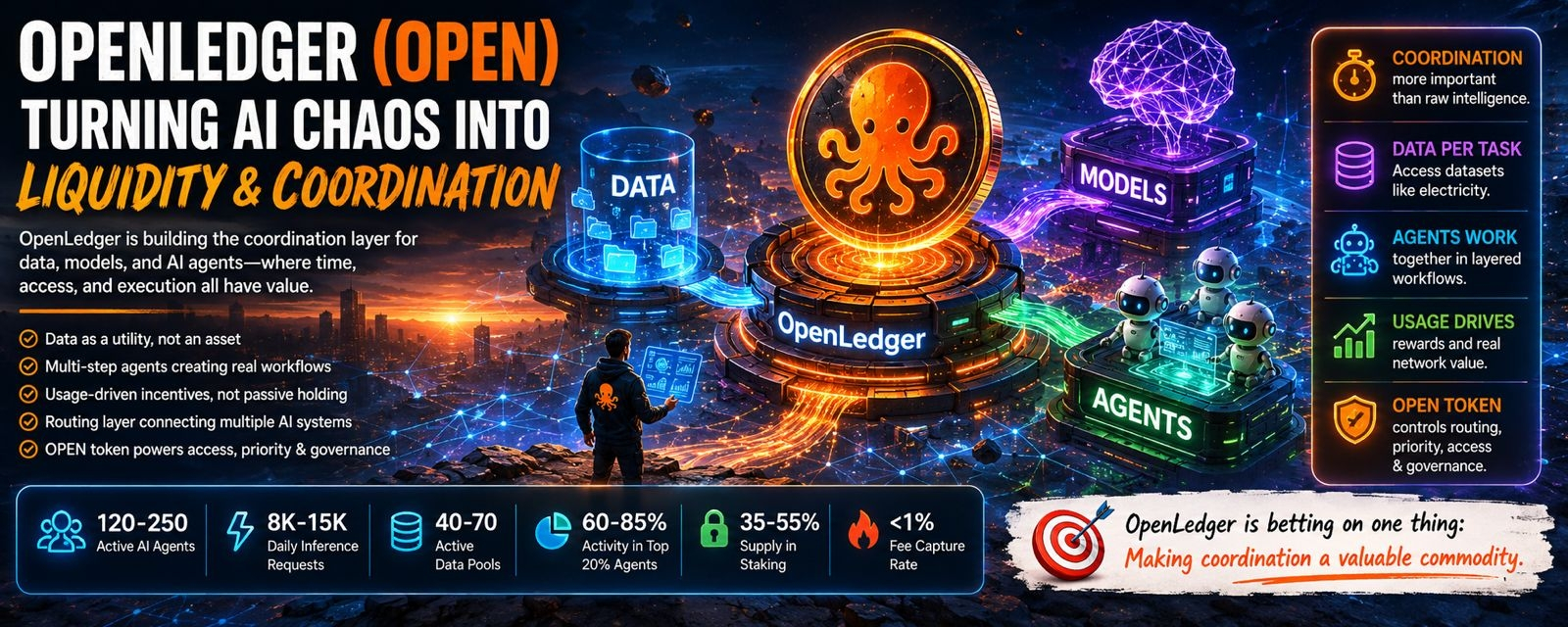
OpenLedger (OPEN) is easier to understand if you stop thinking of it as an “AI blockchain project” and instead treat it like an experiment in pricing coordination between machines that are constantly out of sync.
The real problem it’s pointing at isn’t that AI models are weak or missing. It’s that everything around them is messy in a way that doesn’t show up in clean demos. Data arrives too late or in the wrong format, compute sits idle in one place while another system is overloaded, and agents keep repeating work that already exists somewhere else but can’t be found quickly enough. OpenLedger is trying to turn that friction into something measurable and tradable.
Recent changes in the system suggest it’s slowly moving away from the idea of a simple marketplace. One shift is how data is being handled. Instead of treating datasets like something you buy once and store, they’re increasingly being used like something you tap into per task. That might sound minor, but it changes the logic completely. Data stops being a static asset and starts behaving more like a utility you continuously draw from. That pushes the system closer to cloud economics than traditional crypto ownership models.
Another shift is happening on the agent side. Workflows are becoming more layered, where one agent pulls information, another processes it, and another executes an action. That matters because it changes where value actually lives. It’s no longer just about how smart a model is, but how well different models and tools can be stitched together without slowing everything down or duplicating effort. In a way, coordination becomes more important than intelligence.
There’s also been a noticeable adjustment in incentives. Rewards are increasingly tied to real usage rather than passive participation. So instead of earning by just staking or holding, participants need to be involved in actual inference or data flows. That quietly shifts the system from passive finance toward activity-based economics, where idle capital slowly loses relevance compared to active contribution.
At the same time, OpenLedger seems to be positioning itself less as a closed system and more as a coordination layer between different AI environments. Instead of forcing everything into one stack, it’s trying to sit in between systems and decide how requests move across them. That’s a very different ambition from most AI tokens, which usually try to become the platform itself.
If you look at early activity signals, the picture is still very early and uneven. There are roughly a couple hundred active agents in circulation, but most of the activity is concentrated in a small subset of them. Daily usage sits in the low tens of thousands of inference requests, which is real but still far from large-scale adoption. Data availability also looks tighter than demand, with only a limited number of active datasets feeding a much larger flow of agent interactions. That imbalance matters because when data is scarce, the entire coordination system becomes constrained no matter how good the incentives are.
Staking participation is relatively high, with a large portion of supply locked up in some form of network participation. On one hand, that shows commitment. On the other hand, it also suggests that a lot of liquidity is being absorbed before the system has fully proven it can generate consistent real demand. Fees and actual revenue generated by usage still appear small compared to the overall level of activity, which means the system is still leaning heavily on incentives rather than self-sustaining demand.
The token itself is less about paying for “access” in a simple sense and more about influencing how the system moves. It affects things like priority in execution, access to certain data pools, routing through agents, and governance decisions over how resources are allocated. Demand for the token comes from people who want faster or prioritized execution, systems that need access to better or more restricted data, and participants who want influence over how the network routes work. On the other side, tokens get locked in staking, spent on usage, or reduced through penalties tied to performance and reliability.
The interesting tension is that the token is trying to do two things at once: act as fuel for activity and act as a control mechanism for coordination. That works only if real usage grows fast enough to justify the complexity of the system. Otherwise, you end up with a network that is heavily engineered but lightly used, where coordination is more sophisticated than what demand actually requires.
A less popular way to look at OpenLedger is that its biggest risk isn’t failure in the usual sense, but building something too early. Most infrastructure projects fail because they can’t do enough. This one risks the opposite problem it may be solving coordination at a level of precision that the current AI market doesn’t actually need yet. Today, most AI usage is still hidden inside centralized APIs where latency and routing are abstracted away, not priced or exposed. OpenLedger is betting that this abstraction will break sooner rather than later, and that coordination itself will become something people are willing to pay for directly.
What really matters going forward is simple. Whether real inference demand starts growing faster than emissions decline. Whether data pools start being reused across multiple agents instead of being consumed once and forgotten. And whether the system can actually convert all this activity into meaningful fee generation instead of relying on incentives to keep things moving.
If those three things start aligning, OpenLedger becomes less of an experiment and more of a working coordination market where time and routing efficiency are the real assets being priced. If they don’t, it becomes an elegant system that proved coordination is possible but not necessarily valuable enough, yet, to stand on its own.