@OpenLedger I do not see OpenLedger as just another AI blockchain trying to attach itself to a trend. I see it as a response to a harder question that most projects prefer not to ask: what happens when intelligence becomes a shared asset, but the people feeding that system are never fully paid for the value they create?
That question matters more than the usual conversation about throughput, token design, or whether a project can attract enough attention in the first place. The deeper issue in Web3 has never been a lack of ideas. It has been a mismatch between behavior and incentive. Most systems say they want participation, but what they really reward is speculation. Most systems say they want communities, but what they really build is temporary crowds. Most systems say they want users, but what they actually need is consistent pressure: people arriving, contributing, staying, and returning for reasons that are stronger than a price chart.
OpenLedger seems to sit right inside that tension.
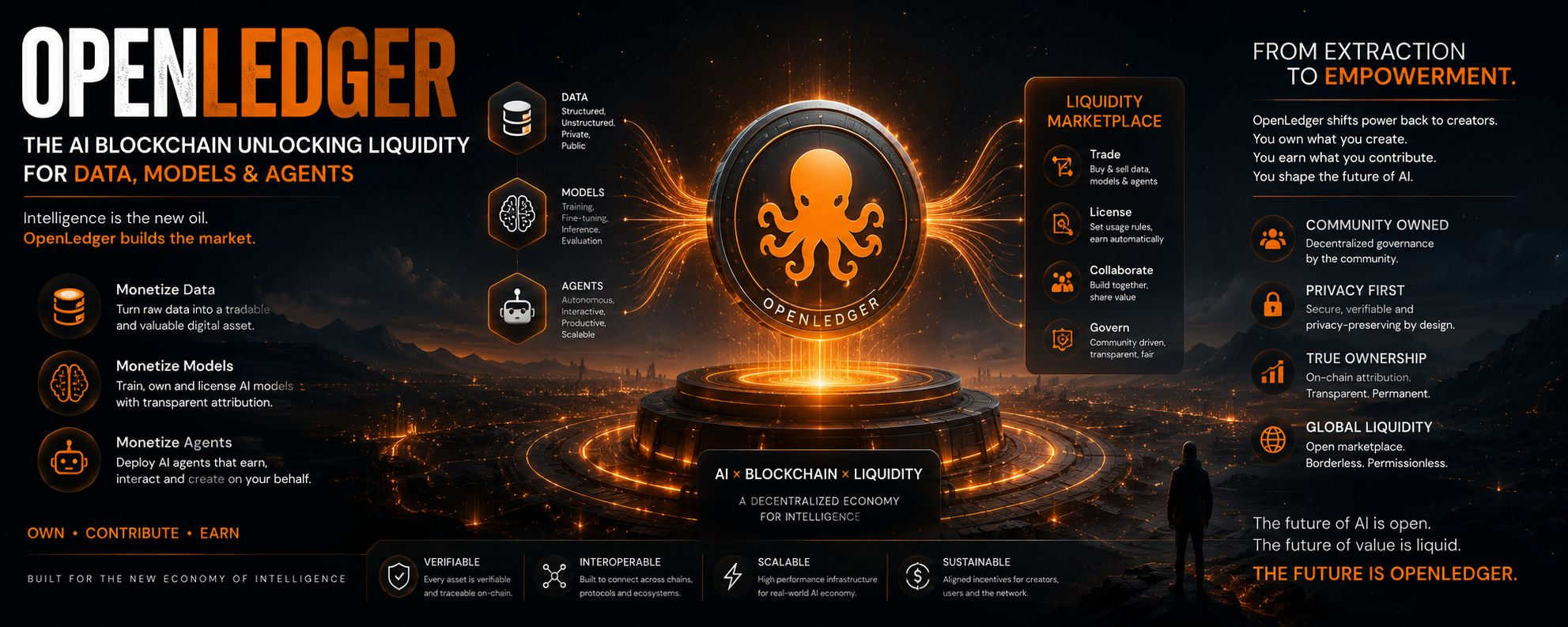
The interesting thing about a system like this is that it does not simply distribute value. It rearranges who gets to capture it. That is a subtle difference, but it changes everything. In a normal AI economy, data is collected, models are trained, agents are deployed, and the economic upside tends to flow upward into the hands of the platform. The contributors may be visible in theory, but invisible in practice. Their inputs become part of a machine that grows larger than them. OpenLedger is trying to make that flow less one-way by turning data, models, and agents into things that can be monetized more directly. That sounds technical on the surface, but underneath it is really about ownership behavior. It asks people not just to use a network, but to see their participation as something that can be priced, tracked, and repeated.
That is where the system gets more interesting than the marketing language usually allows.
Because once participation becomes monetizable, the network stops being just a product and starts becoming a habit-forming environment. Not in the shallow sense of “engagement,” but in the deeper sense of recurring utility. People return when the system gives them a reason to care about the next action, not just the current one. In AI-driven Web3 structures, that means users need to feel that their contributions are accumulating into something with persistent value. A dataset is not just a dataset if it can continue producing downstream returns. A model is not just a model if its usefulness can be separated into measurable ownership. An agent is not just a feature if it can become a productive unit in its own right.
This is the part most projects miss. They build surfaces. They do not build pressure.
Pressure, in a system sense, is what keeps the mechanism alive when the hype fades. It is the reason people keep showing up when nothing dramatic is happening. In the best case, OpenLedger is not asking users to believe in a narrative first. It is asking them to interact with a structure that makes economic sense even before the story becomes exciting. That is a much more durable proposition. Systems that rely purely on emotion need constant reinvention. Systems that create recurring incentives can survive more boring periods, and boring periods are where most crypto projects quietly break.
I think that is where OpenLedger’s real test begins.
If the system only works when attention is high, then it is still just a narrative vehicle. If it keeps producing reasons to participate when market enthusiasm slows, then it becomes something more serious. That distinction matters because the entire crypto sector has spent years pretending that liquidity alone is a sign of health. It is not. Liquidity can be a temporary weather condition. Real health is when the underlying behavior still makes sense after the temperature changes.
OpenLedger appears to understand that the demand for AI infrastructure is not just coming from traders or speculators. It comes from a broader shift in how digital labor is being organized. Data is no longer passive. Models are no longer sealed. Agents are no longer just experiments. They are becoming the basic units of a new kind of productive system, and productive systems attract economic pressure. The question is not whether people will want to own pieces of them. The question is whether the network can make that ownership meaningful enough to matter when enthusiasm thins out.
That is also where the risks become visible.
The first fragility is narrative dependence. Any project built around a new economic model has to survive the gap between concept and habit. People can understand a story quickly, but they only respect a system after using it long enough to notice its constraints. If OpenLedger feels useful only in theory, the market will eventually reduce it to another AI-themed chain with strong framing and weak retention. If users cannot see why their actions matter over time, the monetization angle becomes decorative instead of structural.
The second fragility is user intent. Not everyone entering a system wants to build, contribute, or coordinate. Many arrive to extract. Some come to test the edges. Some come only because price moved. A network like this has to assume that a meaningful portion of its attention is opportunistic, not loyal. That is not a flaw unique to OpenLedger; it is just the reality of open systems. But it means the project’s survival depends on whether it can convert opportunistic entry into persistent participation. That conversion is hard. It does not happen because of slogans. It happens because the system quietly rewards returning behavior better than one-time behavior.
The third fragility is economic. When a network promises monetization, it creates expectation. That expectation can be healthy, but it can also become a source of sell pressure if the value captured feels too abstract, too delayed, or too unevenly distributed. If growth slows, the project will be tested on whether its internal economy has real buyers, real use, and real loops of demand. Many systems look strong while new participants are entering. The harder question is what they look like when the inflow becomes less exciting and the outflow of value starts to matter more. That is where most token-linked ecosystems reveal whether they are businesses, experiments, or just temporary instruments for carrying sentiment.
What makes OpenLedger subtly different, at least in the way it presents itself, is that it feels closer to infrastructure than entertainment, and closer to behavior design than speculation. That is not a small distinction. Infrastructure does not need to scream. It only needs to become necessary. Behavior design does not need to promise abundance. It needs to make the next action feel obvious enough that users repeat it without needing to be persuaded each time.
And yet, even that advantage comes with a cost. Infrastructure is harder to romanticize. It is slower to become visible. It can be useful long before it is loved. That means the project may spend a long time in the awkward phase where serious users can see the shape of the idea, but the market still wants a simpler story. Those periods are dangerous because they punish systems that are more honest than flashy. They also filter for conviction. Only networks with enough real utility, or enough patience, survive the gap.
I think OpenLedger exists at exactly the right historical moment for this kind of experiment. The market has become more skeptical of pure play-to-earn logic, more cautious about empty metaverse theater, and more interested in systems that can justify themselves through use rather than promises. People are less impressed by abstract upside and more interested in whether a project actually changes the way value moves. In that sense, the timing is good. Not because the market is easy, but because the market is tired of being sold the same old illusion in different packaging.
So the real question is not whether OpenLedger has a compelling narrative. It does. The real question is whether it can turn intelligence into a system of repeatable economic behavior without losing the users who make that intelligence valuable in the first place.
That is the part still worth watching.
Not whether the project can attract attention. Not whether it can sound aligned with the moment. What needs to be proven is simpler and harder: can it make contribution feel durable, can it make ownership feel real, and can it keep value moving after the novelty wears off?