
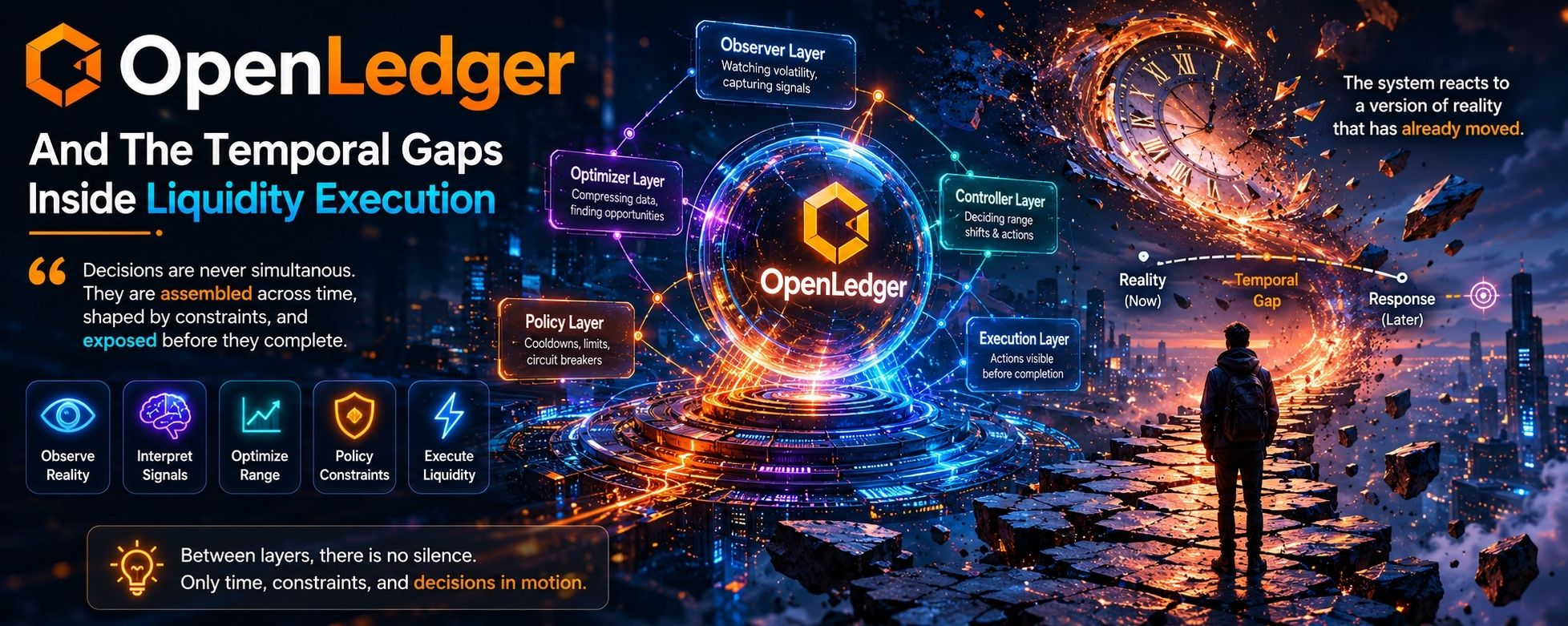
The longer I watch automated liquidity systems, the less they look like machines making clean decisions.
At first, everything appears straightforward. A position moves out of range. Liquidity shifts. A rebalance happens. Looking from the outside, it’s easy to assume there was a clear decision somewhere behind it all.
But when I try to trace that decision back to its source, I rarely find a single moment that explains what happened.
Instead, I find layers.
One signal reacts to volatility. Another interprets that signal. A separate mechanism evaluates risk. Somewhere else, a policy framework decides whether any action should happen at all. By the time execution finally occurs, the original trigger feels distant, almost unrecognizable.
What fascinates me is that these systems don’t behave like neatly separated components. We often describe them using simple categories: observer, optimizer, controller, executor.
Reality feels messier.
The boundaries between those roles blur together. Information flows across layers before any single layer fully understands what it’s receiving. Decisions seem to emerge gradually rather than being created at a specific point in time.
That’s where OpenLedger keeps capturing my attention.
The more I think about it, the less I see it as infrastructure performing a single function. It feels more like a shared coordination surface where information, constraints, and decisions continuously pass through different participants before becoming action.
Nothing stays in one place long enough to claim ownership.
A forecast influences a liquidity adjustment. That adjustment triggers a risk evaluation. The risk evaluation interacts with policy constraints. By the time execution happens, the outcome belongs to the entire chain rather than any individual step.
Maybe that’s coordination.
Or maybe it’s something more interesting: distributed uncertainty producing a coherent result.
Liquidity rebalancing makes this especially visible.
People often imagine autonomous systems as moving instantly once they identify an opportunity. In practice, there are delays everywhere. Cooldowns. Risk limits. Validation checks. Circuit breakers.
We usually think of these as rules sitting on top of execution.
I’m no longer convinced that’s accurate.
They feel woven directly into the system’s perception of time.
Almost as if the system is constantly pausing to confirm that it’s still allowed to move.
Every adjustment becomes a sequence of permissions rather than a single action.
Sometimes those safeguards are protective.
Sometimes they introduce their own form of friction.
The distinction isn’t always obvious.
Execution itself creates another layer of complexity.
Before an action is completed, fragments of it become visible. Signals appear. Intent becomes partially observable. Information leaks through behavior long before a final result exists.
That changes how I think about liquidity systems.
The challenge isn’t simply making the correct decision.
It’s preserving the integrity of that decision while it’s still forming.
Because exposure begins before execution finishes.
And that exposure affects everything around it.
The more I observe these systems, the more I notice a persistent temporal gap.
Not a dramatic one.
Just a small but constant delay between reality and response.
By the time a system reacts, the market has already moved. By the time a correction arrives, the conditions that inspired it have shifted again.
The gap never fully disappears.
It only changes shape.
Maybe that’s the part we underestimate when talking about autonomous liquidity.
We focus on intelligence, optimization, and execution speed.
But underneath all of it sits a quieter challenge.
Every decision is being made inside a reality that is already becoming outdated.
The system isn’t reacting to the present.
It’s reacting to its most recent understanding of the present.
And those two things are never exactly the same.
The longer I watch these interactions unfold, the harder it becomes to describe what exists between coordination and execution.
It doesn’t feel like failure.
It doesn’t feel like perfect coordination either.
It feels like a constantly shifting space where decisions are assembled across time, shaped by constraints, and exposed before they are complete.
A place where actions appear synchronized from a distance, but reveal subtle delays the closer you look.
And once you notice those delays, it’s difficult to stop seeing them everywhere.
