
At first, AI looked like a competition of intelligence.
Bigger models. Cleaner outputs. Faster reasoning. Better benchmarks.
The assumption felt almost natural. Whoever built the most capable model would capture the most value. The model was the product. The output was the proof. The intelligence was the asset.
But the more I looked at how these systems actually create value, the more that explanation started to feel incomplete.
Not wrong.
Incomplete.
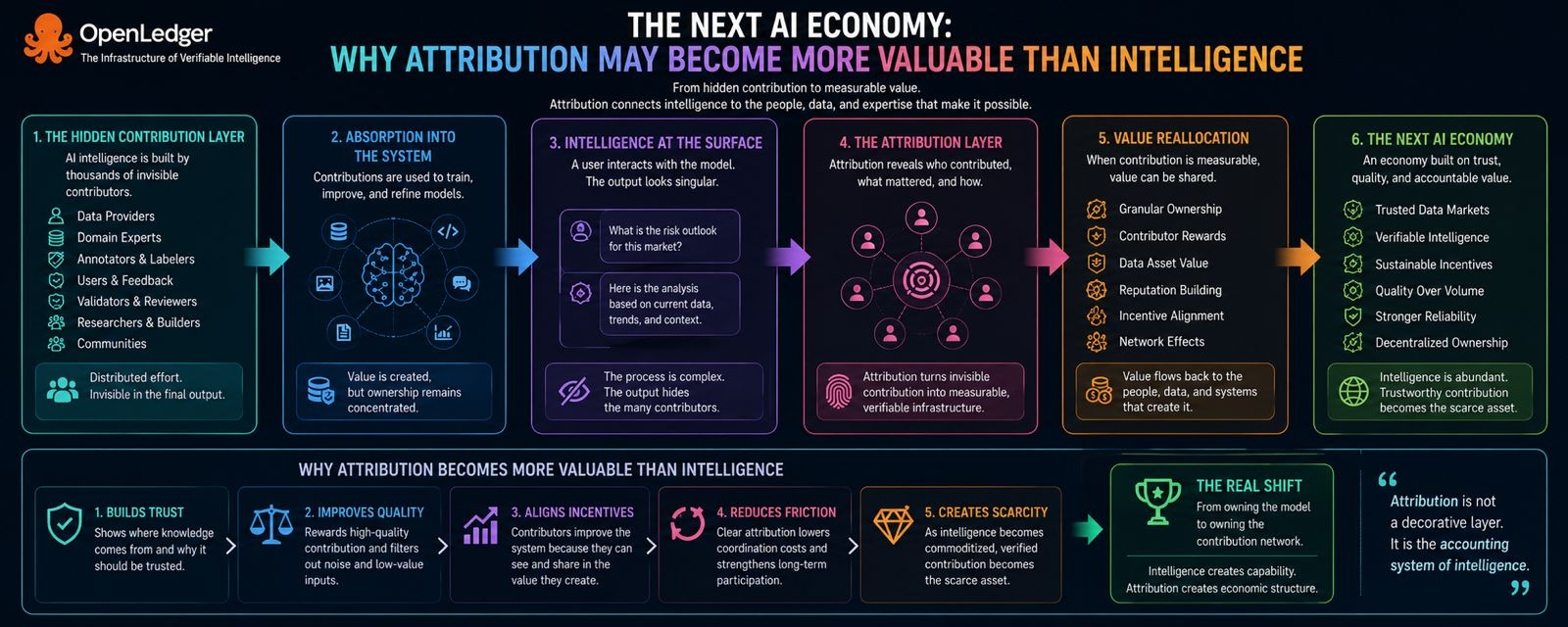
Because the visible intelligence of AI hides something much larger underneath it. A model does not become useful in isolation. It absorbs knowledge, behavior, correction, feedback, examples, labels, preferences, failures, domain judgment, and repeated human interaction. The final answer may look singular, but the process behind it is distributed.
That is the hidden layer.
AI appears centralized at the surface, but its value is built through countless invisible contributions. Data providers. Domain experts. Users correcting errors. Communities generating context. Builders testing edge cases.validators improving reliability. Researchers structuring knowledge. Every useful response carries traces of work that rarely appears in the final product.
And that is where the structural issue begins.
The conversation around AI is still mostly about intelligence. How smart is the model? How fast is it? How accurate is the output? How well does it perform against another model?
But the deeper question is different.
Who created the value that made the intelligence useful?
That distinction matters.
If intelligence is treated as the only asset, then contribution becomes raw material. Something absorbed. Something consumed. Something extracted quietly into the system. But if attribution becomes measurable, then contribution changes category. It stops being background input and starts becoming economic infrastructure.
Different thing.
This became clearer to me when I started thinking about AI not as a product, but as a production chain. In a normal interaction, a user asks a question and receives an answer. Simple. Useful. Efficient. But under the surface, that answer depends on previous datasets, human feedback loops, tuning decisions, evaluation systems, and domain-specific corrections.
Now imagine observing the same system under pressure.
A finance-related question requires accurate market interpretation. A medical question requires caution and reliability. A legal question requires context and jurisdiction. A coding question requires not just syntax, but tested logic. In each case, the model output depends on invisible layers of contribution. Some data matters more than other data. Some corrections prevent serious errors. Some contributors improve reliability far more than others.
Repeated use reveals the difference.
The issue is not merely whether the model can answer. It is whether the system can identify which contributions made the answer trustworthy.
That is the attribution gap.
Today, most AI systems reward the visible layer. The platform. The model. The interface. The company that packages the intelligence. But the contribution layer remains blurry. The people and communities that improve the system often disappear into the background. Their work strengthens the output, but their role is difficult to trace.
Not because it has no value.
Because the system was not built to show it.
That changes the meaning of AI economics.
The more valuable AI becomes, the more important it becomes to ask where that value came from. If a model improves because of specialized data, repeated user feedback, expert correction, or community validation, then the economic question cannot remain limited to ownership of the model itself. The model is only one layer. The contribution system beneath it may be just as important.
Maybe more important.
At first, attribution sounds like a fairness issue. And it is. But reducing it to fairness alone misses the deeper point. Attribution is also a reliability mechanism. It tells the system which inputs matter, which contributors improve outcomes, which data sources deserve trust, and which signals should be weighted more heavily over time.
In other words, attribution is not just about giving credit after value is created.
It is about shaping how value is created in the first place.
That distinction matters.
The obvious interpretation is that AI needs more data. The deeper interpretation is that AI needs better contribution signals. More data can create noise. Better attribution can create selection. More participation can expand the system. Better attribution can discipline it.
Not quantity.
Quality under pressure.
Once contribution becomes traceable, incentives start to change. A contributor is no longer just feeding information into a machine. They are participating in a value chain. A dataset is no longer just a static file. It becomes a productive asset. A correction is no longer a small invisible improvement. It becomes part of the reliability structure.
This is where the next AI economy starts to look different from the current one.
In the current model, value often flows upward. Data and feedback move into the system. Intelligence improves. The platform becomes more valuable. The contributor usually remains outside the economic loop.
In an attribution-based model, the loop becomes harder to ignore. If contribution can be tracked, measured, and connected to outcomes, then ownership becomes more granular. Value does not only belong to whoever controls the final model. It also begins to attach to the people, datasets, communities, and verification layers that made the model useful.
That is a major shift.
Because markets do not only reward creation. They reward measurable creation.
This is why attribution may become more valuable than intelligence. Not because intelligence will stop mattering. It will matter enormously. But intelligence without attribution has a structural weakness. It depends on invisible inputs while concentrating visible rewards. Over time, that creates tension. Contributors become less willing to participate. Data quality becomes harder to secure. Trust becomes more expensive. Verification becomes more important.
The system starts to carry hidden coordination costs.
Attribution reduces some of those costs by making contribution legible.
Legibility matters in any economy. If value cannot be traced, it is difficult to price. If it cannot be priced, it is difficult to reward. If it cannot be rewarded, it becomes difficult to sustain. The system may still function for a while, but it begins to depend on extraction rather than participation.
And extraction has limits.
Participation compounds differently.
When contributors know that high-quality input can be recognized, measured, and rewarded, their behavior changes. They have a reason to improve the system rather than merely use it. Communities have a reason to curate better data. Experts have a reason to validate knowledge. Builders have a reason to produce useful tools, not just visible tools.
The incentive structure becomes more selective.
That selectivity is important. Open contribution sounds powerful, but not every contribution improves the system. Some inputs add noise. Some data is low quality. Some feedback is careless. Some participation is opportunistic. A serious AI economy cannot treat all contribution as equal.
And honestly, some of that is rational.
Any system that wants to scale reliable intelligence has to become opinionated about quality. It has to decide what counts, what matters, what improves outcomes, and what should be ignored. Perfect neutrality may sound attractive, but infrastructure cannot survive on neutrality alone. It needs filters. It needs evaluation. It needs trust signals. It needs mechanisms that separate useful contribution from volume.
Not every open system becomes better by becoming larger.
Sometimes it becomes better by becoming more selective.
That creates the central tradeoff.
Do you optimize for broad participation or reliable attribution?
If participation is too open, quality can collapse. If attribution is too strict, access can narrow. If rewards are too loose, the system invites gaming. If rewards are too selective, it risks reproducing the same concentration it was supposed to challenge.
That is the real tension.
Not whether AI should be intelligent. That question is already settled. The real question is whether the economy around intelligence can become transparent enough to sustain trust, and selective enough to sustain quality, without becoming another closed system.
This is where projects focused on attribution and contribution infrastructure become more interesting. Not because they promise a cleaner slogan. But because they are touching the part of AI that the public conversation often skips. The ownership layer. The proof layer. The economic layer beneath the output.
Once that layer becomes visible, AI stops looking like a single machine answering questions.
It starts looking like a market.
A market for data quality. A market for verification. A market for domain expertise. A market for human judgment. A market for trust.
That changes the meaning of the system.
The future of AI may not be defined only by who has the largest model. It may also be defined by who can coordinate the most reliable contribution network around intelligence. A powerful model can generate impressive outputs, but a trusted attribution layer can shape an entire economy around those outputs.
One creates capability.
The other creates structure.
The more I looked at it, the more difficult it became to separate intelligence from ownership. Intelligence explains what the system can do. Ownership explains who benefits when it does it. Attribution sits between both. It connects contribution to value. It turns invisible labor into visible infrastructure.
That may be the real shift.
The first AI economy was built around access to intelligence. The next one may be built around proof of contribution.
Because when intelligence becomes abundant, the scarce asset changes. It is no longer only the ability to produce answers. It is the ability to prove where trustworthy answers came from, who improved them, and why the system should value one contribution more than another.
In the end, attribution is not a decorative layer added to AI.
It is the accounting system of intelligence.
And every serious economy eventually needs accounting.