Crypto loves a good story.
Every cycle gets one.
First it was DeFi. Then NFTs. Then GameFi. Then the metaverse. Then modular chains, restaking, new Layer 1s, and about a hundred other things people swore would change everything.
Now it's AI.
And honestly, if you've been around long enough, you've probably developed a healthy amount of skepticism every time a project puts "AI" somewhere in its pitch deck.
I know I have.
I've seen this before.
A hot narrative shows up, money floods in, timelines get filled with big promises, and suddenly every project claims it's building the future.
Sometimes they're right.
Most of the time? Not really.
That's actually why OpenLedger caught my attention.
Not because it's another AI project.
Because I don't think the AI part is the most interesting thing about it.
Here's the thing.
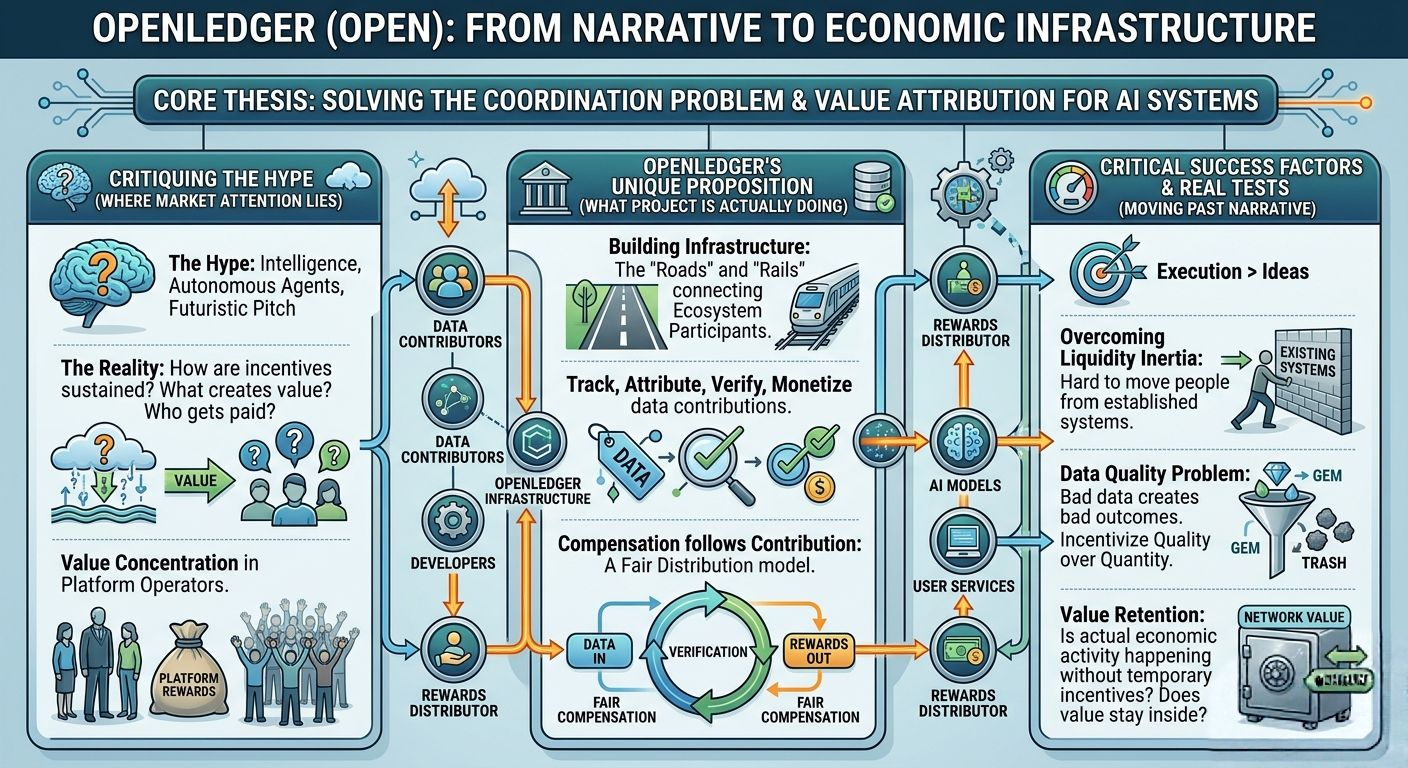
A lot of AI-blockchain projects spend most of their time talking about intelligence, autonomous agents, decentralized models, machine economies, and all the futuristic stuff people love to hear about.
Sounds great.
But when you dig deeper, you often hit the same question:
Where does the value actually come from?
And more importantly, who gets paid?
People don't talk about this enough.
Technology gets all the attention. Economics usually determines who survives.
You can build the smartest system in the world, but if your incentives don't work, your network eventually stalls out. Users leave. Developers lose interest. Capital goes somewhere else.
That's just how markets work.
When I started looking at OpenLedger, I kept coming back to one question:
Is this actually an AI project?
Or is it solving a coordination problem that AI happens to expose?
Because those are very different things.
And honestly, I think the second question matters a lot more.
The modern AI industry runs on data.
Everything does.
Recommendation engines. Predictive systems. AI models. Intelligent applications. All of it.
Data sits underneath the entire stack.
Yet there's still a huge unanswered question hanging over the industry.
Who owns the value created from that data?
Think about it.
Millions of people contribute information every single day.
Users create behavioral data.
Businesses generate datasets.
Developers improve models.
Communities provide feedback that makes systems better over time.
Everyone contributes.
But the economic rewards often end up concentrated in the hands of a relatively small number of platform operators.
That's not really a technical problem.
It's an economic one.
And that's where OpenLedger gets interesting.
From what I can see, OpenLedger isn't trying to win the race to build the smartest AI model on the planet.
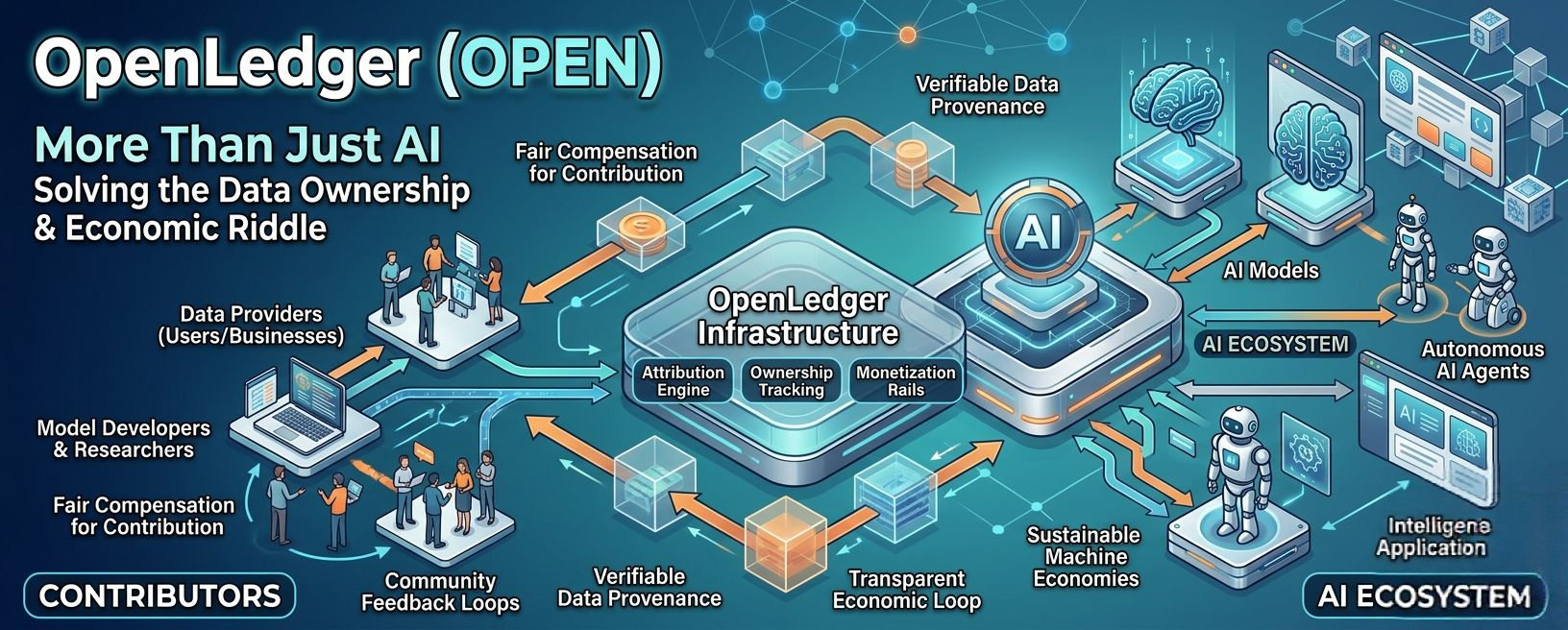
Instead, it looks like it's trying to build infrastructure that tracks, attributes, and potentially monetizes contributions inside AI ecosystems.
That sounds less exciting than talking about superintelligence.
I get it.
Infrastructure rarely gets people excited.
But history keeps showing the same pattern.
The companies building the roads often end up becoming just as important as the people driving on them.
Sometimes more important.
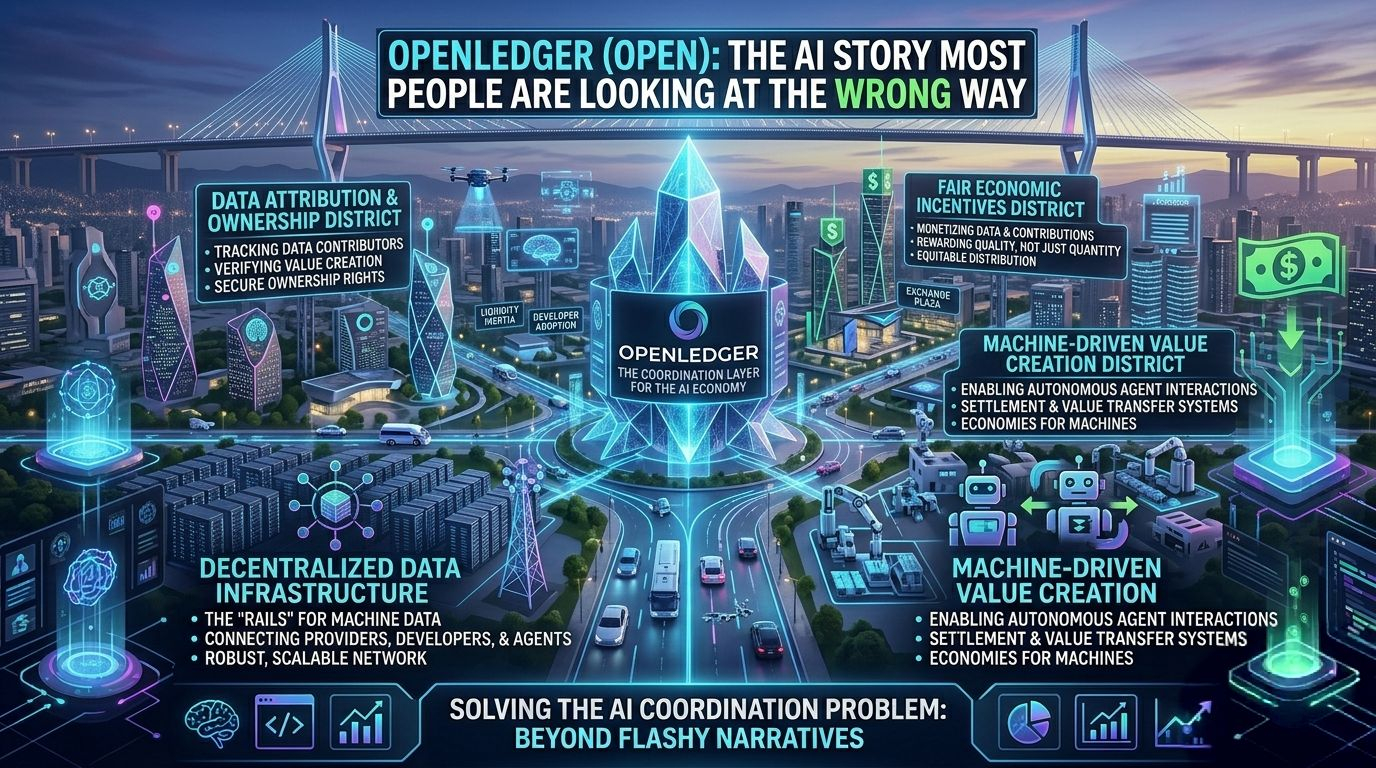
OpenLedger seems focused on building the rails that connect data providers, developers, AI models, applications, contributors, and eventually autonomous agents into one economic system.
That's a very different bet.
And honestly, it's probably a smarter one.
Because if AI keeps expanding the way many people expect, attribution becomes incredibly important.
Someone creates data.
Someone improves models.
Someone builds applications.
Someone consumes services.
Someone generates value.
How do you measure all that?
How do you verify it?
How do you distribute rewards fairly?
Those questions don't disappear just because the technology gets better.
In fact, they become harder.
Imagine a future where autonomous AI agents regularly buy information, negotiate services, execute tasks, and interact with other intelligent systems.
Sounds futuristic today.
Maybe it won't sound futuristic five years from now.
If that world shows up, those agents will need infrastructure.
Ownership systems.
Settlement systems.
Attribution systems.
Value transfer systems.
Human economies already have versions of these things. Contracts, accounting systems, property rights, payment rails.
Machine economies will need their own versions too.
That's the part of the OpenLedger thesis that I find compelling.
The project doesn't seem to treat AI as some magical standalone technology.
It treats AI as a participant in an economy.
And once you look at it that way, everything changes.
Data providers contribute resources.
Developers build applications.
Models generate outputs.
Users consume services.
Value flows through the network.
The challenge becomes making sure compensation actually follows contribution.
Simple idea.
Very hard problem.
Of course, this is where things get tricky.
Good ideas don't automatically become successful networks.
Crypto history is basically a graveyard full of technically impressive projects that never achieved meaningful adoption.
OpenLedger faces the same reality.
One major challenge is what I'd call liquidity inertia.
People already use existing systems.
Developers already build on existing platforms.
Capital already sits in established ecosystems.
Moving people somewhere new is incredibly difficult.
Even when the new system is objectively better.
People like convenience.
They like familiarity.
They like doing what everyone else is already doing.
Markets reward that behavior all the time.
Then there's the data quality problem.
And honestly, this one matters a lot.
An attribution-based economy only works if the contributions being measured actually create value.
Otherwise, incentives start pushing people toward quantity instead of quality.
We've seen this happen everywhere.
Reward the wrong behavior and people optimize for the reward instead of the outcome.
That risk becomes even bigger inside AI systems because model quality depends heavily on data quality.
Bad incentives create bad data.
Bad data creates worse outcomes.
It's a chain reaction.
Developer adoption is another huge piece of the puzzle.
A lot of crypto projects underestimate this.
Developers build applications.
Applications attract users.
Users create activity.
Activity creates value.
That's the loop.
Break any part of it and growth slows down.
So OpenLedger's long-term success won't depend solely on architecture.
It'll depend on whether developers actually want to build there.
That means tools matter.
Documentation matters.
Integrations matter.
Support matters.
The boring stuff matters.
Actually, scratch that.
The boring stuff usually matters most.
Then you get to the question almost nobody wants to discuss during bull markets.
Value retention.
A network can generate activity.
That doesn't mean value stays inside the ecosystem.
We've all watched projects hand out rewards, create temporary excitement, and then watch capital disappear the moment incentives dry up.
Activity isn't enough.
Sustainable participation matters more.
Especially in AI ecosystems where progress depends on continuously improving data quality, model performance, and application usefulness.
That's why I don't think the most important question is whether OpenLedger combines AI and blockchain.
Lots of projects do that.
The real question is whether OpenLedger can build a functioning marketplace around data attribution and machine-driven value creation.
That's the bet.
If it works, the implications stretch far beyond one token or one network.
It could suggest that future AI economies need entirely new ownership models.
It could give contributors a more direct connection to the value they help create.
It could push economic incentives deeper into the infrastructure layer instead of concentrating them primarily at the application layer.
Maybe.
Nothing is guaranteed.
Technology history is full of ideas that looked brilliant on paper and never reached meaningful adoption.
Execution matters.
Timing matters.
Competition matters.
User behavior matters.
All of it.
That's why the real test won't happen while AI remains the hottest narrative in crypto.
The real test comes later.
When attention moves on.
When social media starts chasing the next trend.
When speculative capital finds a new story to tell itself.
That's when the important metrics start speaking for themselves.
Are developers still building?
Are contributors still providing valuable data?
Are applications creating real demand?
Are users paying for services?
Is actual economic activity happening without temporary incentives propping everything up?
Those answers will determine whether OpenLedger becomes lasting infrastructure or just another project that benefited from a popular narrative.
For now, though, I think OpenLedger deserves a closer look than most people are giving it.
Not because it's an AI token.
That's the easy headline.
The more interesting story is that it's trying to solve a very real coordination problem in a world that's becoming increasingly influenced by intelligent machines.
Will it succeed?
I don't know.
Nobody does.
But the problem it's trying to solve is real.
And in crypto, that's usually a much better starting point than a flashy narrative.