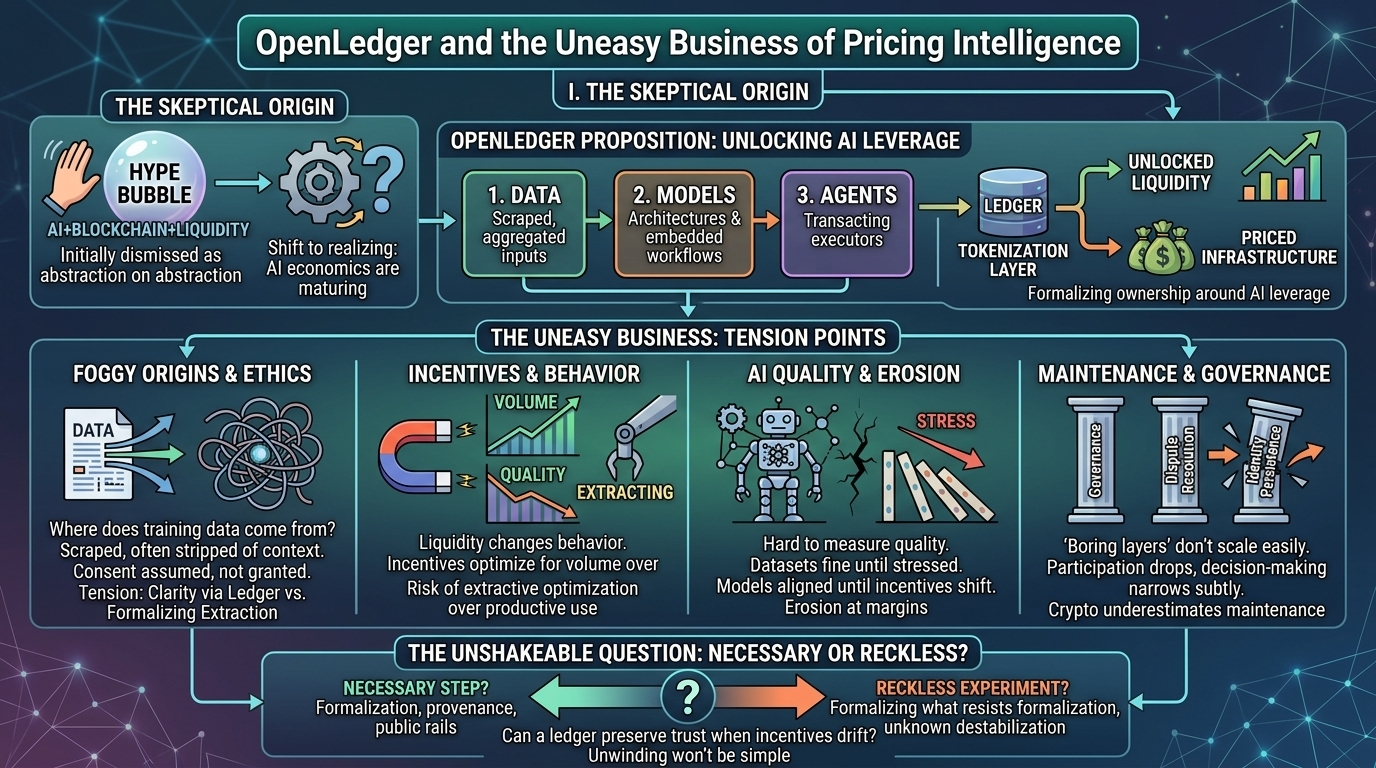
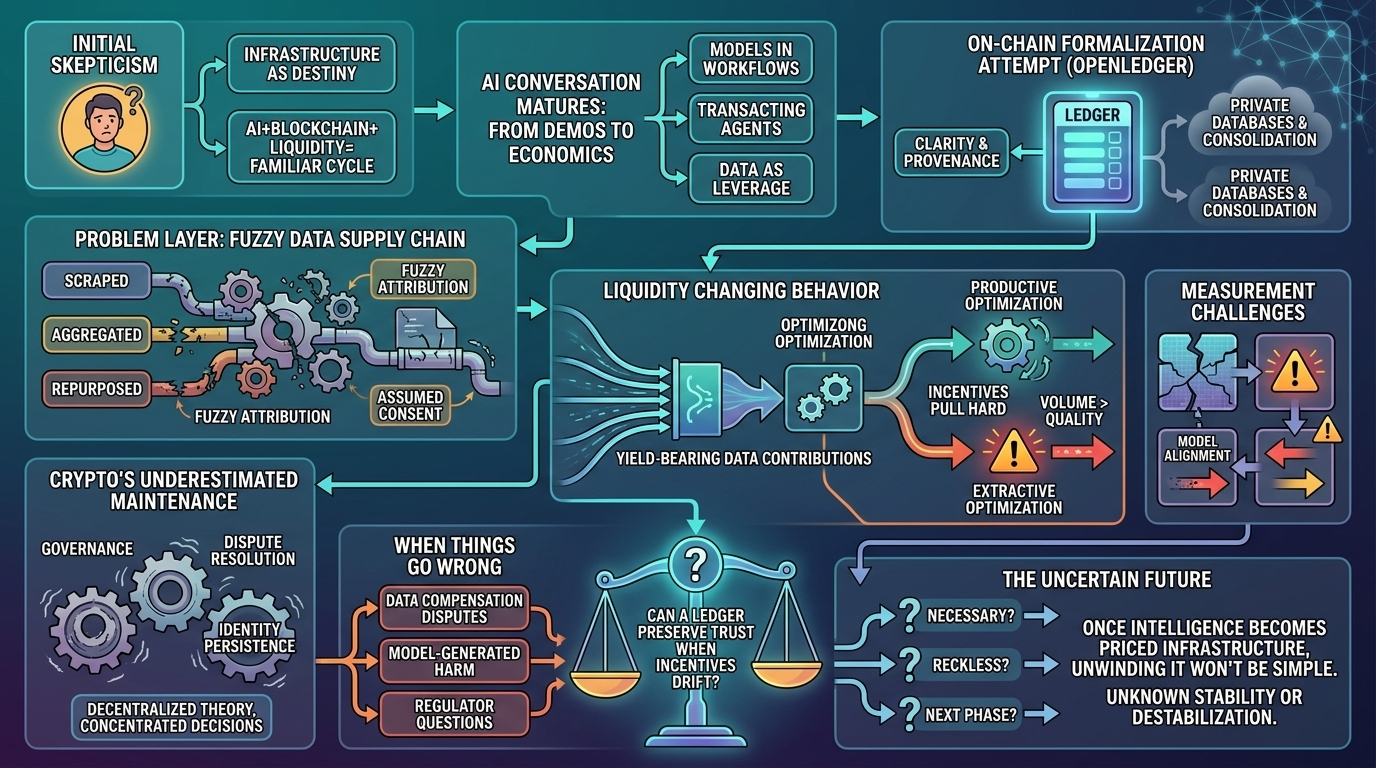
I didn’t take it seriously at first That’s not a knock on the team it’s just where my head goes these days I’ve watched too many cycles where infrastructure is pitched as destiny Add AI to blockchain sprinkle in liquidity call it inevitable. It’s a familiar rhythm
OpenLedger an AI focused chain trying to unlock liquidity around data models and agents landed in that mental bucket for me Another attempt to tokenize whatever the moment finds valuable
But something about it kept pulling me back
Maybe it’s because the AI conversation has matured past demos and into economics Models aren’t just curiosities anymore They’re embedded in workflows Agents are starting to transact. Data isn’t just fuel it’s leverage And once something becomes leverage, someone will try to formalize ownership around it
That’s where OpenLedger seems to sit Not at the flashy layer, but at the uncomfortable one
I keep coming back to the idea that we don’t really know where most AI inputs come from anymore. We talk about training data as if it’s a clean supply chain It’s not It’s scraped aggregated repurposed often stripped of context Attribution is fuzzy Consent is sometimes assumed rather than granted
So what does it mean to monetize that layer
Maybe that’s too harsh Maybe formalizing it on chain is actually a step toward clarity At least there’s a ledger At least contributions can be recorded At least there’s some attempt at provenance rather than quiet consolidation inside private databases
But that’s where things start to feel uncomfortable
Because liquidity changes behavior Once data contributions become yield bearing the system will attract optimization. Some of it productive Some of it extractive. Crypto has taught us this lesson repeatedly Incentives pull hard on edges. Edge cases multiply Quality becomes harder to measure than volume
And measuring quality is already hard in AI
A dataset can appear fine until it’s stressed in an unusual scenario A model can seem aligned until incentives shift Agents can behave responsibly until market conditions reward speed over caution Infrastructure doesn’t break in obvious ways It erodes at the margins
I didn’t take it seriously at first because it sounded like abstraction on top of abstraction Now I’m less dismissive If intelligence is becoming economic infrastructure, maybe we need public rails around its inputs. Maybe relying entirely on centralized AI providers is the bigger risk
Still crypto tends to underestimate maintenance The boring layers governance dispute resolution identity persistence rarely scale as smoothly as the whiteboard suggests Participation drops over time Power concentrates subtly The ledger remains decentralized in theory but decision making narrows
I keep wondering how OpenLedger behaves when things go wrong When data contributors dispute compensation When models trained on tokenized inputs generate harm When regulators start asking who owns what exactly
A ledger can record transactions It can timestamp contributions But can it preserve trust when incentives drift
That’s the question I can’t shake
Maybe unlocking liquidity around data and agents is necessary. Maybe it’s reckless Or maybe it’s just the next phase in a long experiment where we keep trying to formalize things that resist formalization
I’m not convinced either way I just know that once intelligence becomes priced infrastructure, unwinding it won’t be simple And I’m not sure we fully understand what we’re stabilizing or destabilizing yet