
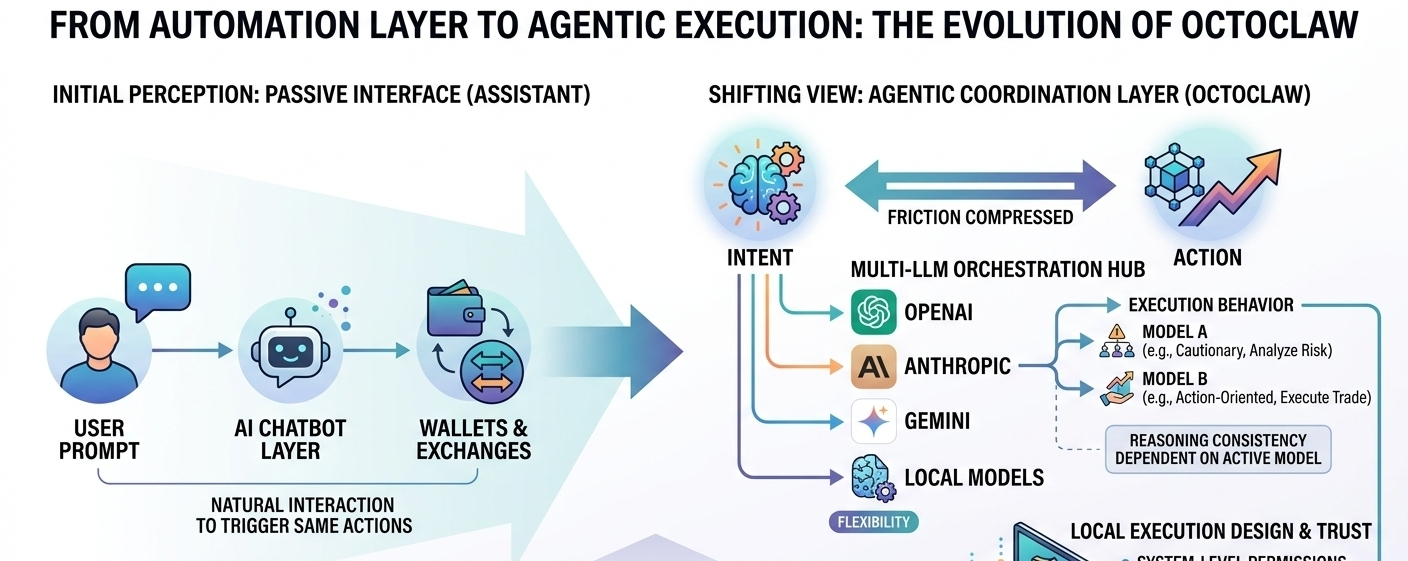
I used to think OctoClaw was just another automation layer on top of Web3. Something that reacts to users, not something that decides or initiates anything on its own.
At first, I saw it as an AI trading interface basically a chatbot connected to wallets and exchanges. A more natural way to trigger the same actions we already do with bots, nothing fundamentally new, just a different layer of interaction.
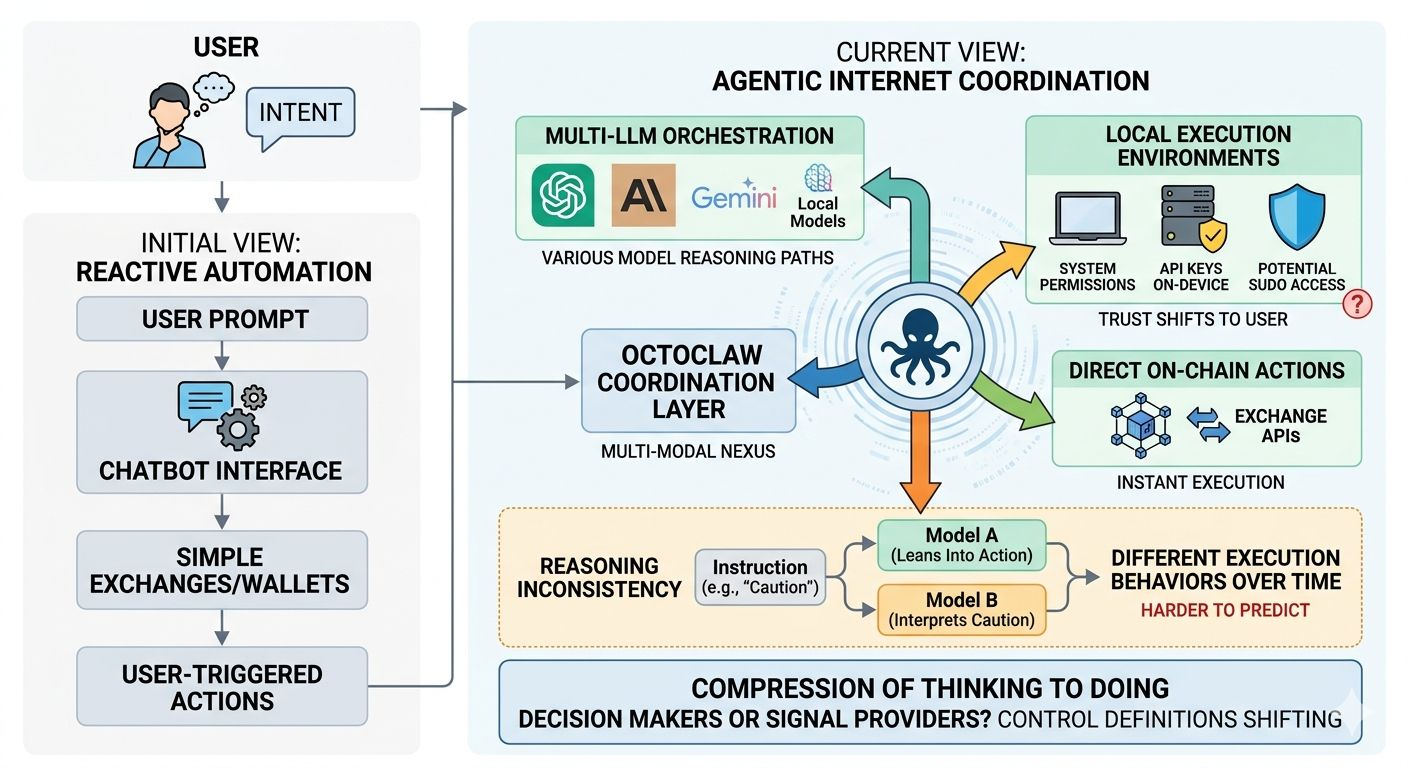
Then my view shifted when I noticed it doesn’t only respond to prompts. It can interpret intent and turn it into on-chain actions. That difference between asking for something and letting a system execute it quietly changes the role of the user.
That’s where the idea of an agentic internet started to feel real. OctoClaw looks less like a product and more like a coordination layer between intent, models, and execution. Multi-LLM orchestration adds flexibility across OpenAI, Anthropic, Gemini, and local models. But there’s a hidden tradeoff reasoning consistency becomes dependent on which model is active at the moment of execution.
In practice, that means the same instruction can behave differently over time. One model might interpret caution, another might lean into action. When this connects directly to exchange APIs, the variance is no longer theoretical it becomes execution behavior, which is harder to predict.
The local execution design adds another layer. System-level permissions, API keys stored on device, even sudo access in some cases. It can reduce third-party exposure, but it also shifts trust completely to the user. Power becomes more private, but also more fragile when things go wrong.
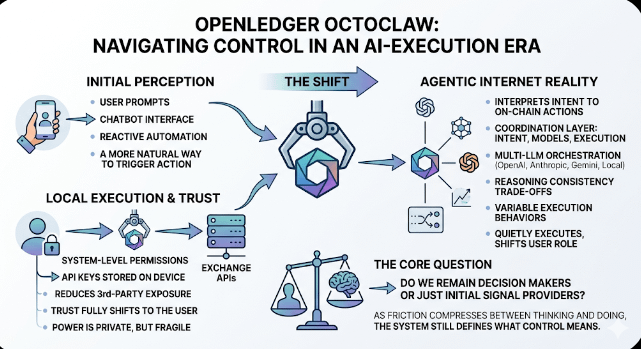
What stood out to me is how this fits into a broader shift in OpenLedger style systems. These are not just assistants anymore. They are becoming execution environments where intent flows directly into action. The friction between thinking and doing is getting compressed.
And that leaves an open question. If AI is fast enough to turn intent into financial action almost instantly, do we remain decision makers or just initial signal providers? I’m not sure the system is stable enough to answer that yet. Or maybe it’s still defining what control means.