
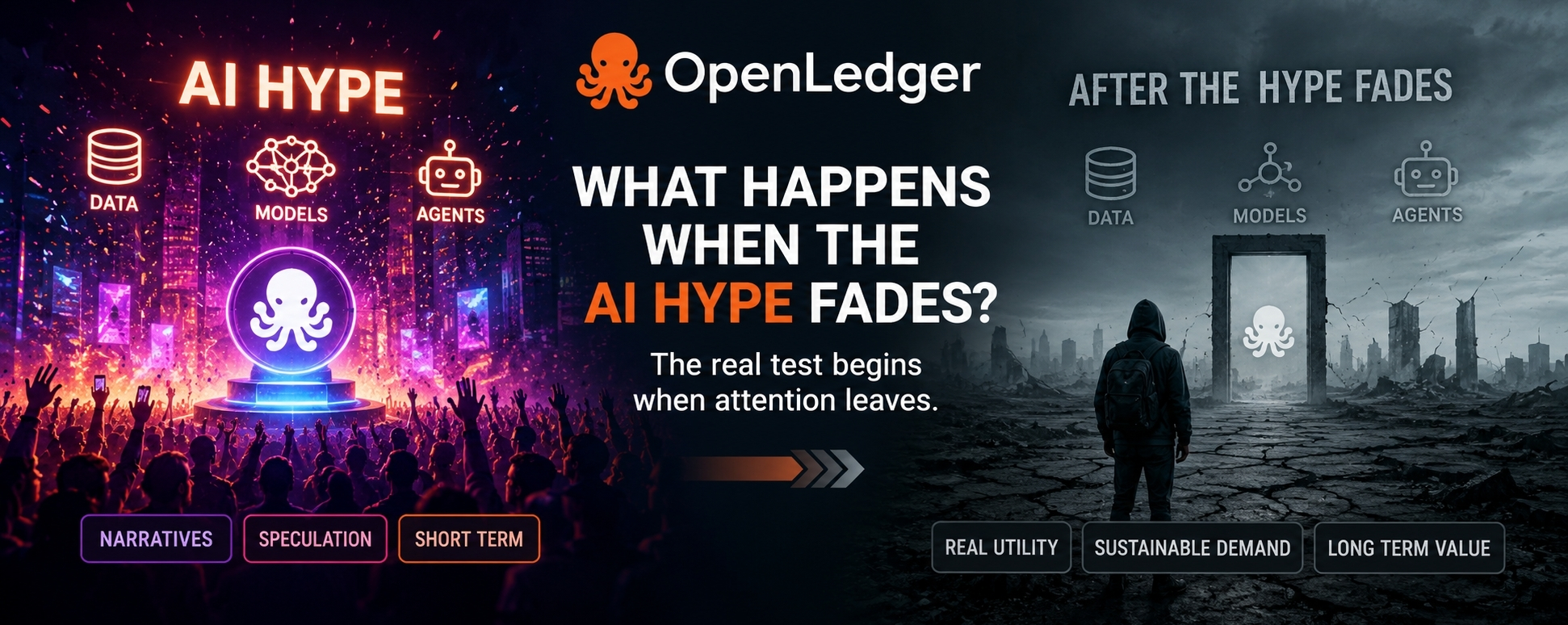
I've been around long enough to know that markets love a good story.
A few years ago it was DeFi. Then NFTs. Then metaverse projects. Now AI is pulling in most of the attention. Every cycle seems to find a theme that promises to reshape everything, and for a while it feels like nothing else matters.
That's probably why I keep looking at OpenLedger with more caution than excitement.
The idea itself isn't hard to understand. OpenLedger wants to build an economic layer around data, AI models, and autonomous agents. In a world where AI is becoming more valuable every month, that sounds like a logical direction.
But I've learned that logic alone doesn't make a network survive.
Good ideas fail all the time.
What interests me isn't the vision. Every project has one. What interests me is what people actually do when the rewards slow down and the spotlight moves somewhere else.
Crypto has a habit of making activity look like demand.
People interact because incentives exist. Metrics grow because rewards are available. Communities expand because attention is flowing. From a distance, all of it can look like adoption.
Sometimes it is.
Sometimes it isn't.
That's where I think OpenLedger faces its biggest test.
Can it become useful enough that people stay even when speculation fades?
Because eventually it always fades.
The market gets distracted. New narratives appear. Liquidity chases the next opportunity. What remains afterward is usually the truth.
I've watched markets reward noise before utility. I've watched projects dominate conversations for months and then quietly disappear once the excitement dried up. The technology didn't necessarily fail. The incentives did.
OpenLedger sits in a space where the opportunity is real, but so are the questions.
Do builders genuinely need this infrastructure?
Do companies actually want decentralized access to data and models?
Will AI agents create enough economic activity to justify an entire ecosystem around them?
Those questions matter more than any roadmap.
Compatibility removes friction. It does not create demand.
That's something the crypto industry forgets over and over again. Making something possible is different from making it necessary.
The token is another piece of the puzzle. Its long-term value won't come from being attached to AI. Plenty of projects can claim that. The real challenge is whether the network creates behavior that depends on the token rather than simply passing through it.
That's a much harder thing to achieve.
I'm not looking at OpenLedger and seeing certainty.
I'm looking at it and seeing a test.
A test of whether AI and blockchain can create something more durable than another market narrative. A test of whether participants remain active when rewards become less attractive. A test of whether the network can generate genuine demand instead of temporary attention.
The story is interesting.
The technology is interesting.
But the part that matters most hasn't happened yet.
The harder question starts after the hype.
And that's the part I'm still watching.