
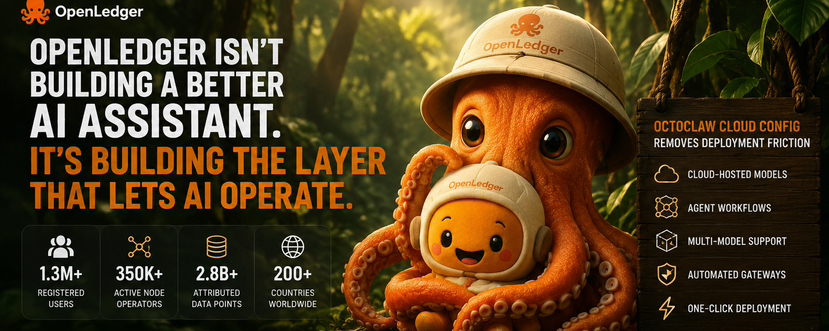
I thought I understood what @OpenLedger was building. Like most people following the project, I spent a lot of time looking at attribution, Datanets, and the broader vision of creating an economy around AI. Then I started reading about OctoClaw's Cloud Config update, and something clicked. The update itself wasn't dramatic. There was no bold promise to change everything overnight. Yet the more I looked into it, the more it felt like #OpenLedger was quietly addressing one of the biggest problems preventing AI agents from becoming genuinely useful: deployment friction.
The strange thing about AI today is that intelligence is no longer the hardest part. We already have models that can write, research, reason, and generate surprisingly useful outputs. The problem usually starts after that. Anyone who has experimented with AI agents knows the experience can become messy very quickly. Models need hosting. Credentials need management. Environments need configuration. Workflows need orchestration. What looks simple in a demo often becomes complicated in practice. That's where many promising AI systems lose momentum.
What caught my attention about Cloud Config is that it appears designed to remove those obstacles rather than add new features. Instead of requiring users to manage heavy local infrastructure, the system allows connections to remote AI models, cloud hosted inference endpoints, and agent workflows through a more unified layer. The technology itself isn't necessarily revolutionary. The idea behind it is. $OPEN seems to be betting that the future of AI adoption depends less on making agents smarter and more on making them easier to operate.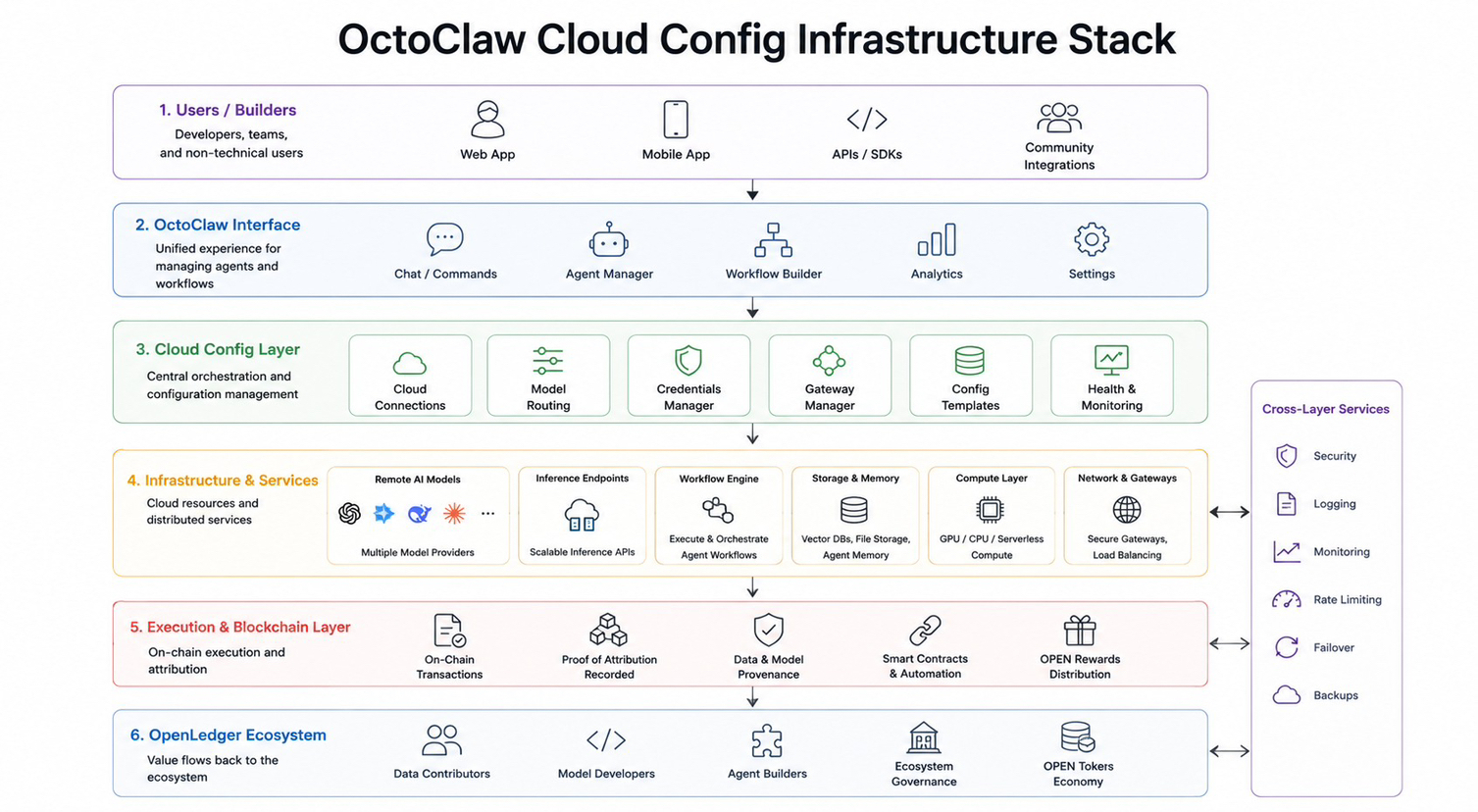
The more I thought about that, the more it changed how I viewed OctoClaw itself. Initially, I saw it as another AI assistant entering an increasingly crowded market. But the recent direction suggests something different. OpenLedger appears to be positioning OctoClaw as an execution engine rather than a chatbot. Researching information, generating outputs, executing commands, automating workflows, coordinating systems, and even supporting on-chain actions all point toward a larger ambition. The goal seems less about conversation and more about operation.
That distinction feels important because markets often underestimate operational infrastructure. Everyone notices the model producing an answer. Fewer people notice the system that keeps the workflow running. Yet those invisible layers often determine whether a technology scales beyond early adopters. Looking at recent ecosystem growth, that challenge becomes even more relevant. OpenLedger has surpassed 1.3 million registered users while supporting more than 350,000 active node operators. At that scale, operational simplicity stops being a convenience and starts becoming a necessity.
One detail that stood out to me was the growing focus on cloud hosted agent deployments. Recent documentation and community tools point toward support for Oracle Cloud infrastructure, remote model hosting, automated gateway management, and long running agent environments. I don't think those updates will generate major headlines. Most investors probably won't discuss them. But they matter because they address the gap between an AI demo and a functioning AI system. That's often where adoption succeeds or fails.
The ecosystem's multi model direction also caught my attention. Community developed Cloud Config implementations now support multiple cloud hosted models, including DeepSeek, Kimi, Gemini Flash, Qwen Coder, and Minimax variants. Features such as model aliases, fallback routing, cloud based Ollama integrations, and simplified deployment flows suggest a future where users care less about which model powers a workflow and more about whether the workflow simply works. That feels like a subtle but important shift.
At the same time, this infrastructure push fits surprisingly well with OpenLedger's original vision. The protocol has consistently argued that contributors should be rewarded for the value they create. Through Proof of Attribution, the goal is to build an ecosystem where models, data, and applications become economically connected. The network has already reported more than 2.8 billion attributed data points flowing through its infrastructure. But attribution alone doesn't create participation. Participation happens when barriers become low enough that people can contribute without needing to become infrastructure experts first.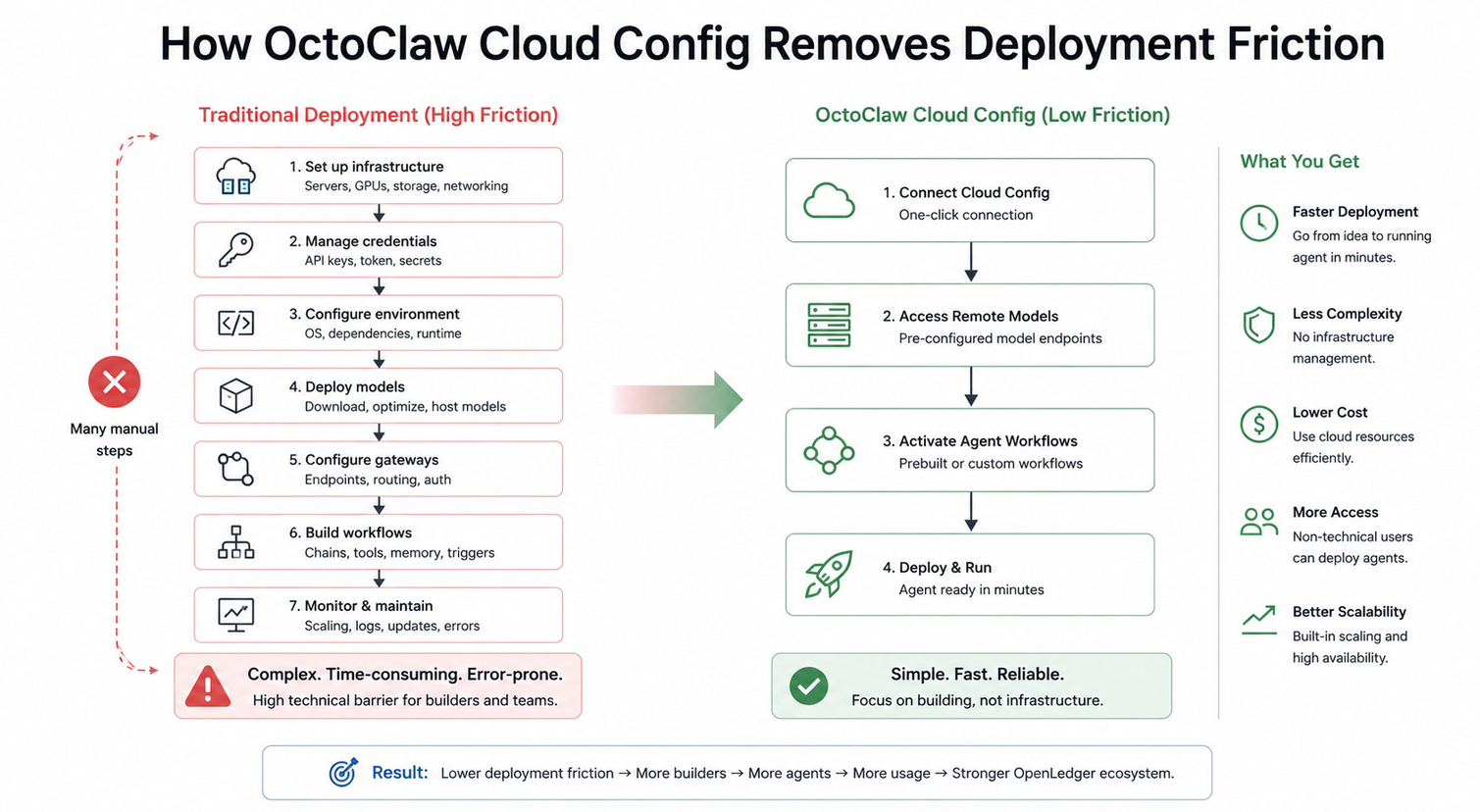
AI is evolving too quickly for anyone to make confident predictions. Many projects promise seamless automation and discover that reality is far more complicated. OpenLedger still needs to prove that simplifying deployment leads to sustained usage and not just temporary curiosity. Reliable execution is much harder than a compelling roadmap. The market will eventually judge outcomes, not intentions.
Still, I keep returning to the same realization. For years, AI has been measured by the quality of its answers. Increasingly, I think it will be measured by its ability to operate. The most important AI systems may not be the ones producing the smartest response. They may be the ones quietly coordinating models, workflows, data, and actions behind the scenes. If that future arrives, OctoClaw's Cloud Config may end up being remembered as more than a technical upgrade. It may be one of the first signs that OpenLedger wasn't building a better assistant at all. It was building the infrastructure layer that allows autonomous AI to become practical.