
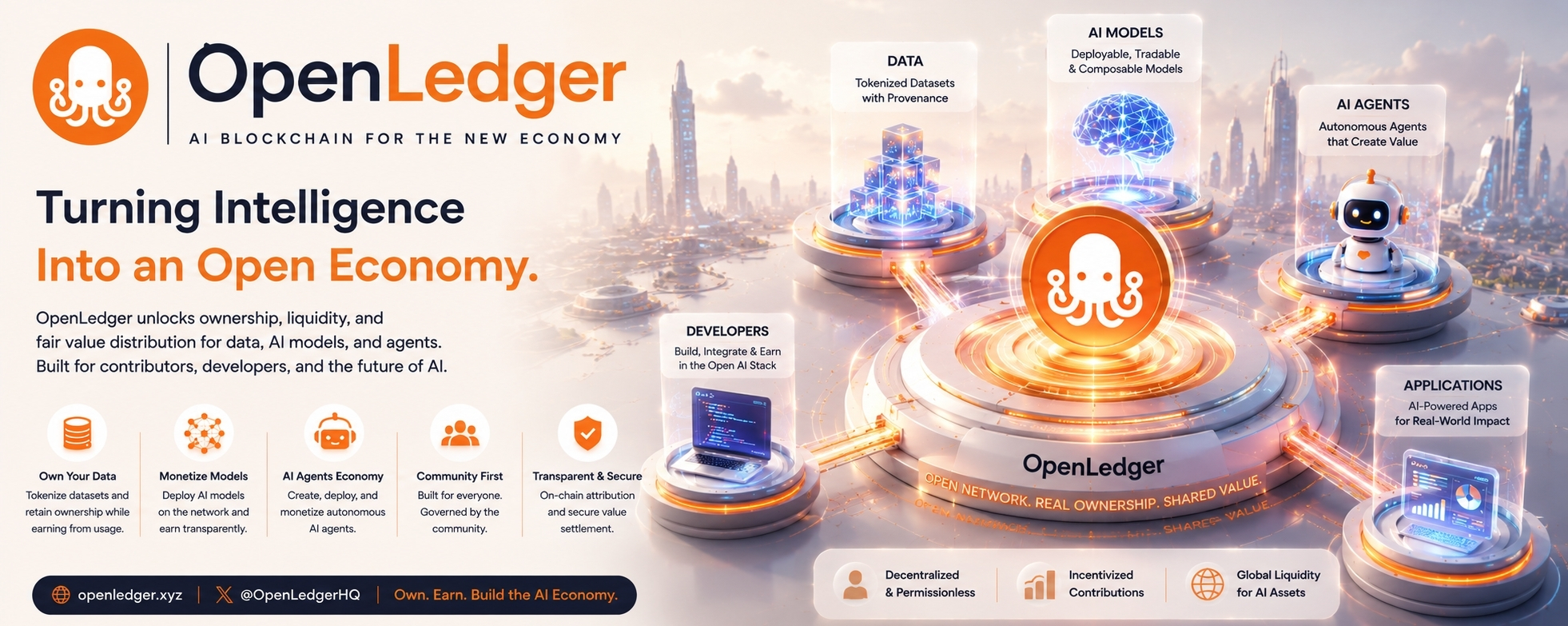
@OpenLedger A few years ago, the biggest question in AI was simple:
Can machines become intelligent?
Today, that question feels almost outdated.
AI can already write.
It can code.
It can analyze.
It can generate images.
It can automate workflows that would have taken entire teams not long ago.
The conversation has changed.
We’re no longer asking whether AI can do useful things.
We’re asking what kind of world emerges when AI becomes part of everything.

And the more I think about that future, the more one question keeps coming back:
Who owns the value AI creates?
At first glance, the answer seems obvious.
The companies building the models.
But the deeper you look, the more complicated it becomes.
Because AI isn't created by a single company.
It's built on layers.
Massive amounts of data.
Open-source contributions.
Developer communities.
User interactions.
Specialized tools.
Infrastructure providers.
Modern AI is less like a product and more like an ecosystem.
Yet most of the value generated by that ecosystem still flows toward a relatively small number of centralized platforms.
That isn't necessarily anyone's fault.
It's simply how the industry evolved.
But it does create a strange imbalance.
Millions of people contribute to AI's growth, directly or indirectly, while only a small part of the ecosystem participates in the ownership of that growth.
That's why #OpenLedger caught my attention.
Not because it's promising another breakthrough model.
And not because it's claiming to build artificial superintelligence.
What makes OpenLedger interesting is that it's focused on the economic layer surrounding AI.
A layer most people barely talk about.
The first time I looked into the project, I realized it wasn't trying to solve an intelligence problem.
It was trying to solve a coordination problem.
Because as AI grows, intelligence may not be the bottleneck anymore.
Ownership might be.
Think about where the industry is heading.
Soon there won't just be AI models.
There will be millions of AI agents.
Specialized systems.
Autonomous tools.
Industry-specific models.
Personal AI assistants.
Business automation agents.
All interacting with data, services, and each other.
That future sounds exciting.
But it also raises an obvious question.
How does value move between all these participants?
How does a data contributor get rewarded?
How does a developer monetize a specialized model?
How does an AI agent interact economically with another AI system?
Traditional internet infrastructure was never really designed for that.
And that's where OpenLedger starts making sense.
The project approaches AI as an open economy rather than a closed platform.
Instead of treating data, models, and agents as resources trapped inside corporate walls, OpenLedger attempts to make them economically accessible.
Tradable.
Monetizable.
Composable.
The idea is surprisingly simple.
If data creates value, it should have ownership.
If models create value, they should have liquidity.
If agents create value, they should be able to participate economically.
That shifts the conversation completely.
Because suddenly AI isn't just about intelligence anymore.
It's about incentives.
And incentives are what determine whether ecosystems thrive.
History shows this repeatedly.
The internet grew because people could build businesses on top of it.
Open-source software grew because contributors found ways to create value.
Marketplaces grew because incentives aligned between participants.
AI will likely follow the same pattern.
The systems that succeed won't necessarily be the smartest.
They'll be the ones that create sustainable economic networks around intelligence.
The more I think about it, the more OpenLedger feels less like an AI project and more like infrastructure.
Infrastructure is rarely the most exciting thing to talk about.
People get excited about applications.
Products.
Consumer experiences.
But infrastructure is often where the long-term value gets built.
Roads matter more than the cars driving on them.
Payment networks matter more than individual transactions.
Cloud infrastructure matters more than any single app running on top of it.
The same logic may eventually apply to AI.
As the ecosystem expands, coordination becomes increasingly important.
Not just technical coordination.
Economic coordination.
Who contributes?
Who gets rewarded?
Who owns what?
How does value flow through the network?
Those questions become more important every year.
This is also why the blockchain component feels more practical here than in many AI projects.
The blockchain isn't there to make AI smarter.
It's there to create transparent ownership, attribution, and incentive structures.
In other words, it organizes the economy around intelligence.
And that may turn out to be one of the biggest opportunities in the entire sector.
Because intelligence is becoming abundant.
Models are improving rapidly.
Tools are becoming more accessible.
But ownership, attribution, and value distribution remain largely unsolved.
OpenLedger appears to be focused on that gap.
The gap between creating intelligence and creating an economy around intelligence.
Of course, none of this guarantees success.
Building infrastructure is difficult.
Open ecosystems require governance.
They require scalability.
They require incentive systems that remain fair over time.
Those challenges are real.
But they're also the kinds of challenges every foundational technology eventually faces.
The internet had to solve communication.
Financial systems had to solve trust.
Cloud computing had to solve scalability.
AI may now be reaching the point where it needs to solve ownership.
And that's why I keep coming back to projects like OpenLedger.
Not because they're trying to replace AI.
Not because they're trying to build the smartest model.
But because they're asking a different question entirely:
If AI becomes one of the largest economic forces in the world, how do we make sure the people, data, models, and agents contributing to that future can participate in the value being created?
The more AI evolves, the more important that question becomes.
And the more OpenLedger starts to feel like a piece of infrastructure the industry may eventually need.
@OpenLedger #OpenLedger #openledger
