
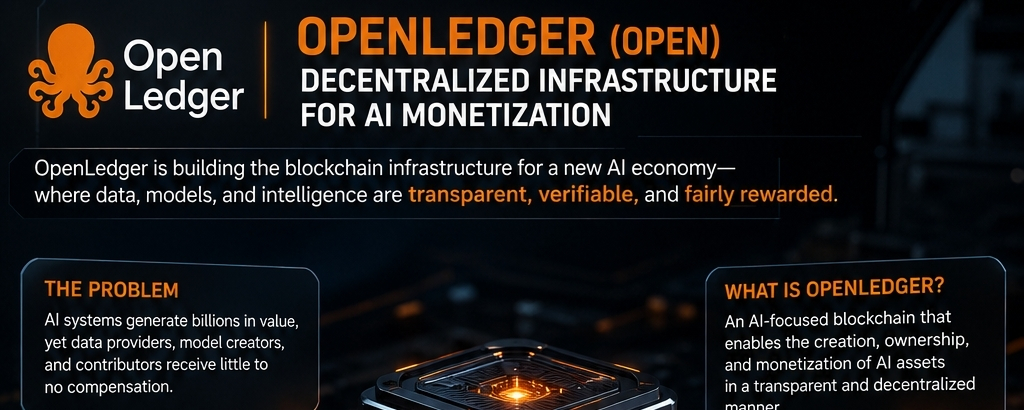
Artificial Intelligence is rapidly becoming the most valuable technology sector in the world. From content generation and data analysis to autonomous agents and enterprise automation, AI is reshaping industries at an unprecedented pace. Yet behind this explosive growth lies a major problem that most people rarely discuss. The individuals, developers, researchers, and communities who contribute the data and intelligence that power AI systems often receive little to no compensation for their contributions.
This imbalance has created one of the biggest challenges in modern technology. AI companies generate billions of dollars in value, while the contributors who provide datasets, training inputs, annotations, and specialized knowledge remain largely invisible. OpenLedger aims to change that equation.
OpenLedger (OPEN) is emerging as one of the most ambitious projects at the intersection of blockchain and artificial intelligence. Rather than treating AI as a closed ecosystem controlled by a handful of corporations, OpenLedger introduces a decentralized infrastructure where data providers, model creators, developers, and users can all participate in and benefit from the value generated by AI. The project describes this vision as “Payable AI,” a framework designed to make AI transparent, traceable, and economically fair.
At its core, OpenLedger is an AI-focused blockchain that records contributions across the entire AI lifecycle. Whether someone provides training data, develops a model, improves a dataset, or contributes computational resources, their involvement can be tracked and verified on-chain. This creates a system where rewards are distributed according to measurable contributions rather than centralized decisions.
One of the most important innovations introduced by OpenLedger is its Proof of Attribution mechanism. Traditional AI models often operate as black boxes. Users rarely know where training data originated, how models were built, or who should receive credit for the final output. OpenLedger attempts to solve this issue by creating a transparent attribution layer that traces the influence of data and models on AI-generated results. When an AI model produces an output, the system can identify which datasets contributed to that result and automatically distribute rewards to contributors.
This concept has major implications for the future of AI ownership. In today's ecosystem, data is frequently collected, aggregated, and monetized without meaningful compensation for the original contributors. OpenLedger introduces a framework where data becomes a productive digital asset. Contributors are not simply acknowledged; they are economically rewarded whenever their data creates value within the network.
The timing of OpenLedger's development is particularly significant. Regulatory scrutiny surrounding AI training data has intensified worldwide. Questions regarding copyright, intellectual property, data ownership, and content licensing continue to dominate discussions among governments, technology companies, and legal experts. OpenLedger's infrastructure directly addresses these concerns by providing verifiable data lineage and transparent attribution records. Instead of relying on trust, the network creates an auditable system where the origin and usage of data can be verified on-chain.
In recent months, OpenLedger has achieved several notable milestones that demonstrate growing momentum. The project officially launched its OPEN Mainnet, marking a major transition from concept to operational infrastructure. This launch introduced the network's core functionality, allowing developers and contributors to participate in the Payable AI ecosystem through a live blockchain environment. The mainnet deployment represented a critical step toward creating a fully functioning marketplace for AI data, models, and agents.
Network activity has also shown encouraging growth. According to project data, OpenLedger has registered millions of nodes on its testnet, processed tens of millions of transactions, supported thousands of AI models, and enabled the launch of multiple ecosystem products. These figures suggest increasing interest from developers, data contributors, and infrastructure participants who see potential in decentralized AI monetization.
The OPEN token plays a central role within the ecosystem. It functions as the economic backbone of the network, facilitating model registration, inference payments, governance participation, and contributor rewards. Developers use OPEN to publish and deploy AI models, while users spend the token to access AI services and model outputs. Revenue generated through these interactions is distributed across the network according to OpenLedger's attribution framework. This creates a circular economy where value flows directly between users, developers, and data providers.
Beyond simple payments, OPEN also enables governance participation. Token holders can contribute to decisions regarding protocol upgrades, fee structures, reward distribution mechanisms, and broader ecosystem development. This governance model aligns with OpenLedger's broader vision of community-owned AI infrastructure rather than centralized control.
Another reason OpenLedger has attracted attention is its focus on specialized AI applications. The project believes the future of AI will not be dominated solely by large general-purpose models. Instead, specialized models trained on high-quality domain-specific data are expected to become increasingly valuable. OpenLedger provides the infrastructure needed to build, deploy, monetize, and manage these specialized AI systems while ensuring contributors receive fair compensation.
The ecosystem also supports emerging technologies such as AI agents, decentralized applications, Retrieval-Augmented Generation systems, and real-time data integrations. These capabilities position OpenLedger as more than just a blockchain network. It aims to become a foundational infrastructure layer for the next generation of AI-powered applications.
From an investment and market perspective, OpenLedger has generated significant interest within both the AI and crypto sectors. The project has secured backing from notable investors, including Polychain Capital and Borderless Capital, helping strengthen confidence in its long-term vision. Its token launch attracted substantial trading activity and market attention, reflecting growing interest in AI-focused blockchain infrastructure.
Looking ahead, OpenLedger's future potential extends beyond cryptocurrency markets. As AI becomes increasingly integrated into business operations, the demand for transparent data sourcing, contributor compensation, and verifiable model training is likely to grow. Enterprises may eventually require systems that can demonstrate compliance, licensing transparency, and ethical AI development practices. OpenLedger's architecture is specifically designed to address these emerging needs.
Future ecosystem developments are expected to include expanded AI marketplaces, broader model monetization tools, enhanced attribution systems, and partnerships that connect traditional intellectual property frameworks with AI licensing mechanisms. Recent initiatives involving AI rights management and creator compensation standards indicate that the project is actively positioning itself at the center of these discussions.
Ultimately, OpenLedger represents a broader shift in how society may approach artificial intelligence. Instead of concentrating value among a small number of technology companies, it proposes a collaborative model where contributors, developers, and users share in the economic benefits generated by AI. The project's emphasis on transparency, attribution, and decentralized ownership addresses some of the most pressing challenges facing the AI industry today.
While the long-term success of OpenLedger will depend on adoption, developer participation, and execution, its vision aligns closely with the growing demand for accountable and fair AI systems. As artificial intelligence continues to expand into every sector of the global economy, platforms that can connect innovation with transparent value distribution may become increasingly important.
OpenLedger is not simply building another blockchain network. It is attempting to create the economic infrastructure for a future where AI is open, traceable, and collectively owned. If that vision gains traction, the project could play a significant role in shaping how AI is built, monetized, and governed in the years ahead.