
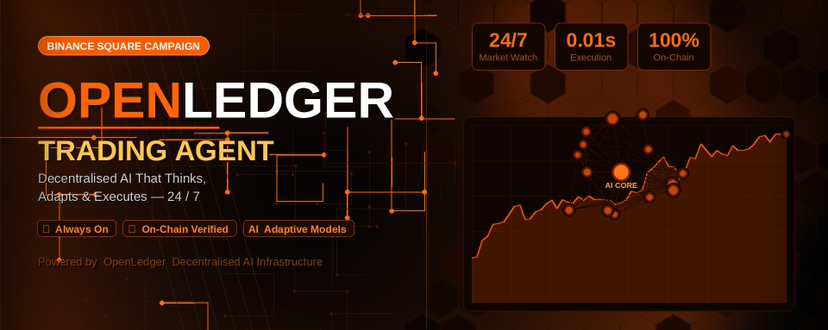
Before We Begin — A Thought Worth Sitting With
Most people enter the crypto market with one goal: make money.
Simple enough, right?
But ask anyone who has spent serious time trading — the ones who have stayed through full market cycles, not just a bull run or two — and they will tell you something honest.
Trading is not the hard part.
Deciding is the hard part.
Knowing when to enter. When to hold. When to exit before the chart does something you did not prepare for. Managing your emotions when red candles stack up like dominoes. Staying awake at 3 AM because the market never sleeps, even when your body demands it.
That is the real challenge.
And that is exactly the problem OpenLedger is solving — not with promises, not with hype — but with something far more concrete.
A Trading Agent powered by decentralised AI.
This article is a full breakdown of what that means, why it matters, how it works, and why the timing of this technology could not be more relevant to every trader, investor, and builder in this space today.
Part One: What Is OpenLedger, Really?
Let us start from the foundation.
OpenLedger is a decentralised AI infrastructure platform. It is not a trading app. It is not a portfolio tracker. It is not another DeFi protocol promising passive income with no explanation.
It is something much more important.
OpenLedger is building the base layer that makes AI agents possible — AI agents that run transparently, verifiably, and without relying on centralised servers or closed systems.
Think of it this way.
Right now, most AI tools are black boxes. You put data in. Something happens inside. A result comes out. You have no idea what the model was trained on, whether the outputs are trustworthy, or whether the company behind it is acting in your interest.
OpenLedger changes that model entirely.
On OpenLedger, the AI infrastructure is open. The data contributions are tracked. The model training is auditable. The agents built on top of it operate according to rules that anyone can inspect.
This is not a small improvement. This is a fundamental shift in how AI and blockchain intersect and one of the most powerful demonstrations of this infrastructure in action is the Trading Agent.
Part Two: Problem That Makes Trading Agents Necessary
Before we get into what the Trading Agent does, let us be honest about why it needs to exist.
Human Trading Problem:
Humans are emotional. There is no getting around this. We feel fear when markets drop. We feel greed when they rise. We second-guess our own strategies at the worst possible moments.
Professional traders spend years — sometimes decades — training themselves to override these instincts. And even then, the best traders in the world have losing streaks. Even the best funds have bad quarters.
The average retail trader? The odds are not kind. Study after study in traditional markets and crypto markets tells the same story: most retail traders underperform the market over time, largely because of emotional decision-making.
Information Problem:
The crypto market runs on information. News, on-chain data, social sentiment, whale movements, protocol updates, macroeconomic signals — all of it matters.
But no human being can monitor all of it, all the time.
By the time most traders read about a major development, the market has already priced it in. The edge goes to whoever processed the information first.
That used to mean only large institutions could compete effectively. They had the capital to hire analysts, build data pipelines, and run automated systems.
The individual trader was always at a disadvantage.
Time Problem:
Markets do not wait for you.
A setup that forms at 4 AM on a Tuesday does not care that you have a meeting in the morning. A liquidation risk that builds over three hours does not pause because you are cooking dinner.
This is one of the most exhausting realities of trading crypto. The market is global, continuous, and indifferent to your schedule.
Consistency Problem:
Even traders who understand markets deeply cannot always execute with consistency.
One day they follow the plan. The next day, after a bad night of sleep or a frustrating loss, they deviate from it. They hold too long. They exit too early. They take a trade they should have passed on.
Inconsistency is the silent killer of many trading careers.
All four of these problems — emotion, information overload, time constraints & inconsistency — share a common solution.
You need something that does not sleep, does not panic, does not get greedy, and processes more data than any human ever could.
You need a Trading Agent.
Part Three: What OpenLedger Trading Agent Actually Does
Let us get specific.
The OpenLedger Trading Agent is not a simple bot that buys when RSI hits a number and sells when a moving average crosses. That technology is old. It exists already. And it fails regularly because markets are dynamic — rigid rules break in changing conditions.
The Trading Agent on OpenLedger is something different. It is an AI-powered system built on decentralised infrastructure, designed to think, adapt, and act across market conditions.
Here is what that looks like in practice.
Continuous Market Monitoring:
The Trading Agent watches the market continuously. Not in intervals. Not when you remember to check. Continuously.
It processes price action, volume, order book depth, and on-chain signals in real time. It does not miss setups because it was busy. It does not skip an exit because it looked away.
This alone solves the time problem.
Multi-Source Data Processing:
Beyond basic price data, the Trading Agent ingests and processes multiple data streams simultaneously.
Sentiment from social platforms. On-chain wallet movements. Funding rates. Open interest. Derivatives data. News signals. Protocol activity.
A human trader can follow one or two of these streams. The Trading Agent can follow all of them — and weight them intelligently based on what the market conditions suggest matters most right now.
This solves the information problem.
Strategy Execution Without Emotion:
When the Trading Agent identifies a valid setup, it executes. No hesitation. No second-guessing. No “but what if this time is different.”
When it detects a risk signal, it responds. No hope. No “just give it a few more candles.”
This is not rigidity. The agent is designed to be adaptive. But its adaptations are based on data and logic — not fear or greed.
This solves the emotional problem.
Consistent Rule Application:
The Trading Agent applies the same logic every time. The same risk parameters. The same entry criteria. The same exit conditions.
If a strategy works, it is applied consistently. If it stops working, the system can detect that shift and adjust — not because a human noticed and reacted, but because the underlying models flagged the change.
This solves the consistency problem.
Part Four: Why Decentralisation Changes Everything
Here is where OpenLedger separates itself from every other AI trading solution on the market.
There are already automated trading bots available. Some of them are sophisticated. Some of them produce real results for real users.
But almost all of them share a critical vulnerability.
They are centralised.
That means:
The company behind them controls the model
You cannot verify what the bot is actually doing
If the company changes its policies, shuts down, or gets compromised, your strategy is at risk
You have to trust that the team is acting in your interest — and trust is not a guarantee
OpenLedger changes this at the infrastructure level.
Verifiable Execution:
On OpenLedger, the actions of the Trading Agent are logged on-chain. The execution is transparent. You do not have to take the platform’s word for what happened. You can verify it yourself.
This matters enormously for trust. In a space where rug pulls and misrepresentation have cost the community billions of dollars, verifiability is not a nice feature. It is a necessity.
Open Data Contributions:
AI models that power OpenLedger’s agents are trained on data contributed by participants in the network. Those contributions are tracked. Contributors are credited.
This creates an ecosystem where the quality of the AI improves as more people participate — and where the participants who make it better are recognized for their role.
This is fundamentally different from a corporate AI model trained on proprietary data that nobody outside the company can inspect.
No Single Point of Failure:
Because OpenLedger operates on decentralised infrastructure, there is no single server that can be taken down, no single company that can be pressured into changing the rules, no single point that an attacker needs to compromise.
System is as resilient as the network it runs on.
Aligned Incentives:
Perhaps most importantly, the incentive structures of a decentralised AI platform are built differently.
On OpenLedger, the people contributing data, running nodes, building agents, and using the platform are all participants in the same ecosystem. When the platform grows, everyone who contributed to that growth benefits.
This is very different from a centralised company where growth benefits shareholders and users are the product, not the partners.
Part Five: Architecture Behind Trading Agent
Let us go a level deeper into how this actually works — without getting lost in jargon.
Layer 1 — Data Infrastructure:
Everything starts with data. And data quality is everything in AI.
OpenLedger has built infrastructure for collecting, cleaning, and validating data from multiple sources. This is not trivial work. Raw market data is messy. On-chain data requires interpretation. Social data requires filtering.
The data layer ensures that what goes into the models is reliable. Garbage in, garbage out is a real principle — and OpenLedger has engineered against it from the start.
Layer 2 — Model Training and Validation:
The AI models that power the Trading Agent are trained on this validated data. The training process is not a black box — the methodology is open to inspection.
Importantly, the models are not just trained once and frozen. These models are designed to be dynamic, based on the latest available information, changes in market conditions, and the knowledge gained from experience.
It is this ability to change with time that makes the Trading Agent useful in all types of markets—trending markets, range markets, and high volatility periods among others.
Layer 3 — Agent Logic:
This is the third layer above the data and model layer and deals with making decisions about how to trade using the outputs generated by the model.
Here the risk settings can be set. Position sizing rules are applied. Entry and exit logic is codified. Drawdown protections are enforced.
The agent logic is configurable — meaning that users and builders on the platform can set parameters appropriate to their own risk tolerance and goals.
Layer 4 — Execution and Settlement:
When the agent makes a decision, execution happens on-chain or through connected exchange integrations. The action is logged. The outcome is recorded.
Settlement follows the same transparent, verifiable process.
At every step, the system produces a record that can be audited.
Part Six: Who Is Trading Agent For?
This is an important question, and the honest answer is: a wider range of people than you might think.
Active Retail Trader:
If you are already trading crypto and you are frustrated by the emotional toll, the time demands, and the information overload — the Trading Agent is for you.
It does not replace your market knowledge. It executes on it — consistently, continuously, without the human limitations that cost you trades.
Think of it as the difference between having a strategy and living that strategy at all times.
Long-Term Holder Who Wants More:
Many people in crypto are not interested in active trading. They hold Bitcoin or ETH or a basket of quality assets and check in monthly.
That is a legitimate approach but it leaves value on the table.
Trading Agent can operate strategies that extract additional value from volatile conditions — not by taking excessive risk, but by intelligently responding to market movements that a pure holder would simply ride through.
Builder:
OpenLedger is a platform, not just a product. For developers, AI researchers, and DeFi builders, it provides the infrastructure to build custom agents, integrate data sources, and create novel applications on top of the decentralised AI layer.
The Trading Agent is one example of what is possible. The same infrastructure can power research agents, risk monitoring systems, portfolio management tools, and much more.
Institution:
As crypto markets mature, institutional participants are increasingly looking for solutions that meet their standards for transparency, auditability, and compliance.
A decentralised AI platform that produces verifiable records of every decision and action is a fundamentally better fit for institutional requirements than an opaque centralised bot.
OpenLedger’s infrastructure is built in a way that scales to institutional demands.
Part Seven: Timing Has Never Been Better
There is a reason this technology is emerging now. And understanding that context makes the opportunity clearer.
AI Is Reaching Tipping Point:
The AI capabilities that power agents like the one OpenLedger is building have advanced dramatically in the past three years. What would have required enormous computing resources and highly specialised teams just a few years ago is now accessible at a fraction of the cost.
This means the gap between “we have an idea” and “we have a working system” has collapsed dramatically.
OpenLedger is not pitching a future capability. It is deploying current technology.
Crypto Markets Are More Complex Than Ever:
The crypto market of 2026 is not the market of 2017 or 2020. It is more liquid, more interconnected, and more influenced by a broader range of factors.
Macro signals matter. Regulatory developments move markets. On-chain data provides insights that never existed in traditional markets.
This complexity is overwhelming for human traders. It is a feature, not a bug, for AI systems designed to process complex, multi-source data.
De-centralisation Is No Longer Trade-Off:
Early decentralised applications often asked users to accept inferior user experience in exchange for trustlessness. That trade-off is disappearing.
OpenLedger delivers decentralised infrastructure that performs at a level competitive with centralised alternatives. The trustlessness is no longer a penalty. It is simply an additional benefit.
Demand for AI Tools in Finance Is Exploding:
Global adoption of AI in financial services is accelerating. Institutions are investing billions. Retail platforms are scrambling to integrate AI features.
OpenLedger is not trying to catch a wave that has not formed. It is building infrastructure for a wave that is already breaking.
Part Eight: Risk, Responsibility & Honest Expectations
Any serious discussion of a trading tool has to include an honest conversation about risk.
Trading involves risk. AI-powered trading does not eliminate risk. Anyone who tells you otherwise is not being straight with you.
What a well-designed Trading Agent does is manage risk better. It applies consistent risk parameters. It does not override stop losses because of hope. It does not size positions larger than defined because of excitement.
But markets can and do produce outcomes that no model anticipated. Black swan events happen. Correlations break down. Liquidity vanishes at the worst moments.
The Trading Agent is a tool. A powerful, well-built tool. But it operates in a market that is fundamentally uncertain.
What OpenLedger’s approach does — through decentralisation, transparency, and open auditing — is ensure that the tool is working as intended. That the logic is sound. That the execution matches the strategy.
It eliminates the risk of the tool working against you. It does not eliminate the inherent risk of the market itself.
Understanding this distinction is important.
The goal is not to remove risk. The goal is to approach risk intelligently, consistently, and with the best possible information — and then accept the outcomes with discipline.
That is what the Trading Agent is designed to support.
Part Nine: OpenLedger’s Vision for Ecosystem
The Trading Agent is not the end of the story. It is the beginning of a demonstration.
OpenLedger’s larger vision is a decentralised AI ecosystem where multiple agents work together — each specialised, each contributing, each benefiting from the shared infrastructure.
Imagine a world where:
A research agent monitors on-chain developments and surfaces relevant signals
A sentiment agent tracks narrative shifts across social platforms
A risk agent monitors portfolio exposure across protocols
A trading agent executes on the synthesised intelligence from all of the above
And all of them operate transparently. All of them produce verifiable records. All of them run on infrastructure that no single entity controls.
This is not science fiction. The building blocks are here. OpenLedger is assembling them.
Trading Agent is proof that the assembly works.
Part Ten: How Binance Square Community Fits In
The Binance ecosystem has always been about participation. From early IEO launches to Launchpool opportunities to the Square community itself — Binance has consistently created platforms where the community is more than an audience. It is an active participant.
OpenLedger fits perfectly into this ethos.
The decentralised AI infrastructure that OpenLedger builds is not meant to serve only OpenLedger. It is meant to serve the broader ecosystem — including the Binance community that has been at the heart of crypto adoption for years.
For Binance Square users specifically, the opportunity is multilayered:
As learners:
Trading Agent and the infrastructure behind it represent the cutting edge of how AI and crypto are converging. Understanding this now is not just interesting. It is strategically valuable.
As participants:
OpenLedger’s model rewards network participation. Data contributors, node operators, and ecosystem builders are integral to the platform’s growth — and the platform’s growth benefits those participants.
As traders:
Trading Agent is, at its core, a tool built for people who trade crypto. The Binance Square community is that community.
As builders:
For the developers and entrepreneurs in this space — OpenLedger’s infrastructure is an open invitation to build something new.
Part Eleven: A Day in Life of Trading Agent
Let us make this concrete with a practical scenario.
It is a Tuesday. You have a meeting in two hours. The market has been volatile all week — a major macroeconomic announcement is expected later today and nobody is quite sure how the market will respond.
Under normal circumstances, this is a stressful trading day. You are distracted. Your execution is likely to be off. You might either over-trade out of anxiety or miss opportunities because you are not watching closely enough.
With the Trading Agent running:
The system is monitoring the market continuously. It has processed pre-announcement positioning data — the way smart money tends to hedge or accumulate before major news events. It has reviewed funding rates, which are currently elevated — suggesting overleveraged long positioning that could unwind quickly if the news is negative.
Based on this analysis, the Trading Agent has reduced exposure going into the announcement. Not to zero — that would be leaving opportunity on the table — but to a level that limits downside if the market moves against existing positions.
The announcement comes. The market initially spikes, then reverses sharply — a classic “buy the rumour, sell the news” pattern.
Trading Agent, monitoring in real time, identifies the reversal signal within seconds of the pattern forming. It planned response works, exiting long positions at defined levels, potentially entering short position if momentum data supports it.
You, meanwhile, were in your meeting. You checked your phone once and saw a notification that the agent had adjusted positions.
You did not panic. You did not rush to a terminal. You did not make a reactive decision that you would later regret.
You return to your desk. The positions are exactly where the strategy said they should be. The execution was clean.
That is not a fantasy. That is what a well-built Trading Agent, running on reliable infrastructure, can actually deliver.
Part Twelve: What Sets OpenLedger Apart from Competitors
The AI trading space is not empty. There are competitors. Some of them are legitimate. It would be dishonest to pretend otherwise.
So why OpenLedger?
De-centralisation Is Not an After-thought:
For most AI trading platforms, decentralisation is marketing language. Their core infrastructure is centralised. They use the word “decentralised” loosely.
For OpenLedger, decentralisation is the architecture. It is foundational. The entire system was designed from the beginning to operate without centralised control.
This is a meaningful difference — not just philosophically, but practically. It affects everything from data security to execution integrity to the long-term sustainability of the platform.
Data Network Effect:
As more participants contribute data to OpenLedger, the models get better. As the models get better, the agents perform better. As the agents perform better, more participants are attracted to the platform.
This is a classic network effect — and it is one that competitors with closed data pipelines cannot replicate.
OpenLedger’s infrastructure is designed to capture and amplify this compounding improvement.
Community-Aligned Incentives:
OpenLedger does not make money by keeping its edge secret from users. It makes money when the ecosystem grows. The incentive structure actively rewards community contribution and participation.
This alignment is genuinely rare. Most AI companies have a fundamentally adversarial relationship with their users at some level — they extract data from users to build proprietary models that they then sell back to users.
OpenLedger flips that model.
Long-Term Vision Matches Long-Term Trajectory:
AI and blockchain are two of the most significant technological trends of this generation. OpenLedger is building at their intersection.
The long-term trajectory of both technologies points in the same direction: more intelligent systems, more transparency, more decentralisation, more individual empowerment.
OpenLedger is not building for the next product cycle. It is building for the next decade.
Part Thirteen: Getting Started — What You Can Do Right Now
For anyone reading this who wants to engage with OpenLedger and the Trading Agent, the path forward is clear.
Step 1 — learn more:
The OpenLedger documentation and community channels are the best places to understand the platform’s architecture, the Trading Agent’s capabilities, and the broader ecosystem vision. Do not rely on any single article — including this one — as your only source of information. Go to the source.
Step 2 — follow campaign:
OpenLedger’s current campaign on Binance Square and Creatorpad is an opportunity to engage with the project at an early stage. Early community members who understand what a project is building — before the broader market does — are consistently the ones who benefit most from its growth.
Step 3 — engage with community:
The people building on OpenLedger, contributing data to it, and discussing it are valuable sources of insight. Conversations happening right now in Discord, on Binance Square & in other crypto communities contain information and perspectives that no single article can fully capture.
Step 4 — assess fit:
Every financial tool and every investment opportunity needs to be assessed in the context of your own situation — your risk tolerance, your existing knowledge, your goals, and your capacity to absorb potential losses.
OpenLedger is not for everyone in the same way. Some people will find the Trading Agent to be an immediate fit. Others will find more value in the infrastructure layer as a builder. Others might engage primarily as data contributors.
Know what role fits you best.
Part Fourteen: Final Thoughts — Why This Matters Beyond Trading
We started this article by talking about trading. But let us end it by zooming out.
The Trading Agent is a specific application. An impressive one. A genuinely useful one for the people it serves.
But what OpenLedger is really building is something larger.
It is demonstrating that AI can be trustworthy — not because you trust the company behind it, but because the system itself is transparent and verifiable.
It is demonstrating that AI can be open — not just open source in a technical sense, but genuinely accessible to contributors and participants who are rewarded for making the system better.
It is demonstrating that AI and blockchain are more powerful together than either is alone — that the transparency and immutability of the blockchain can give AI the accountability structure it has always lacked.
These are not small ideas. In a world where AI is becoming increasingly central to how decisions are made — in finance, in healthcare, in governance, in everyday life — the question of whether AI systems are trustworthy and accountable is not an abstract philosophical question. It is one of the most important practical questions of our time.
OpenLedger is answering that question with working technology.
The Trading Agent is the proof of concept.
The broader ecosystem is the vision.
And the Binance Square community — one of the most engaged, most knowledgeable, and most active communities in the entire crypto space — is perfectly positioned to understand both.
Summary: What We Covered
For those who want a quick recap before diving deeper:
OpenLedger:
Is a decentralised AI infrastructure platform building the base layer for transparent, verifiable AI agents.
Trading Agent:
Is one of its flagship applications — an AI-powered system that monitors markets continuously, processes multi-source data, executes strategies without emotional interference, and operates with full transparency on decentralised infrastructure.
Problem it solves:
Is real and well-documented: human traders are limited by emotion, time, information overload, and inconsistency. The Trading Agent addresses all four limitations.
What makes it different:
Is the decentralisation, not as a marketing claim, but as architectural reality — verifiable execution, open data, no single point of failure, aligned incentives.
Timing is right:
Because AI capabilities have reached a point where this is buildable, crypto markets are complex enough that AI tools deliver genuine value, and the demand for trustworthy AI in financial applications is growing rapidly.
Opportunity for Binance Square community:
Is to engage early, learn deeply, and participate in an ecosystem whose long-term trajectory aligns with where both AI and blockchain are heading.
⚠️ Purely informational & educational content only, not financial or investment advice.
#OpenLedger #BinanceSquare #creatorpad
