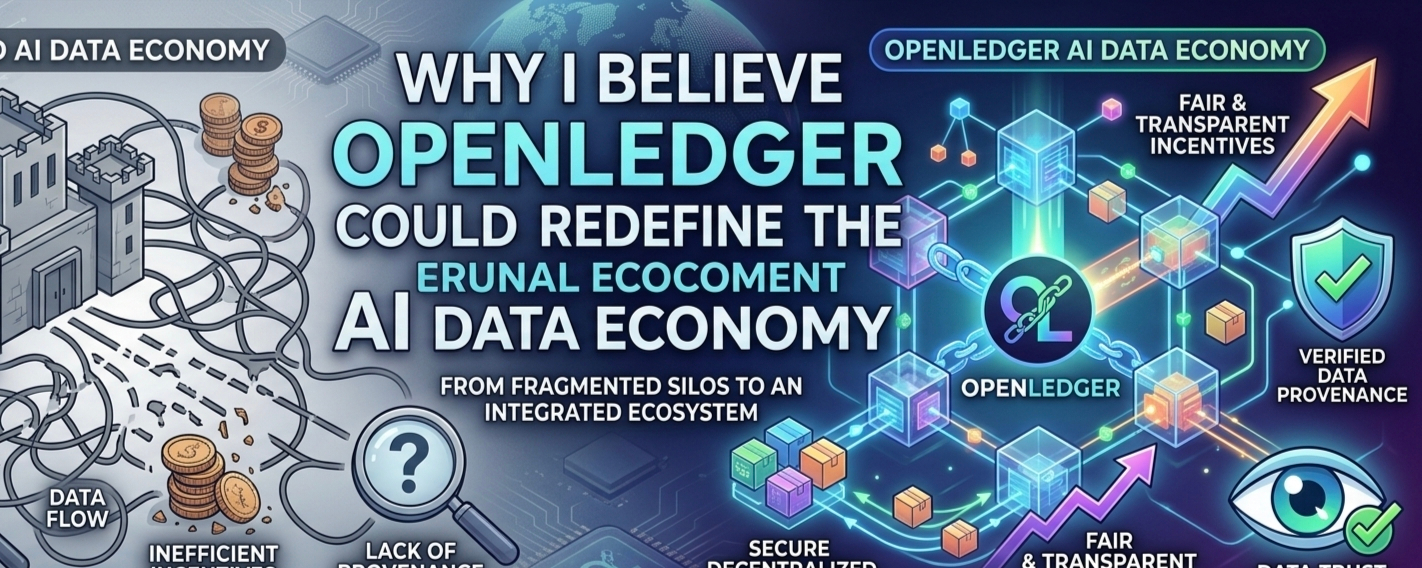
I have spent time studying OpenLedger, and the more I examine it, the more I see it as an attempt to solve one of the biggest contradictions emerging in the AI economy. Data has become one of the most valuable resources in the world, yet the people and organizations generating that data rarely participate in the value it creates. OpenLedger appears to be built around a simple but ambitious idea: transforming data, AI models, and autonomous agents into liquid digital assets that can be owned, contributed, monetized, and exchanged within a blockchain-native environment.
What immediately caught my attention is that OpenLedger is not trying to compete with AI models directly. Instead, I see it focusing on the infrastructure layer that sits underneath them. Most discussions around artificial intelligence revolve around model capabilities, but I believe the more important long-term question is where the training data comes from, who owns it, and how contributors are rewarded. OpenLedger seems to recognize that future AI systems will depend not only on increasingly powerful models but also on sustainable incentives for the people and organizations providing high-quality data.
I find this particularly relevant because today's AI landscape is experiencing a growing imbalance. Large models consume enormous amounts of information, but the mechanisms that compensate data creators remain relatively weak. OpenLedger appears to address this by creating an ecosystem where datasets themselves become productive assets rather than passive resources. In theory, contributors can provide valuable data, developers can build models on top of it, and value can flow back through the network instead of accumulating solely at centralized platforms.
From a human perspective, I find the concept genuinely compelling because it aligns incentives more fairly than many existing AI systems. At the same time, I remain cautious. History shows that creating a marketplace for data is significantly harder than creating a marketplace for tokens. Data quality, authenticity, compliance requirements, privacy concerns, and valuation standards introduce complexity that cannot be solved through blockchain technology alone. OpenLedger's success will ultimately depend on whether it can maintain trust while enabling economic activity around AI assets.
When I think about who benefits most from a system like OpenLedger, healthcare immediately comes to mind. Imagine a network of hospitals possessing thousands of medical images useful for training diagnostic AI models. Today, sharing that data often creates legal, ethical, and privacy challenges. A blockchain-based framework that tracks ownership, permissions, usage rights, and compensation could allow institutions to contribute value without losing control of sensitive information. Instead of raw patient records being openly distributed, authorized participants could monetize access while maintaining compliance requirements.
Another example is pharmaceutical research. Drug discovery increasingly relies on massive datasets gathered across multiple organizations. In traditional environments, data-sharing agreements are slow, expensive, and difficult to audit. A platform designed to verify contributions and distribute rewards transparently could reduce friction between research institutions while preserving accountability. Similar opportunities exist in finance, supply chains, insurance, and scientific research, where valuable information is often trapped inside organizational silos.
What I find particularly interesting is the project's focus on liquidity. Most datasets and AI models today are economically valuable but operationally illiquid. Organizations may possess assets worth millions in potential intelligence but have no practical way to monetize them without selling complete control. OpenLedger appears to be exploring a middle ground where ownership remains intact while utility becomes tradable. If executed correctly, this could create entirely new economic models around AI development.
Operationally, I see convenience emerging from the consolidation of several disconnected processes into a single framework. Data providers gain attribution, developers gain access to structured resources, model creators gain monetization opportunities, and users gain transparency regarding where intelligence originates. Rather than treating AI development as a black box, the system attempts to make contributions visible and economically measurable.
The broader market context also makes the idea increasingly relevant. As of 2026, AI infrastructure has become one of the fastest-growing segments in technology investment, while concerns around data ownership, copyright disputes, model transparency, and regulatory compliance continue to intensify. Healthcare organizations are under growing pressure to balance innovation with privacy protection, and governments worldwide are paying closer attention to how AI systems acquire and utilize data. In that environment, platforms focused on data provenance and value attribution are likely to attract more attention than they would have only a few years ago.
Despite the potential, I believe several risks deserve attention. One challenge is data quality. Blockchain can verify transactions and ownership records, but it cannot automatically guarantee that contributed data is accurate, unbiased, or useful for training advanced models. Another challenge is adoption. A data economy becomes valuable only when enough participants contribute meaningful resources. Building that network effect is often one of the most difficult tasks for any infrastructure project.
There is also the issue of regulation. Healthcare, financial, and enterprise datasets operate under strict legal frameworks. Even if a platform offers strong technical safeguards, organizations may remain cautious about participating until regulatory standards become clearer. Furthermore, AI itself is evolving rapidly. Infrastructure designed for today's workflows must remain adaptable as model architectures, agent systems, and data requirements continue changing.
My overall view of OpenLedger is cautiously optimistic. I see a project attempting to address a genuine structural problem rather than chasing short-term narratives. The idea of unlocking liquidity for data, models, and AI agents feels increasingly relevant as artificial intelligence becomes more deeply integrated into economic activity. However, I also believe the hardest part lies ahead. Building technology is relatively straightforward compared to building