
The first time I seriously thought about @OpenLedger , I did not start with blockchain.
I started with a small personal experience.
A few months ago, I was working on an AI-based content and research task. The tool gave me a polished answer in seconds. It looked clean, useful, and complete. At first, I was impressed. But after reading it carefully, I noticed something strange. The answer had confidence, but no visible history. It gave information, but it did not show the real journey behind that information. I could not see which source shaped the answer, whose data influenced it, or which layer of knowledge made it useful.
That moment stayed with me.
Not because the answer was bad.
It was not bad.
It was actually useful.
But it revealed something deeper.
Modern AI often gives us the final result while hiding the chain of contribution behind it. The user sees the answer, but not the people, datasets, models, corrections, and systems that helped produce it. The output looks independent, but in reality it is built on many invisible inputs.
That is where OpenLedger becomes relevant.
At first, OpenLedger may look like another AI blockchain project. The language around it can sound familiar: data, models, agents, monetization, decentralization, attribution. But when I studied the idea more deeply, I realized its importance is not simply in combining AI with blockchain. Its importance is in addressing a structural weakness inside the AI economy.
AI has become powerful, but its value chain is still unclear.
Who contributes?
Who benefits?
Who gets ignored?
Who gets rewarded?
These questions are not decorative. They sit at the center of the future AI economy.
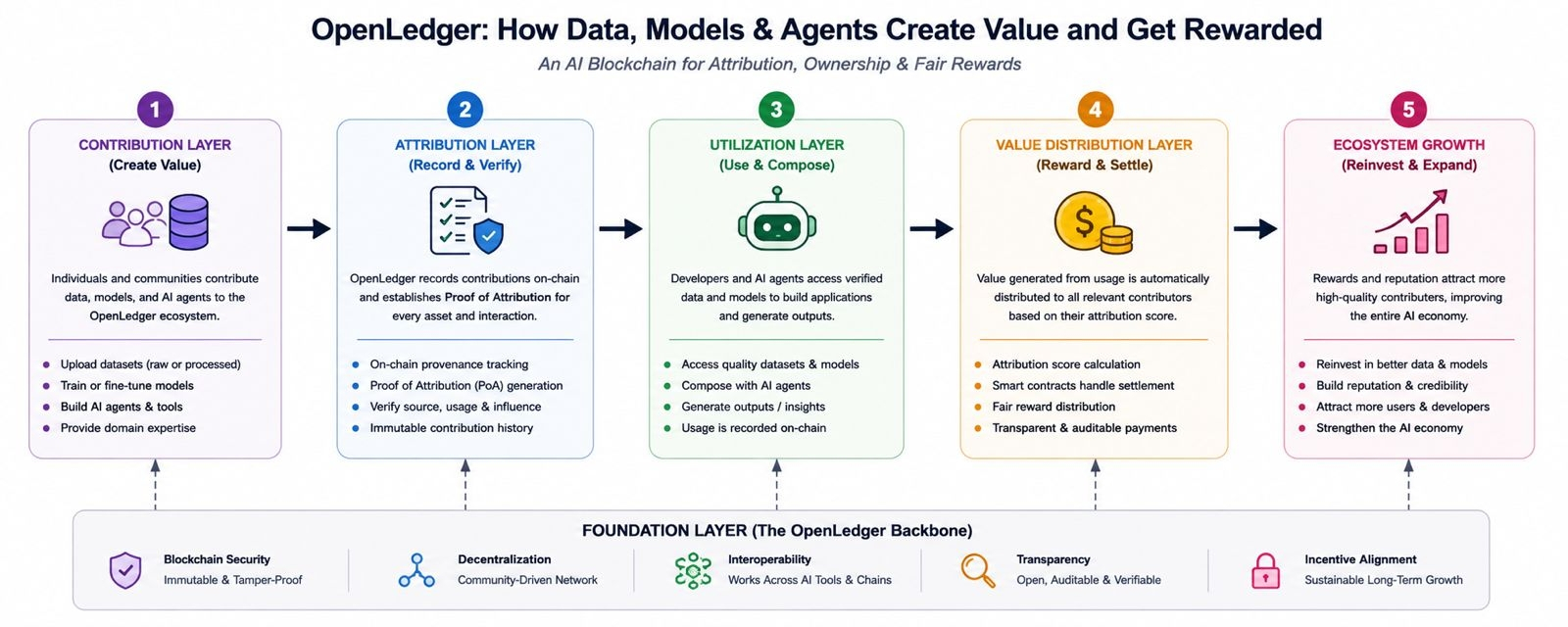
OpenLedger is trying to solve this by building an infrastructure where data, models, and AI agents can be tracked, attributed, and monetized. Its core idea, Proof of Attribution, is important because it tries to connect AI output back to the original sources of value. In other words, OpenLedger is not only asking whether AI can produce intelligence. It is asking whether intelligence can remember where it came from.
That distinction matters.
The obvious interpretation is that OpenLedger helps people earn from data. The deeper interpretation is that OpenLedger is trying to create economic memory for AI systems. Without such memory, contribution disappears into the background. A dataset becomes invisible once it is used. A contributor becomes irrelevant once the model is trained. A community becomes valuable only until its knowledge is absorbed.
That is the hidden cost of today’s AI.
The system looks efficient from the outside, but inside it creates an imbalance. Platforms can capture value at scale, while contributors often remain unseen. This is not always because of bad intention. Sometimes it happens because the system has no proper mechanism to measure contribution. If value cannot be traced, it cannot be fairly rewarded.
OpenLedger enters exactly at this point.
To understand this more clearly, imagine a practical situation. A developer wants to build a specialized AI agent for finance, healthcare, education, or legal research. The agent does not become useful only because of code. It needs reliable data. It needs domain-specific examples. It needs cleaned information. It needs models trained on meaningful inputs. It may also need contributors who understand local context, language, user behavior, and real-world use cases.
Now suppose that AI agent gives a valuable output.
The surface-level view is simple: the agent answered the user.
But the deeper view is more complex: many hidden contributors helped make that answer possible.
This is where OpenLedger’s idea becomes operationally important. If the system can trace which data, model, or agent contributed to an output, then value can be distributed more fairly. Data is no longer treated as a free raw material. Models are no longer viewed as isolated products. AI agents become part of a larger economic network where contribution can be recognized.
This is not just a technical upgrade.
It is a shift in power.
In traditional AI systems, the platform usually controls the final value. Contributors may provide data, feedback, behavior, or knowledge, but they rarely receive proportional recognition. OpenLedger challenges this structure by introducing a system where contribution can become visible and financially meaningful.
However, this also creates a serious challenge.
Once rewards are attached to contribution, incentives change. People behave differently when they know their data, model, or agent can generate value. Some will contribute high-quality datasets. Some will create useful models. Some will build reliable agents. But others may try to exploit the system by uploading low-quality or repetitive data only to gain visibility.
That is why OpenLedger’s real challenge is not only attribution.
It is quality under pressure.
A reward system cannot simply reward everything. If it does, the network becomes noisy. But if it becomes too strict, it may discourage open participation. This creates a difficult balance. OpenLedger must support broad contribution while still protecting reliability, trust, and usefulness.
That is the systemic tradeoff.
Do you reward open participation, or do you protect dependable performance?
Both matter
Open participation allows more people to enter the AI economy. It gives value to communities, builders, researchers, and data contributors who are often left outside traditional AI platforms. But dependable performance requires filtering, verification, and standards. Without these, the system may become crowded with weak contributions.
And honestly, some selectiveness is necessary.
Any serious infrastructure has to protect its own reliability. A payment system cannot accept every transaction without fraud checks. A marketplace cannot treat every seller as equally trustworthy. A search engine cannot rank every page the same. In the same way, an AI attribution network cannot treat every dataset, model, or agent as equally valuable.
This does not make OpenLedger less open.
It makes the project more realistic.
What stood out to me is that OpenLedger is not only creating a marketplace for AI assets. It is trying to create a trust layer for AI value. That trust layer is important because future AI systems will not only depend on large models. They will depend on specialized data, domain-specific agents, and verifiable sources of intelligence.
This is where OpenLedger becomes strongly connected to the next phase of AI.
The future will not be only about who has the biggest model. It will also be about who has the most reliable data network, the most transparent attribution system, and the strongest incentive structure for contributors. AI cannot scale responsibly if its inputs remain invisible and its contributors remain unpaid.
The broader economic meaning is clear.
OpenLedger turns data from a hidden input into a visible asset. It turns contribution from a silent activity into an economic signal. It turns AI agents from simple tools into channels through which value can move. This is why the project matters beyond the usual blockchain discussion.
Still, the idea must be judged carefully. A system that rewards contribution also defines contribution. A system that measures value also influences what people consider valuable. If the measurement is weak, the incentives become weak. If the incentives are weak, the quality of the AI economy suffers.
So OpenLedger’s biggest responsibility is not just to build technology.
It must build trust.
The deeper I looked at the project, the more I felt that its real purpose is not to make AI louder or faster. AI already has speed. It already has scale. What it lacks is memory, accountability, and fair economic recognition.
That is the hidden layer OpenLedger is trying to build.
In the end, OpenLedger is not important only because it connects blockchain with AI. It is important because it asks a more mature question: if intelligence is created from many sources, should the value also return to many sources?
For me, that is the strongest insight.
A serious AI economy cannot be built only on outputs. It must also remember inputs. It must recognize the people, data, models, and agents that make intelligence possible.
Because when a system forgets contribution, it centralizes power.
But when a system remembers contribution, it changes who gets to matter.