
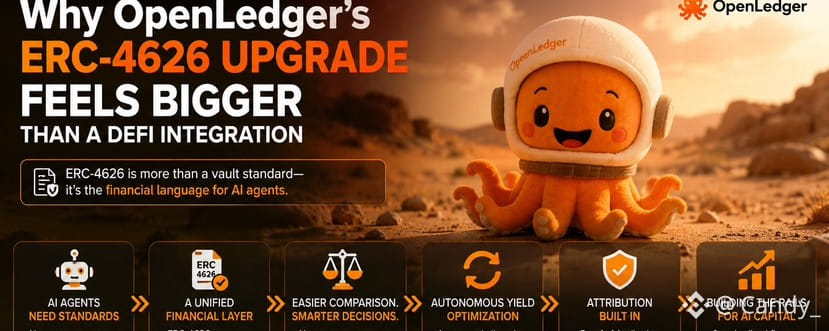
I keep noticing a pattern in crypto. We spend a lot of time talking about how intelligence is evolving, but much less time talking about how intelligence will manage money.
That might sound like a strange observation, yet the more I follow @OpenLedger the more I think it sits at the center of that question. The recent ERC 4626 integration is a good example. Most people viewed it as a standard DeFi upgrade. A vault standard. A backend improvement. Useful, but not exactly headline material. My first reaction wasn't very different. Then I started looking at where $OPEN seems to be heading rather than what the update actually does.
The protocol's long term vision has never been about AI models alone. #OpenLedger is building around Datanets, Proof of Attribution, AI agents, and contributor owned intelligence. The idea isn't simply to create smarter systems. The idea is to create an economy where intelligence itself can participate. Once I started viewing the ecosystem through that lens, the ERC 4626 integration felt much less like a technical feature and much more like economic infrastructure.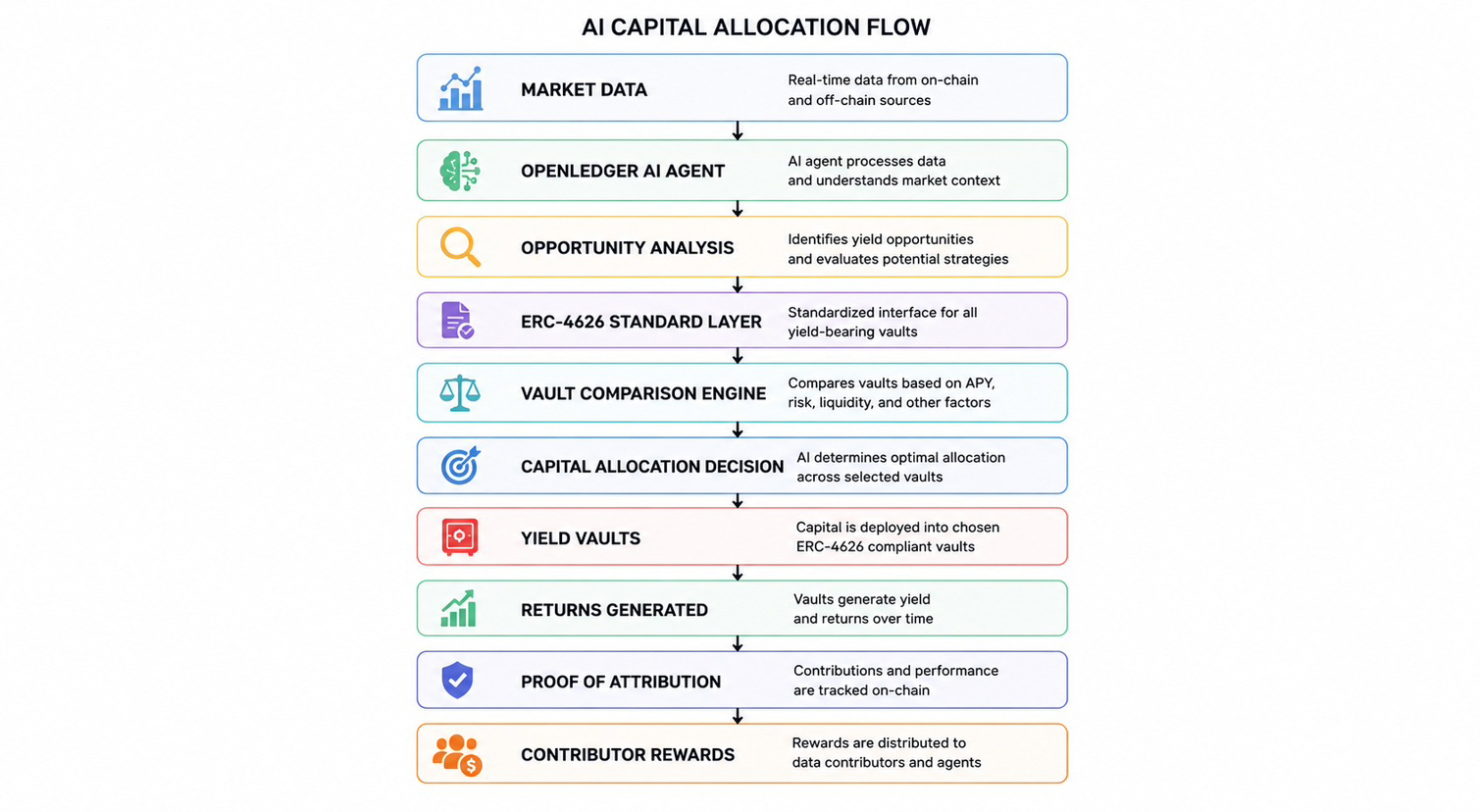
What interests me is that every growing economy eventually runs into the same challenge. It doesn't matter whether we're talking about countries, companies, or digital networks. Eventually, value has to be stored, allocated, managed, and deployed efficiently. Intelligence can identify opportunities, but capital decides which opportunities survive. Data can generate value, but financial systems determine how that value moves through an ecosystem.
That is where ERC 4626 becomes surprisingly relevant. The standard creates a shared framework for yield bearing vaults, making them easier to integrate across wallets, protocols, aggregators, and applications. Normally, that would be viewed as a DeFi efficiency upgrade. But in OpenLedger's case, it appears to be serving a broader purpose. The protocol is increasingly connecting standardized vault infrastructure to its vision of AI managed finance and automated capital allocation.
Before this integration, AI agents could already perform actions, execute workflows, and interact with on chain systems. The problem was that yield opportunities remained fragmented. Every protocol came with different structures, different interfaces, and different logic. That environment slows down automation. It forces intelligent systems to treat every opportunity as a separate problem. A shared standard changes that dynamic. Suddenly, yield becomes easier to interpret, compare, and manage programmatically.
The more I think about it, the more I believe OpenLedger is trying to make financial infrastructure understandable to machines. Humans can navigate fragmented systems because we adapt. AI agents work best when environments become standardized. ERC-4626 creates exactly that type of environment. Instead of interacting with dozens of unique vault architectures, agents can potentially operate through a common framework. That may sound like a small improvement, but it fundamentally changes how automated financial systems scale.
This is why I find the connection with OctoClaw particularly interesting. OpenLedger's agent framework continues moving toward autonomous execution and workflow coordination. Yet execution alone doesn't create an economy. Agents also need mechanisms for capital deployment, liquidity management, and yield optimization. If OctoClaw becomes the operational layer for AI driven activity, ERC 4626 increasingly looks like the financial layer supporting those operations beneath the surface.
The institutional implications are equally difficult to ignore. Large capital allocators rarely chase complexity. They tend to move toward systems that are standardized, predictable, and easy to integrate. Interestingly, the same characteristics that benefit institutions also benefit autonomous agents. Both perform better when infrastructure follows common standards. By adopting ERC 4626, OpenLedger isn't simply improving composability. It is making itself more accessible to both machine driven and institution driven capital flows.
The ecosystem appears to be growing into these infrastructure needs. OpenLedger has now surpassed 3 million registered users, attracted more than 1.5 million contributors, and generated over 100 million attributed AI interactions. OPEN has also maintained trading activity around the $0.19–$0.21 range, with daily volume frequently exceeding $10 million to $15 million. Those numbers don't guarantee future adoption, but they do suggest the network is moving beyond the stage where infrastructure decisions can be treated as secondary concerns.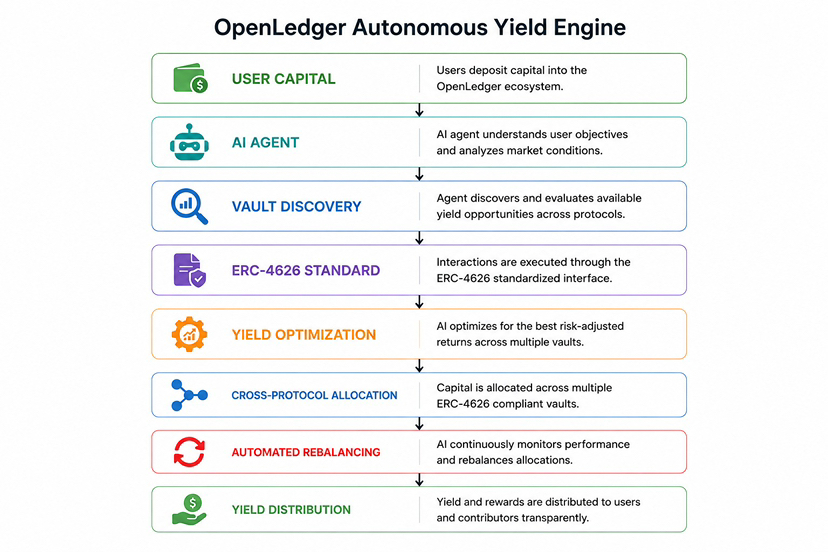
What I find fascinating is that this update may ultimately be remembered for what it enables rather than what it does. Most users will never think about ERC 4626. They will notice smarter agents, smoother financial products, and better automated experiences. The infrastructure itself will remain invisible. Yet that is often how foundational technologies work. Their success is measured by how little users need to think about them.
Maybe that's why I keep coming back to this integration. The market seems to view it as a vault standard. OpenLedger appears to view it as something larger. If the protocol succeeds in combining AI agents, attribution systems, automated execution, and financial automation into a functioning economy, then ERC 4626 may end up serving as more than a DeFi standard. It may become the common financial language that allows intelligence and capital to interact at scale.