
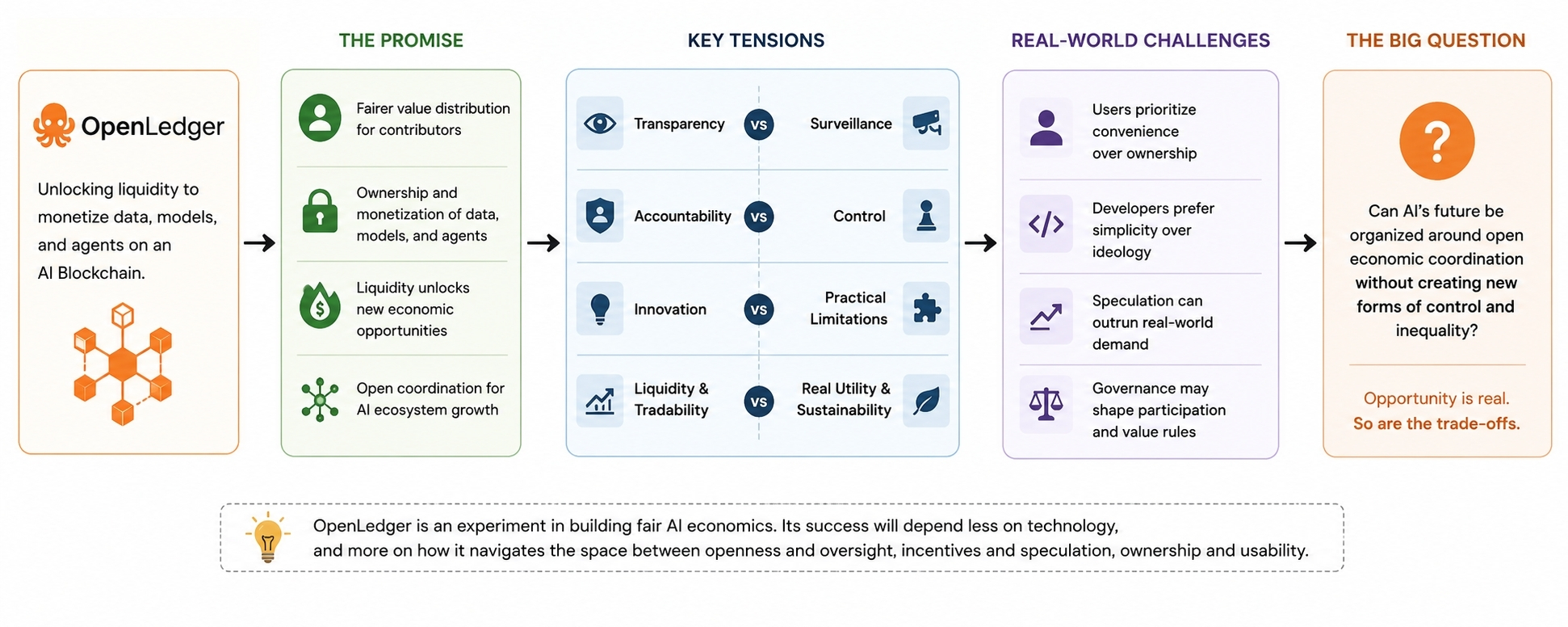

OpenLedger, like a lot of new AI + blockchain hybrids, starts from a feeling that something is unfair in how modern AI value is distributed. Data goes in from many people, models get trained, systems improve, and yet most of the upside gets captured by a small number of platforms. So the idea of turning data, models, and even AI agents into something that can be owned and monetized through an open ledger sounds, at least emotionally, like a correction.
But I keep circling back to what has to be true for that to actually work. The first is the assumption that data can be cleanly turned into an economic asset without losing its context. In practice, data is messy, overlapping, often collective. If you start pricing it too directly, you risk rewarding what is easiest to measure rather than what is actually meaningful. That usually pushes systems toward optimization tricks, not truth.
Then there’s the transparency question. Blockchain systems tend to treat transparency as an automatic goodeverything recorded, everything traceable. But with AI data pipelines, that can quietly drift into a kind of surveillance structure. If every contribution is permanently visible and attributable, people may gain credit, but they also lose the ability to blend into the system. It creates a world where participation is always legible, and that legibility can start to feel like pressure.
Accountability is another double-edged part of it. It sounds positive to say every model or dataset has clear ownership and responsibility attached to it. But once you build strong attribution systems, you also create leverage points who gets to define what counts as valid contribution, who approves changes, who controls distribution rules. What begins as openness can slowly turn into a different form of gatekeeping, just with better branding.
And then there’s the more practical friction that often gets underestimated. Most users don’t wake up wanting economic exposure to their data or agents. Most developers don’t want extra layers of financial or cryptographic complexity unless it’s absolutely necessary. So even if the system is elegant in theory, it has to compete with the simple reality that convenience usually wins over ideology.
There’s also a familiar crypto pattern in the background: liquidity arrives faster than real usefulness. Everything becomes tradable before it becomes truly needed. That can create energy and speculation, but it doesn’t always translate into durable value outside the ecosystem itself.
Still, it would be too easy to dismiss it. The underlying question who owns the value created by AI systems is not going away. OpenLedger and similar ideas are really experiments in whether we can rebuild AI incentives in a more distributed way without recreating new centralized chokepoints. I’m just not convinced yet that making everything financial, transparent, and tradable automatically leads to something healthier. Sometimes it does. Sometimes it just reshapes old problems into newer, more technical forms.