
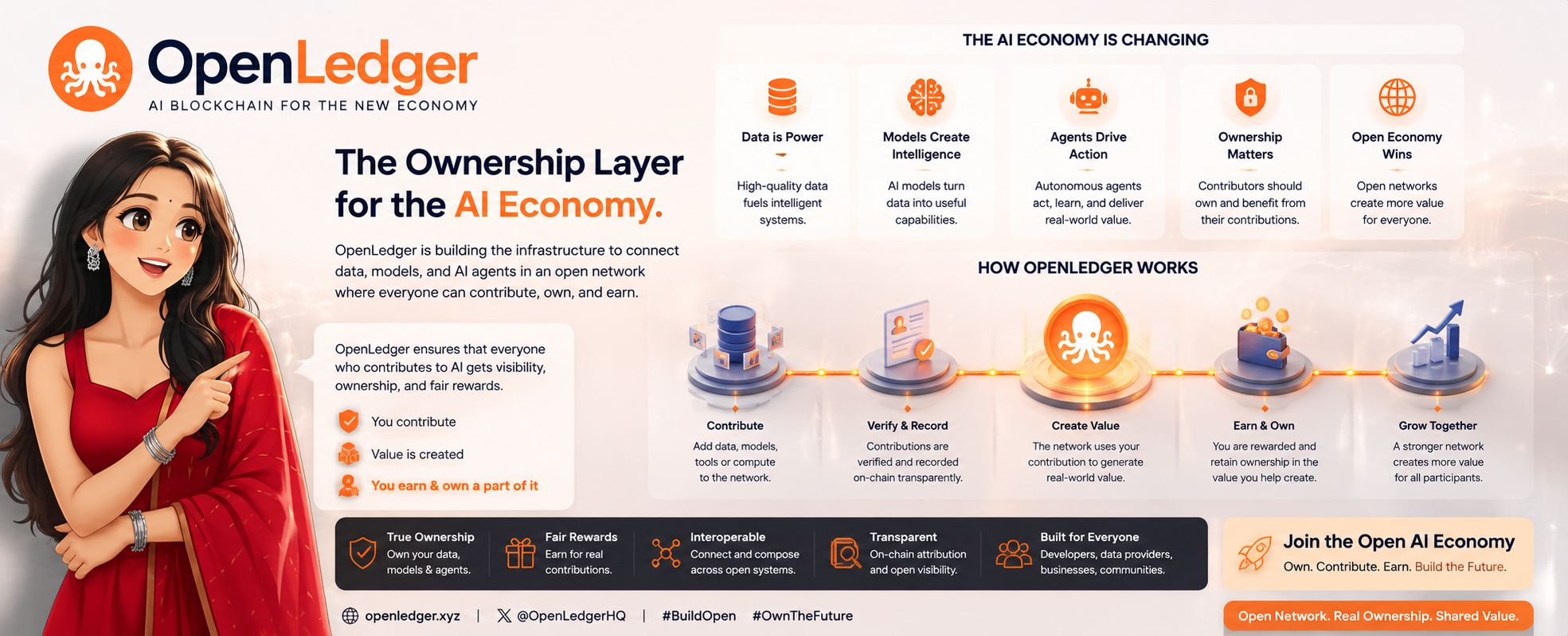
@OpenLedger For the last few years, the AI industry has felt like a race.
Every company wants the most powerful model.
The fastest inference.
The smartest reasoning.
The biggest benchmark scores.
And to be fair, that race has produced incredible progress.
Models today can do things that seemed impossible just a few years ago.
But lately, I've started feeling that the conversation is changing.
Not dramatically.
Quietly.
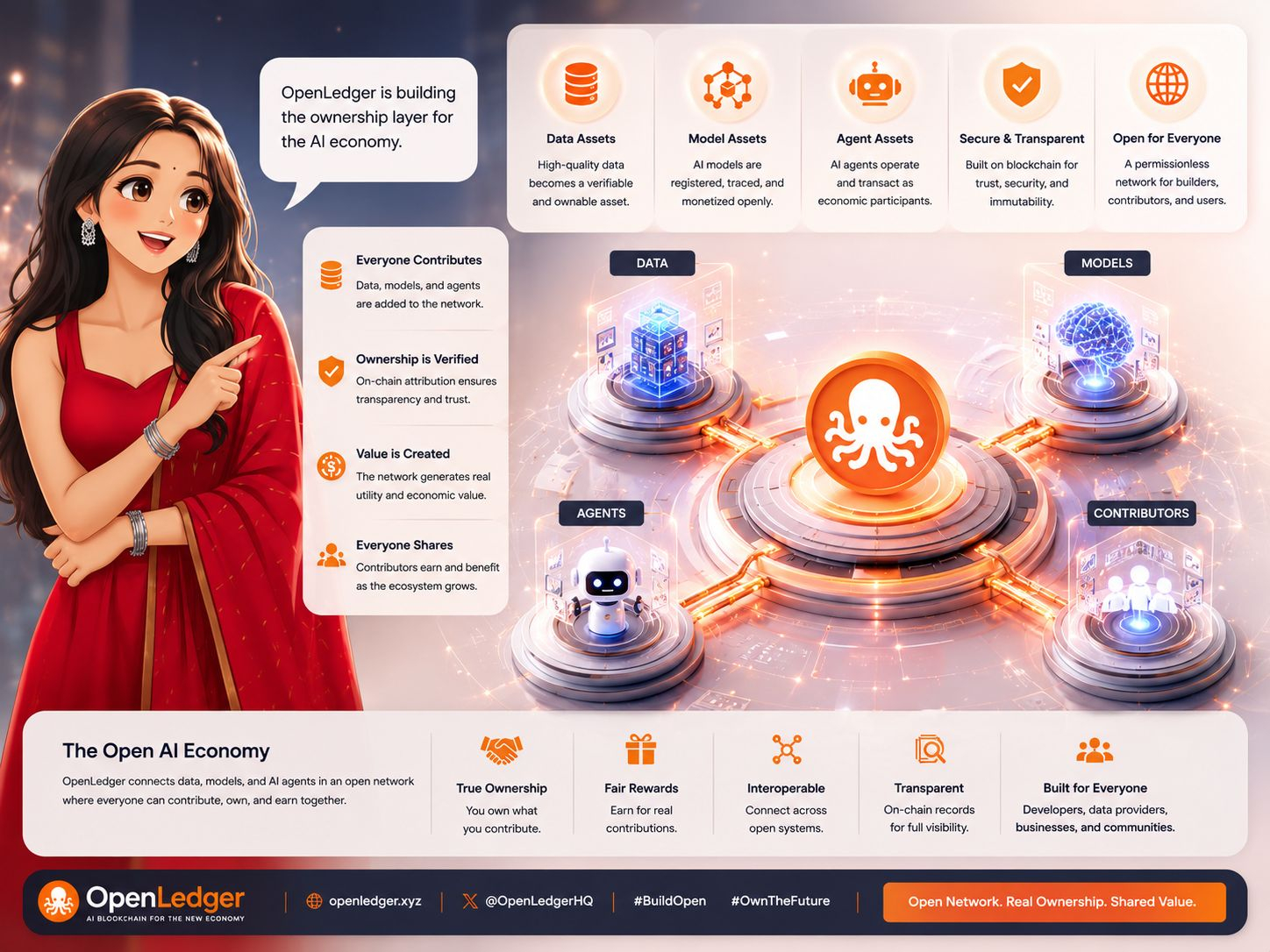
The focus is slowly shifting away from the models themselves and toward something underneath them.
Data.
Not just more data.
Better data.
Verified data.
Useful data.
Because no matter how advanced AI becomes, every model ultimately depends on the information feeding it.
Intelligence can only be as valuable as the knowledge supporting it.
And that's where I think one of the most interesting opportunities in AI is beginning to emerge.
Not in building another model.
But in building an economy around the data that powers those models.
That's one reason OpenLedger has been catching my attention recently.
The project seems to start from a simple observation:
AI models are becoming increasingly accessible.
Data is becoming increasingly valuable.
At first glance, that sounds obvious.
But the implications are huge.
For years, most discussions focused on who could build the best model.
Today, many organizations can access powerful AI capabilities.
Open-source models are improving rapidly.
Specialized models are appearing everywhere.
AI infrastructure is becoming easier to use.
As intelligence becomes more abundant, competitive advantages begin moving elsewhere.
And one of those places may be data ownership.
Think about it.
Every AI system needs information.
Healthcare data.
Financial data.
Scientific data.
Consumer data.
Industry-specific knowledge.
Real-world observations.
The future AI economy may depend less on who owns the model and more on who contributes the most valuable information.
That's where OpenLedger's vision starts becoming interesting.
Instead of treating data as something extracted and absorbed into centralized systems, the protocol appears focused on creating an environment where data itself becomes an economic asset.
A participant.
A source of value.
The first time I thought about this properly, it reminded me of something that happened during the rise of social media.
At first, platforms looked valuable because of their technology.
Eventually people realized the real value came from the network itself.
The users.
The content.
The interactions.
Without those contributions, the platforms would have been empty.
AI may be entering a similar phase.
Models are important.
But models without valuable information eventually hit limits.
The ecosystem feeding those models becomes increasingly important.
And ecosystems thrive when contributors have incentives to participate.
That's the part many people still overlook.
The future AI economy won't just need intelligence.
It will need contributors.
Businesses willing to share knowledge.
Developers willing to build tools.
Communities willing to provide expertise.
Data providers willing to participate.
Without incentives, participation slows.
Without participation, innovation slows.
OpenLedger appears to be building around that reality.
The protocol introduces the idea that valuable contributions should not simply disappear into black-box systems.
They should remain visible.
Rewarded.
Economically connected to the value they create.
That changes the relationship between contributors and AI networks.
Instead of being passive sources of information, contributors become active participants inside the ecosystem.
And participation creates stronger networks.
The more I think about it, the more it feels like AI is entering its infrastructure phase.
The early years were about proving capability.
Can AI generate text?
Can AI write code?
Can AI reason?
Now the questions are evolving.
How do we source high-quality information?
How do we reward contributors?
How do we build sustainable AI economies?
How do we align incentives between participants?
Those aren't model questions.
They're infrastructure questions.
And infrastructure often becomes most important after the technology itself matures.
The internet eventually needed payment systems.
Cloud computing eventually needed scalable architecture.
Digital commerce eventually needed trust mechanisms.
AI may now be reaching the point where it needs ownership and incentive systems.
That's where OpenLedger seems positioned.
Not necessarily as another AI application.
But as a framework for organizing the economic relationships around AI.
A system where data, models, and agents can participate in a shared ecosystem rather than remaining trapped inside isolated platforms.
Of course, building that future won't be easy.
Every infrastructure layer faces challenges.
Quality control.
Governance.
Scalability.
Economic design.
Those are difficult problems.
But they are also the kinds of problems that emerge when technology starts becoming foundational.
And AI is rapidly becoming foundational.
The next chapter of AI may not be defined solely by smarter models.
It may be defined by who builds the systems that connect intelligence, data, and incentives into a functioning economy.
That's why OpenLedger feels increasingly relevant.
Because while much of the industry is focused on creating intelligence, OpenLedger appears focused on something just as important:
Creating a reason for people to contribute to the future of intelligence in the first place.
@OpenLedger #OpenLedger #openledger $OPEN $OPENAI $SLX
