
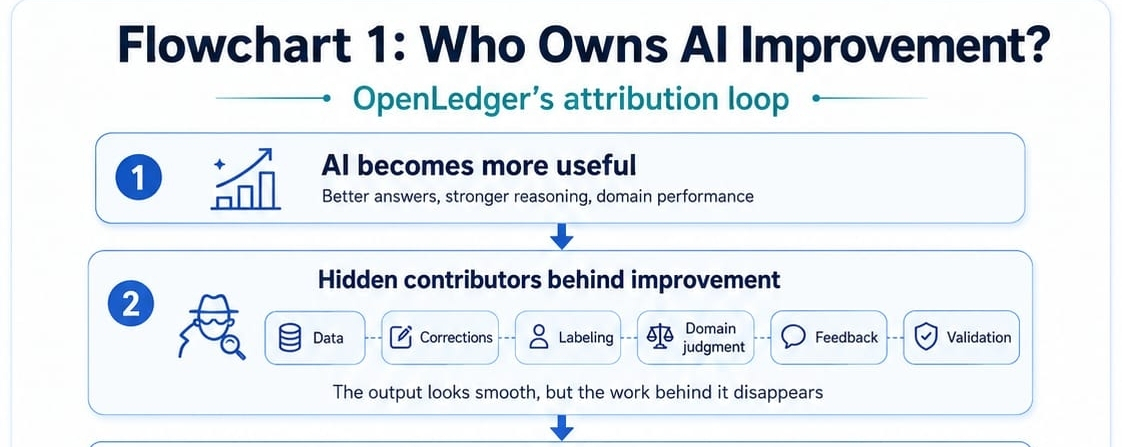
I have a quiet suspicion about AI: the more useful it becomes, the harder, it becomes to see who actually improved it. A model may answer faster, write better, reason more cleanly, or perform better inside a specific domain, but the improvement rarely comes from the model alone. It comes from data, corrections, labeling, domain judgment, feedback, prompts, validation, and repeated human contribution. The final output looks smooth. The work behind it disappears.
That is why OpenLedger interests me. Not because it attaches blockchain to AI, but because it asks an uncomfortable infrastructure question: if AI keeps improving through shared contribution, who owns that improvement?
OpenLedger’s architecture tries to answer this through Proof of Attribution, which its docs describe as a cryptographic mechanism linking data contributions to AI model outputs, with immutable records and rewards based on impact. Its Datanets are structured, domain-specific data networks where contributors provide datasets that can be validated, traced, and used for model training.
The real tension is scalability versus cryptographic truth. It is easy to say every contribution should be tracked. It is much harder to do that when thousands or millions of inferences are happening, each potentially touching different datasets, models, adapters, and attribution weights. A slow attribution system becomes useless. A fast but unverifiable one becomes just another trust layer.
This is where rollup logic becomes important. OpenLedger’s network information points to OpenLedger Mainnet and includes rollup chain details, while its token docs say OPEN launches on Ethereum and then bridges into the OpenLedger Native Chain for staking, governance, attribution validation, and model deployment. The practical role of a rollup is throughput: many actions can be processed away from the base layer, batched, compressed, and settled more efficiently. Ethereum’s own scaling docs explain that rollups move execution offchain while relying on the base layer for settlement, data availability, and state correctness.
But throughput alone is not enough for AI attribution. The system also has to protect the record of who contributed what, which model used it, how influence was calculated, and how rewards were split. That is where cryptographic state transitions matter. In a ZK-rollup model, validity proofs can verify that an offchain state transition is correct before it is accepted onchain. Ethereum describes ZK-rollups as systems where offchain execution is backed by validity proofs that guarantee the correctness of state transitions.
For OpenLedger, the bigger idea is that attribution records should not depend only on a platform’s promise. The Proof of Attribution paper describes DataNets as onchain primitives where datasets are recorded with metadata and timestamps, while models log training provenance so attribution can be tracked deterministically across model versions. It also explains that influence scores can become the basis for inference-level rewards.
This is ambitious, but it is also fragile. Real world AI data is messy. Some data is duplicated. Some is low quality. Some is adversarial. Some looks useful during training but barely matters during inference. OpenLedger’s pipeline addresses this by measuring contribution impact, recording training logs, distributing token rewards based on attribution, and penalizing biased, redundant, or adversarial contributions.
Still, the stress test is not whether the idea sounds fair. The stress test is heavy usage. Can attribution remain accurate when many models use overlapping Datanets? Can rewards stay meaningful when the system has to split value across contributors, model owners, stakers, and infrastructure? Can ZK proof systems, rollup batching, and onchain records handle real inference volume without becoming too expensive or too slow?
The $OPEN design connects directly to this question. OpenLedger says OPEN is used to reward data contributors whose work shapes model behavior, while also serving as gas, model registration utility, inference payment, and governance participation. That creates a cleaner economic loop on paper, but the loop only matters if attribution is credible under pressure.
So I would not frame OpenLedger as a finished answer. I would frame it as a serious attempt to define the accounting layer AI has been missing. The project is worth watching because it focuses on the right infrastructure problem: not only how AI gets better, but whether the people and data behind that improvement can be traced, verified, and rewarded without breaking at scale.