
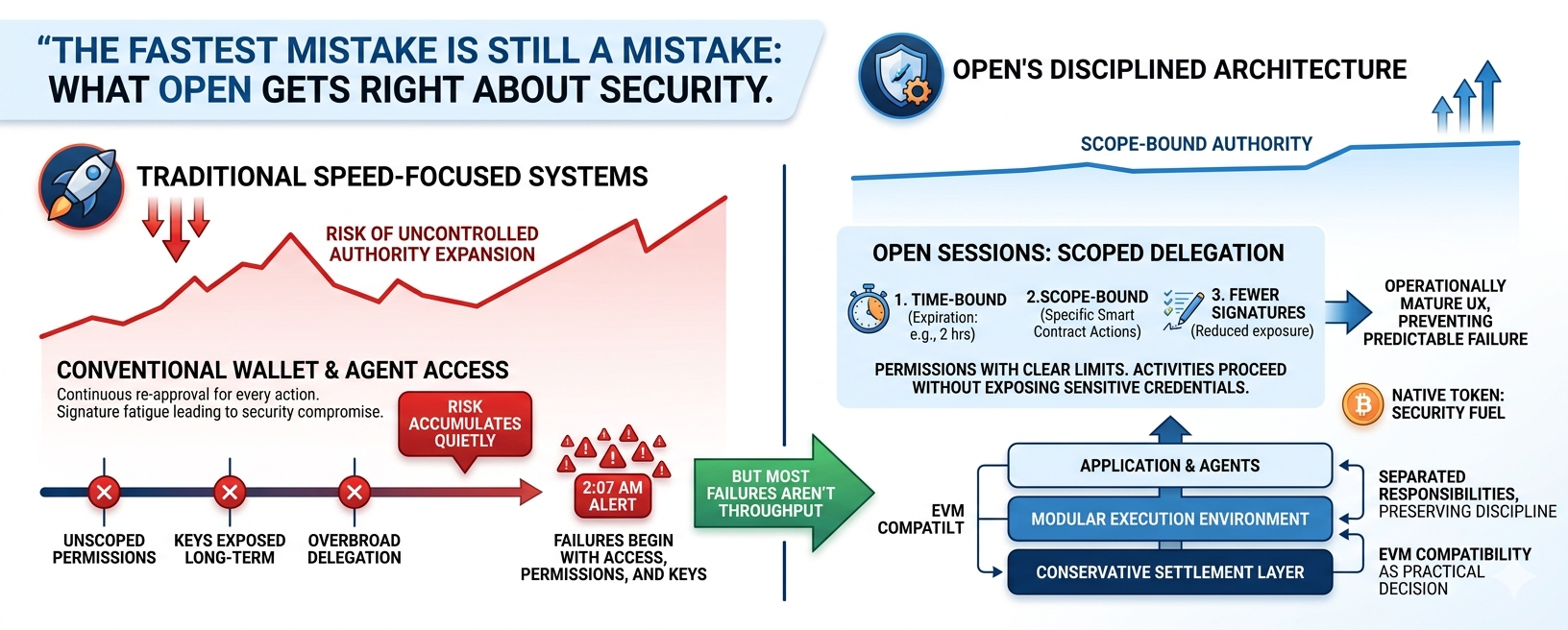
The first alert arrived at 2:07 a.m.
It wasn’t dramatic. No catastrophic exploit. No chain halt. Just another message pushed into a queue already crowded with approvals, escalations, and unanswered questions. A wallet had requested permissions that looked ordinary on the surface. The transaction itself was small. The risk was not.
I remember staring at the screen and realizing, again, that most failures in digital systems rarely begin with throughput limitations. They begin with access. They begin with permissions. They begin with keys ending up somewhere they should never have been.
For years, the industry has measured progress through speed. More transactions per second. Lower latency. Faster finality. Every new architecture seems compelled to present a larger number than the last one. The assumption is simple: if a network moves quickly enough, it must be advancing.
But speed and safety have never been the same thing.
The uncomfortable reality is that most operational failures do not emerge because blocks arrive slowly. They emerge because authority expands quietly. A signing key gains too much reach. A permission remains active longer than intended. A workflow designed for convenience gradually becomes a pathway for compromise.
Risk committees understand this. Auditors understand this. The people reviewing wallet approval requests at inconvenient hours understand this.
That is where OpenLedger began to look different to me.
On paper, OPEN is a high-performance Layer 1 built on the SVM architecture. Performance matters, and the chain is designed to process activity at scale. But what caught my attention was not the pursuit of speed itself. It was the presence of guardrails.
The architecture feels less like a race car and more like a controlled system designed for environments where mistakes carry consequences.
One of the clearest examples is OPEN Sessions.
Most discussions around user experience focus on reducing friction. The challenge is that friction often exists for a reason. Every signature asks a question. Every approval creates a record of intent. Yet forcing users to repeatedly authorize actions can become impractical, especially when intelligent agents, applications, and automated workflows are expected to operate continuously.
The usual answer is broader permissions.
The safer answer is narrower authority.
OPEN Sessions take the second path. Instead of granting open-ended control, delegation becomes enforced, time-bound, and scope-bound. Permissions exist within clearly defined limits. Authority expires. Access is constrained. Activities can proceed without repeatedly exposing sensitive credentials.
The result is a model that feels operationally mature rather than merely convenient.
Scoped delegation + fewer signatures is the next wave of on-chain UX.
That sentence sounds like a product feature until you spend enough time reading audit reports. Then it starts to sound like a risk-control framework.
The distinction matters.
A system that reduces signature fatigue while simultaneously reducing unnecessary key exposure is solving a deeper problem than interface design. It is addressing one of the most common sources of preventable failure.
The broader architecture follows a similar philosophy. Execution operates in a modular environment above a more conservative settlement layer. Responsibilities are separated rather than compressed into a single surface. Activity can remain efficient without requiring every component to inherit the same level of trust assumptions.
That separation creates room for performance while preserving discipline.
Even EVM compatibility appears less as a headline feature and more as a practical decision. Existing tooling, developer workflows, and operational processes can migrate with less friction. The goal is not ideological purity. The goal is reducing unnecessary obstacles while maintaining system integrity.
None of this eliminates risk.
No serious incident report would claim otherwise.
Bridges remain areas of concern across the industry. Every connection between environments introduces assumptions that must be evaluated continuously. Every external dependency expands the attack surface. History has provided enough examples to make that lesson impossible to ignore.
Trust doesn’t degrade politely—it snaps.
The statement sounds dramatic until the moment it becomes true.
A system can appear healthy for months or years before a single compromised credential, flawed permission structure, or overlooked dependency reveals weaknesses that were always present beneath the surface.
That is why security cannot be measured solely by throughput charts.
A network capable of processing enormous volumes of activity still inherits the consequences of poor authorization models. An ecosystem filled with intelligent agents still depends on boundaries that remain enforceable under pressure. The future will likely contain more automation, more delegation, and more machine-driven activity than anything we see today.
The question is not whether systems can move faster.
The question is whether they can maintain discipline while moving fast.
OPEN’s native token plays a role in that equation. It functions as security fuel within the network, while staking feels less like passive participation and more like responsibility—an acknowledgment that resilience is something maintained rather than assumed.
When I think back to that alert at 2:07 a.m., I do not remember worrying about transaction throughput. I remember worrying about who had access, what permissions existed, and whether the boundaries were strong enough to hold.
Those concerns rarely appear in marketing materials. They dominate real-world operations.
In the end, the most valuable characteristic of a ledger may not be how quickly it processes approval. It may be how effectively it refuses it.
Because a fast ledger that can say “no” prevents predictable failure.
