
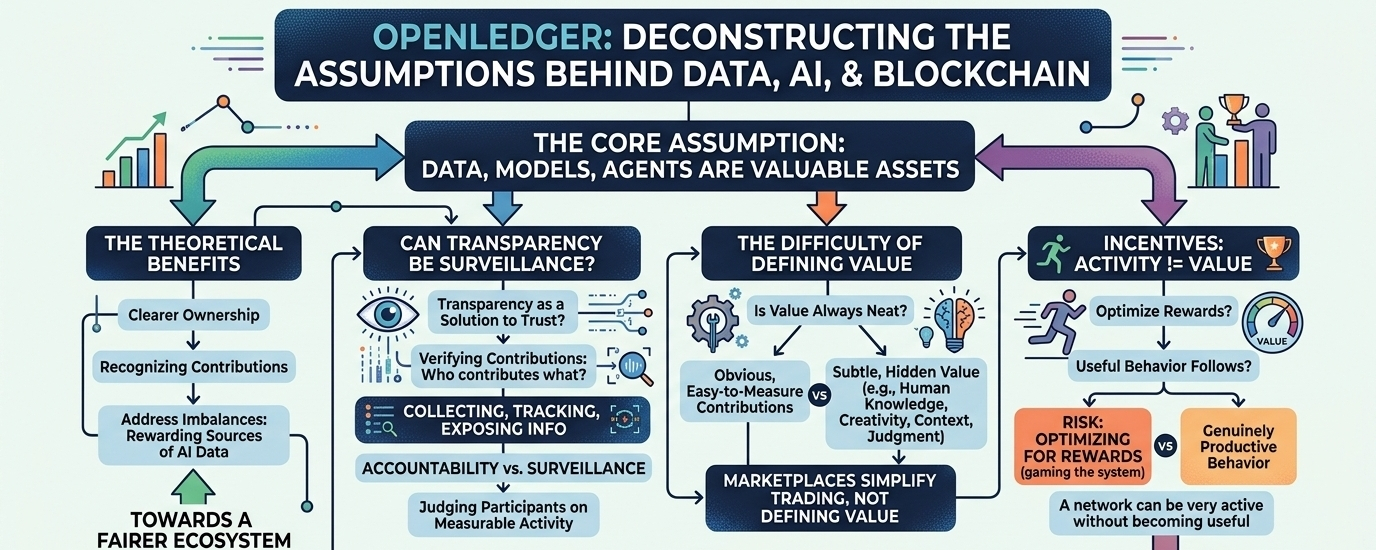

When I look at OpenLedger, what stands out isn't really the technology itself but the assumptions behind it. The idea seems to be that data, AI models, and autonomous agents are valuable assets that deserve clearer ownership and better ways to generate income. That sounds reasonable at first. AI systems are becoming more dependent on data from countless sources, and many of the people contributing to that ecosystem rarely receive direct benefits. In theory, creating a framework that tracks and rewards contributions could help address that imbalance.
What I keep wondering, though, is whether making everything more transparent automatically makes things fairer. Transparency is often treated as a solution to trust problems, but it can create new questions of its own. The more a system needs to verify who contributed what, the more information it may need to collect, track, and expose. What begins as accountability can sometimes feel uncomfortably close to surveillance, especially if participants start being judged primarily through measurable activity.
There's also an assumption that value can be neatly identified and distributed. In practice, value is rarely that clean. Some contributions are obvious and easy to measure, while others are subtle and only become important much later. Human knowledge, context, creativity, and judgment don't always fit into systems designed for attribution and rewards. A marketplace can make value easier to trade, but it doesn't necessarily make value easier to define.
Another thing that feels worth paying attention to is incentives. Projects at the intersection of crypto and AI often assume that if the rewards are structured correctly, useful behavior will naturally follow. Sometimes that's true. Other times, people end up optimizing for the reward itself rather than the purpose behind it. A network can become very active without becoming genuinely useful. Activity and value are not always the same thing.
I don't see these as flaws unique to OpenLedger. They're challenges that almost any project in this space will eventually run into. The ambition is understandable, and the problem it's trying to solve is real. But whether the system succeeds probably depends less on its technical design and more on how people interact with it over time.
What interests me most is not whether OpenLedger can create markets around data, models, and agents. It's whether those markets can remain fair, trustworthy, and genuinely productive once real incentives, competing interests, and human behavior enter the picture. That's usually where the most difficult questions begin.